Korean Theatre Maker Wins Ibsen International Award: A Personal Reflection on Art, Aspiration, and Arrival
By Jerry Adesewo
I have followed the International Ibsen Award for a couple of years now. Not casually, but with the kind of quiet attention that comes from longing—watching, studying, imagining. I have even applied for its scholarship twice; carrying with me the hope that one day, my own work might find its way into that global conversation.
So when news broke that Jaha Koo had been named the 2026 laureate, it did not feel distant. It felt personal. Maybe because this is not just any award. Established by the Norwegian government and widely regarded as the world’s most prestigious theatre prize, the Ibsen Award carries a purse of 2.5 million Norwegian kroner—making it the richest prize in global theatre.
But beyond the money, it is what the award represents that truly matters: recognition of artists who redefine what theatre can be. And that is exactly what Koo has done.
READ ALSO: Theatre Stakeholders Push for Urgent Reforms to Save Nigeria’s Cultural Hub
I have encountered Koo’s work—not in a theatre hall, but through fragments: recordings, critical essays, conversations among practitioners. His now-celebrated trilogy—Cuckoo, Lolling and Rolling, and The History of Korean Western Theatre—does not sit comfortably within traditional definitions of theatre. I remember particularly a trip to Seoul in 2012, and how after watching one of Korea’s most travelled theatrical show, ‘NANTA Cooking’, in which I made a guest appearance; the post-performance conversation suddenly threw up the name of a certain, young Korean theatre maker, who is waiting to take the world by storm. And guess who? Jaha Koo!
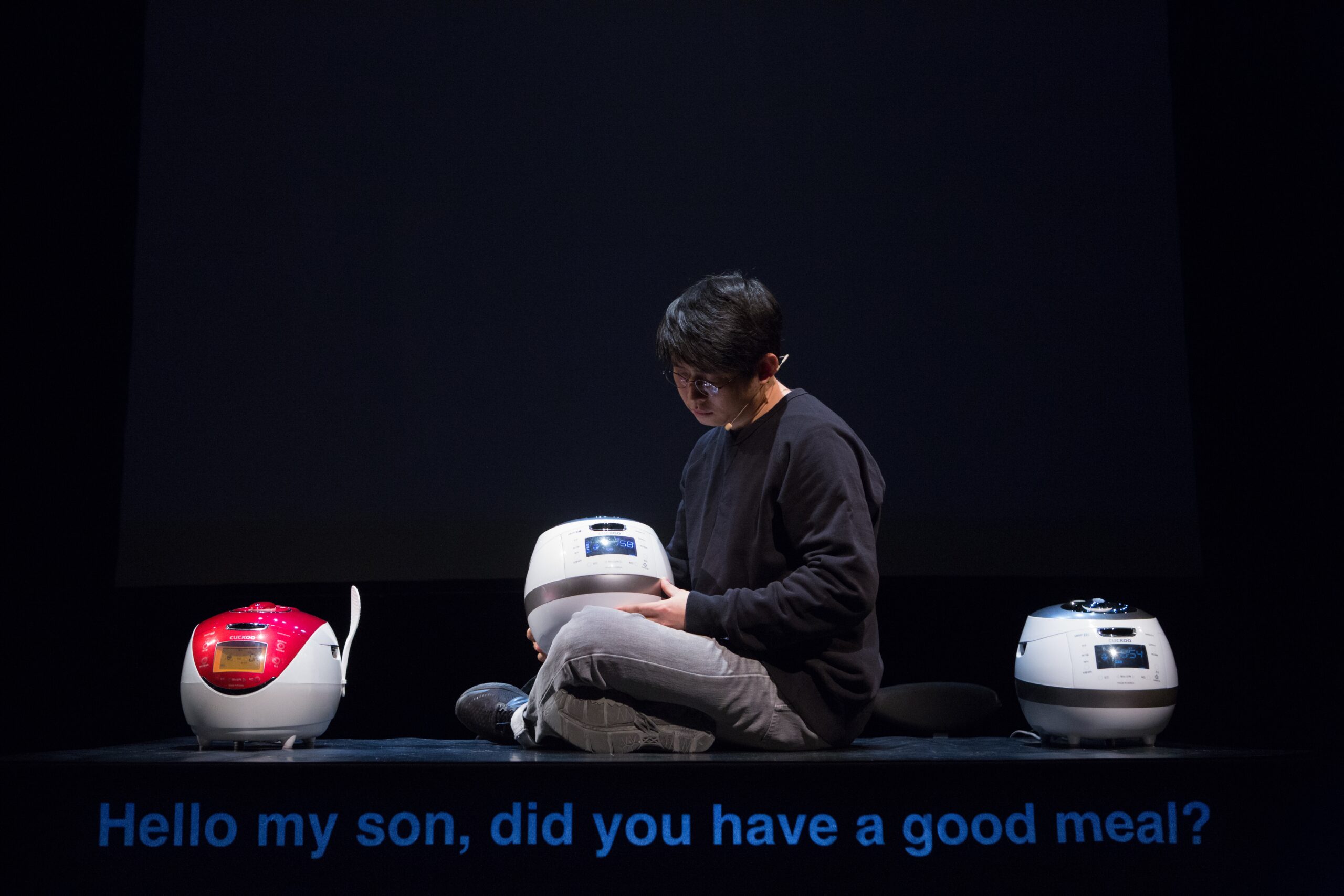
In ‘Cuckoo’, rice cookers speak. Not metaphorically, but literally—machines become narrators of memory, witnesses to Korea’s economic trauma and personal histories. It is theatre, yes, but also installation, music, documentary, and confession woven into one.
Koo works at the intersection of performance, video, sound, and technology—creating what can only be described as a hybrid language of theatre. That is why this moment matters, because for those of us working in spaces where theatre is still often defined by text, stage, and actor, Koo represents a disruption—a reminder that the form itself is still evolving.
I read the jury’s citation describing his work as “quiet, yet deeply political,” and I paused. There is a kind of theatre that shouts, and there is a kind that lingers. Koo’s work lingers. He stretches them.
It deals with identity, colonial histories, economic anxiety, and belonging—but not through spectacle or noise. Instead, through stillness, humour, and an almost disarming vulnerability.
It is theatre that does not insist—it invites. And once you enter, it stays with you.
Koo’s journey is itself instructive. Born in South Korea, trained in Seoul and later in Europe, and now based in Belgium, his work is deeply rooted in Korean experience while speaking to global audiences.
He tells stories of South Korea’s rapid modernisation, of youth disillusionment, of inherited histories—but audiences across continents recognise themselves in these narratives. That is not just craft. That is clarity of voice.
And it raises an important question for artists like us working in Nigeria and across Africa: How do we tell our own stories in ways that remain authentic, yet travel?
For those of us creating within contexts where structure is still forming—where funding is uncertain, where platforms are limited, where access to global circuits is uneven—Koo’s recognition feels like both encouragement and provocation. Encouragement, because it proves that the global stage is not closed. Provocation, because it demands more from us.
Koo did not simply tell stories; he re-imagined how stories could be told. His theatre does not fit into pre-existing categories—it creates its own. Perhaps that is the real lesson.
When Koo describes the award as recognition for artists “who move beyond what is traditionally considered theatre,” it resonates deeply, because, like I mentioned in a recent interview on Trust TV, the future of theatre may not look like what we inherited. It may not even resemble what we currently practise. It will be interdisciplinary. It will be fluid. It will be shaped by those willing to experiment, to fail, to reconfigure the boundaries of performance. Koo’s work sits precisely at that intersection—where theatre becomes a space of convergence: of sound, image, technology, memory, and human experience.
As I reflect on this moment, I do not see it only as Koo’s victory. I see it as a mirror. A mirror that asks uncomfortable but necessary questions:
- Are we pushing the limits of our own practice?
- Are we telling stories that matter beyond our immediate environment?
- Are we willing to redefine the form, not just operate within it?
Moreso, recognition at this level does not come from imitation. It comes from innovation rooted in truth.
There is something quietly reassuring about this moment. That an artist working with rice cookers, memory, and fragmented histories can stand at the pinnacle of global theatre. That theatre, in all its evolving forms, still has room for the unexpected. And that perhaps, for those of us still watching from a distance—still applying, still experimenting, still creating in our own spaces—the distance is not insurmountable. It is simply a journey. Until then, we keep watching. We keep learning. We keep creating, because somewhere between where we are and where we hope to be, theatre is still evolving.
And in its, there is space for all of us.