Sa’ada Isa Yahaya: A Young Voice Refusing Silence
By Jerry Adesewo
Some writers arrive early with polish, and there are writers who arrive early with urgency. Sa’ada Isa Yahaya belongs firmly to the latter. At a time when many of her peers are still finding language for themselves, Sa’ada is already using language to confront history, patriarchy, violence, faith, and the brutal inheritance of womanhood.
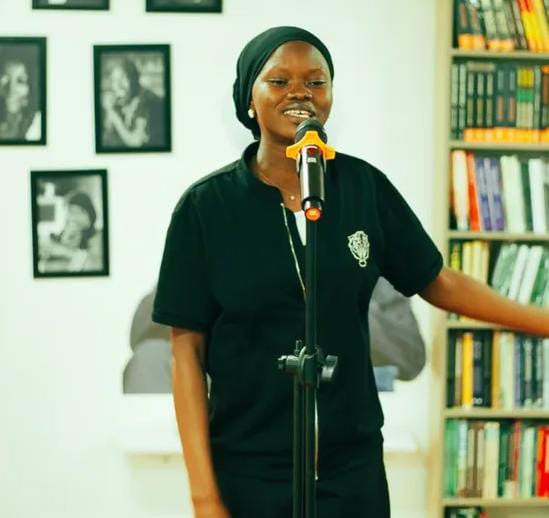
Her poems appear or are forthcoming in respected literary spaces such as Blue Marble Review, Còn-Scìò, Poetry NND Column, Molecule, IHRAM Press, Uproar Magazine, Libretto Magazine, Ice Floe Press, and The Kalahari Review, among others. Yet beyond accolades and publications, what distinguishes Sa’ada is the moral clarity of her voice — a refusal to romanticise pain, and a commitment to naming violence exactly as it is.
A Poem as Testimony
The poem below is emblematic of Sa’ada’s work: intimate yet political, tender yet furious, rooted in personal conversation but expanding into collective indictment. It is written not merely to be admired, but to unsettle.
BONE FIELD
Because the saying goes: Like mother, like daughter…
My sister asks if we will become gravelands like our mother
and the ones before her
a congregation of women who lost themselves
to the war brewing in their homes,
forced to bow before men like their messiahs.
She asks like she doesn’t know
we are our mother’s daughters
and without choice,
we’ve inherited a bouquet of wounds.
We are stuck in a World War three, four, five.
Every day of our lives,
we are reminded that women are remnants
of a lost breath,
striding corpses.
Even history is baffled
by the brand new ways invented
to install abuse in women.
Like the origin of a rumour,
We have never known the face of justice.
The sky is a witness
to the unholy carnage of a girl’s body
like the dissection of beef
Yet chooses to call it a sacred execution,
teaches the sun to run into the arms of the killer
and worship him.
I ask my sister,
if this is not proof enough
to make her see
that the world is blessed
with an abundance of astigmatism,
tragic how it sees everything but what it should,
sees everything but the untamed lust
growing in a boy’s eyes.
Says boys will always be boys
but boys have become men
and men are mutating into monsters.
Monsters cruel enough
to bury doom in a woman’s body
the first time she doesn’t wear silence
like consent,
monsters moulding girls into hashtags,
into question marks,
into trending.
On X,
I walk into the post made by an unmarried woman
in her late 30’s
and I mistake it for a room set on fire,
the comment section turning
into a virtual rape scene.
Isn’t this the definition of sin?
God, if this poem gets to you,
send down salvation.
Send down salvation,
so fierce it impels the world
to give a myriad of damns about us.
Reading the Wound
What Sa’ada achieves in this poem is not merely expression, but excavation. The opening line, “a sister asking whether they will become ‘gravelands’ like their mother”, immediately establishes inheritance as trauma rather than tradition. Womanhood here is not passed down as wisdom, but as injury. The phrase “a bouquet of wounds” is particularly devastating: pain arranged, beautified, and handed over as destiny.
The poem’s repeated invocation of war — “World War three, four, five” — reframes domestic and gender-based violence as a continuous, global conflict. There is no armistice for women. The battlefield is the home, the street, the comment section, the body itself.
One of the poem’s sharpest interventions is its refusal to spiritualise violence. When the sky “chooses to call it a sacred execution,” Sa’ada exposes how culture, religion, and silence collaborate in excusing brutality. Her use of social media imagery — women turned into “hashtags” and “trending” — grounds the poem firmly in the present, where digital spaces replicate physical harm.
Yet the poem is not nihilistic. Its final address to God is not submission but demand. Salvation, in Sa’ada’s vision, is not personal escape; it is systemic outrage. A salvation “so fierce” that the world is forced to care.
Why Sa’ada, Why Now
Sa’ada Isa Yahaya writes from a generation that refuses to whisper. Her poetry is fearless without being careless, emotional without being indulgent, political without losing lyric force. She understands that language can be both wound and weapon — and she chooses the latter.
As OurNigeria Magazine Girl of the Month, Sa’ada represents more than talent. She represents a shift: young Nigerian women using art not just to survive the world, but to interrogate it, indict it, and insist on something better.
If literature is a mirror, Sa’ada holds it up without apology. And if poetry is prophecy, hers is already warning us: silence is no longer an option.