


Beyond the Battlefield — What the Military Needs to End Insecurity in Nigeria
By Jerry Adesewo
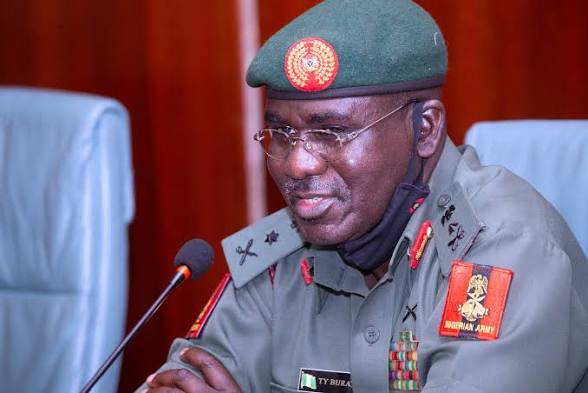
At a time when Nigeria’s security crisis continues to deepen, a rare moment of clarity has emerged from within the military establishment itself. Former Chief of Army Staff, Lt.-Gen. Tukur Buratai (rtd), has openly stated what many have long suspected but few in authority have been willing to admit: the military alone cannot end insecurity in Nigeria.
READ ALSO: Makinde Leads Delegation to Bauchi, Warns PDP Members Against Aligning with Wike’s Faction
That statement is not just an observation—it is an indictment of a national approach that has, for years, placed the burden of a complex crisis almost entirely on the shoulders of soldiers.
For over a decade, Nigeria’s military has been deployed across multiple theatres—counter-insurgency in the Northeast, anti-banditry operations in the Northwest, communal conflict interventions in the Middle Belt, and internal security duties in urban centres. The result is a force that is overstretched, constantly reactive, and often expected to deliver outcomes that go far beyond its constitutional role.
Even recent reports underscore this strain. The military continues to confront insurgent attacks, repel offensives, and recover territory, yet violence persists, adapts, and resurfaces in new forms. The truth is uncomfortable but undeniable: military victories on the battlefield are not translating into sustainable peace.
Buratai’s argument goes to the heart of the matter. Insecurity in Nigeria is not merely a military problem; it is a societal, economic, and political problem—one that is deeply rooted in poverty, weak governance, ungoverned spaces, and the enduring influence of terror financing networks.
To expect the military to “clear, dismantle, and wipe out” insurgency without addressing these underlying drivers is, in his words, “wishful thinking.”
What, then, does the military truly need to succeed?
First, it needs a system that works alongside it, not one that hides behind it. Intelligence agencies must function effectively, not as passive observers but as proactive disruptors of threats. The movement of attackers, the financing of terror networks, and the coordination of violence should not be mysteries uncovered only after blood has been shed.
Second, the military needs political will that goes beyond rhetoric. Buratai’s call for action against terrorism financiers is particularly instructive. Identifying those who fund violence is not enough; failure to prosecute them sends a dangerous signal that the ecosystem sustaining insecurity remains intact.
Third, it needs development to follow security. Roads, schools, healthcare, and jobs are not abstract policy goals—they are strategic tools for stability. Where the state is absent, armed groups often fill the vacuum. Where young people see no future, recruitment into violent networks becomes easier.
Fourth, the military needs to be relieved of roles that dilute its effectiveness. Nigeria’s armed forces are increasingly drawn into policing duties, crowd control, and civil interventions. This blurring of responsibilities not only stretches capacity but also weakens the overall security architecture. A stronger, better-equipped police force and local security systems are essential to allow the military focus on its core mandate.
Finally, and perhaps most importantly, the military needs a nation that understands that security is a shared responsibility. As Buratai noted, insecurity is “embedded within society” and cannot be resolved without collective effort. Communities, traditional institutions, civil society, and government agencies all have roles to play in prevention, intelligence gathering, and peacebuilding.
Nigeria’s current trajectory suggests a dangerous over-reliance on force without a corresponding investment in strategy. Analysts have repeatedly warned that the military is overstretched and that the absence of a coherent long-term approach continues to undermine progress.
This is not a failure of the military alone. It is a failure of coordination, of governance, and of national will.
The soldier at the frontline can only do so much. He can repel attacks, secure territories, and eliminate threats. But he cannot build schools, create jobs, prosecute financiers, or restore trust between citizens and the state.
That is the responsibility of leadership.
Buratai’s warning should not be dismissed as a routine comment from a retired general. It should be taken as a strategic insight from someone who understands both the capabilities and the limits of military power.
If Nigeria is serious about ending insecurity, it must move beyond the illusion that more troops alone will solve the problem. What is required is a whole-of-government, whole-of-society approach—one that treats security not just as a battle to be fought, but as a system to be rebuilt.
Until then, the military will continue to fight bravely.
But it will also continue to fight alone.