


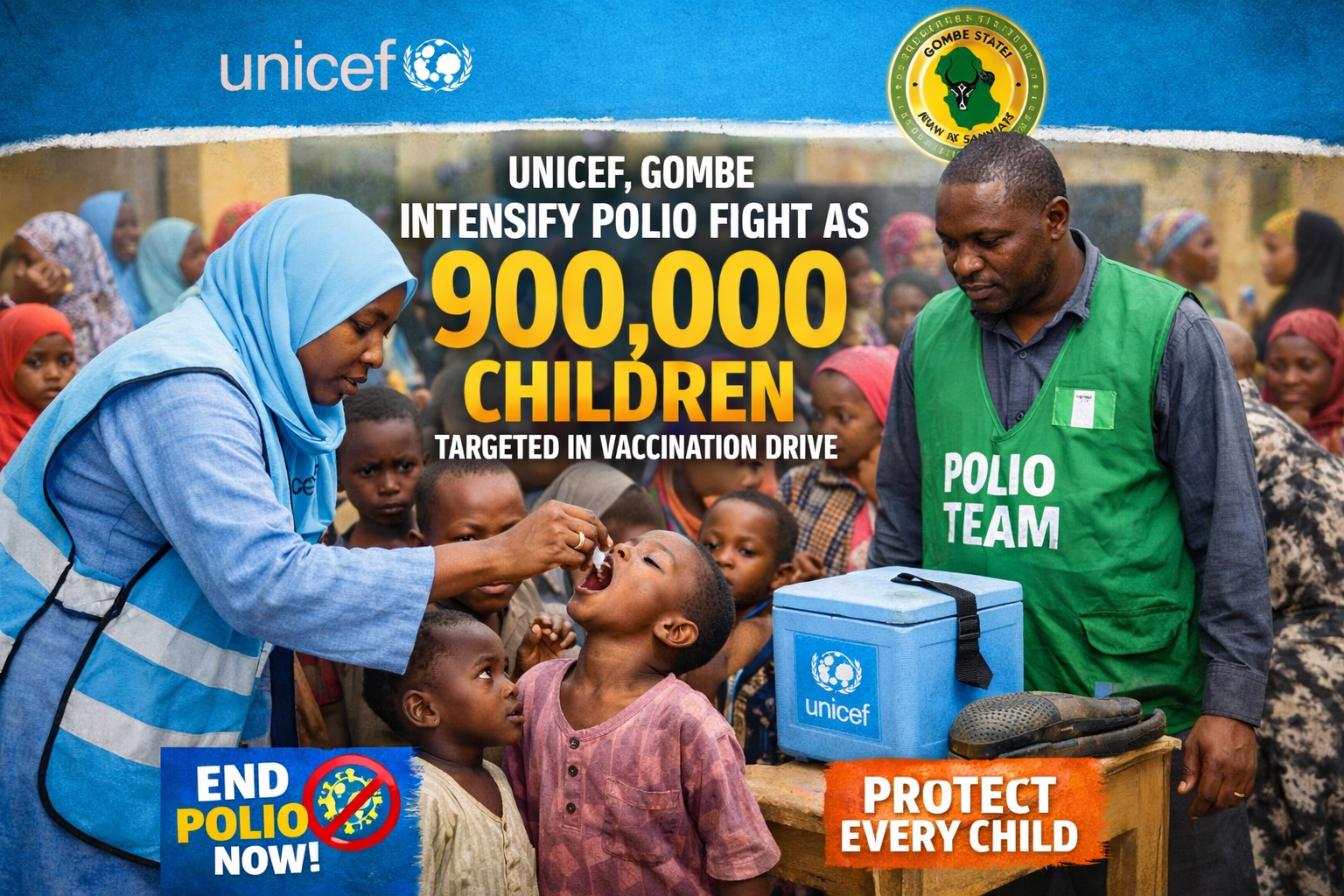
UNICEF Commends Gombe’s Commitment as State Steps Up Polio Vaccination
By Auwal Ahmad Umar, Gombe
UNICEF has commended the Gombe State Government for its strong commitment to child health as the state intensifies its 2026 polio vaccination campaign aimed at protecting hundreds of thousands of children and closing the immunisation gap in vulnerable communities.
The commendation came from the chief of the UNICEF Bauchi Field Office, Dr Nuzhat Rafique, who spoke with journalists shortly after an evening review meeting on the ongoing Immunisation Plus Days campaign in Gombe.
She described the exercise as a critical part of Nigeria’s final push to eradicate polio, noting that Gombe had shown seriousness in both planning and implementation.
According to her, the state government, health authorities, and development partners have demonstrated a high level of commitment, and clear efforts are being made to ensure that no eligible child is left out.
“This campaign is crucial because Nigeria must completely get rid of polio. Gombe is doing its best and trying desperately to reach that status,” she said.
Dr. Rafique praised Governor Muhammadu Inuwa Yahaya and the entire state health team for what she described as visible dedication to the campaign, adding that the regular review meetings were helping to track progress and address challenges as they emerge.
She explained that the campaign, which began with state and local government flag-off ceremonies, had already moved deep into communities, including hard-to-reach settlements and underserved areas.
She also noted that the involvement of traditional rulers, religious leaders and community stakeholders had strengthened public trust and improved community participation.
According to her, many of the official flag-offs were held at the palaces of traditional rulers, a move she said reflected local ownership of the campaign.
She said, “Traditional leaders are part of the campaign, helping to lead it with the government and partners.”
Dr. Rafique disclosed that UNICEF had provided over 965,000 doses of the oral polio vaccine to support the campaign in Gombe, while the state ensured the proper handling, storage, and distribution of the vaccines to teams deployed across the local government areas.
She said the campaign was targeting over 771,000 children while also paying close attention to more than 50,000 zero-dose children—children who have never received routine immunisations.
She stressed that reaching those children remained one of the most important priorities of the exercise.
“Zero-dose children are a serious concern for all of us. We need to reach every one of them, and that is why UNICEF, WHO, and the government are working very closely,” she said.
Concerns raised during field monitoring about some lapses in vaccination procedures: Dr. Rafique said such observations were part of routine supervision and quality improvement in any major public health intervention.
She said while Gombe was doing well, there was still room to improve the quality of delivery and overall coverage.
“Gombe is doing an impressive job, but there is always room for improvement. That is why we go to the field, review what is happening and discuss how to improve coverage and quality,” she said.
Although she said it was too early to give a final figure for the number of children vaccinated, she noted that early reports indicated that more than 60 per cent of daily targets were already being achieved.
However, she clarified that they would only have complete data after fully collating all delayed field reports.
Dr. Rafique said she had personally visited communities in Funakaye, Dukku, and Akko, where she observed strong commitment from vaccinators, supervisors, and community members.
Also speaking, the executive secretary of the Gombe State Primary Health Care Development Agency, Dr. Abdulrahaman Shuaibu, said the state had carried out broad-based advocacy and sensitisation before the start of the campaign.
He said the mobilisation involved traditional institutions, religious leaders, women’s groups, youth groups, and community stakeholders across the state, local government, and ward levels.
Despite the effort, he acknowledged that a few pockets of resistance remained in some communities.
He said health officials were continuing to work with trusted local leaders to address misconceptions and improve vaccine acceptance.
“It is not only in Gombe; across the country, there are still some pockets of non-compliance. What we do is continue to sensitise people and work with community and religious leaders who have the trust of the people,” he said.
Dr. Shuaibu said the state had over the years recorded improved routine immunisation uptake, which he attributed to sustained community engagement and stronger health education.
In the recruitment of vaccination personnel, he explained that each team was made up of three people selected from their local communities to ensure familiarity, trust, and easier access to households.
He added that the personnel were trained before deployment and given daily refresher sessions to strengthen their performance during the exercise.
“Sometimes there are training gaps, but what we do is provide refresher training daily to improve service delivery in the field,” he said.
He expressed confidence that the campaign would achieve more than 95 per cent coverage, urging parents and carers to ensure all children between 0 and 59 months receive the oral polio vaccine.
He said the vaccine was safe, free, and effective, and he appealed to families to support the campaign for their children’s health and future.
At Dawaki Ajiya, one of the communities visited during the exercise, a mother of five, Jamila Jibrin Chiroma, said she allowed all her children to be vaccinated because she believed immunisation was important for their health and protection.
Her response reflects the growing acceptance that health officials say will be key to ending polio transmission and protecting every child in the state.
The campaign continues across Gombe, with health teams moving from house to house, while supervisors and development partners monitor compliance, resolve operational issues, and intensify efforts in areas yet to be fully covered.
If you like, I can also make this more powerful and more “Premium Times” in style with a sharper first two paragraphs and stronger ending.
