


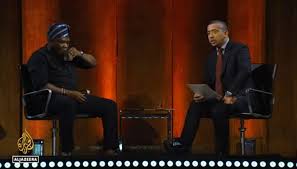
Grilled, Cornered, and Exposed: Daniel Bwala’s Al-Jazeera Meltdown
By Matthew Eloyi
There are tough interviews, and then there are interviews that become instant case studies in how not to represent a government. The appearance of presidential spokesman Daniel Bwala on Al-Jazeera’s Head to Head with Mehdi Hasan will likely be remembered as the latter.
For millions who watched the exchange online, it was painful viewing.
Bwala arrived on the programme as a defender of the administration of President Bola Ahmed Tinubu, presumably ready to project confidence and authority before an international audience. Instead, what unfolded looked less like a robust defence of government policy and more like a political spokesperson struggling to keep up with the most basic scrutiny.
Hasan did what journalists are supposed to do: he asked questions, cited evidence and pressed for clear answers. The questions were predictable: about insecurity, economic hardship and the credibility of the government’s claims about progress in Nigeria.
Yet Bwala appeared repeatedly unprepared.
The most dramatic moments came when Hasan confronted him with his own past words. Before joining the Tinubu camp, Bwala had been one of its loud critics. The transition from critic to loyal defender could have been explained as political evolution. Instead, Bwala chose a baffling route, flatly denying statements that had already entered the public record.
Watching it happen in real time was astonishing.
In the digital era, political memory is permanent. Every speech, every tweet and every television appearance is archived somewhere. Attempting to erase that record on live television is not just ineffective; it is self-inflicted humiliation.
The interview only grew more uncomfortable as the discussion moved to insecurity and violence in Nigeria. When confronted with figures and reports from international organisations, Bwala seemed uncertain about some of the details. For an ordinary commentator, that might be forgivable. For a presidential spokesman representing the government of Africa’s most populous country, it is simply unacceptable. A spokesperson’s primary duty is to know the facts.
Nigeria’s global reputation already faces enormous challenges. The country battles persistent security threats, economic pressure and a long struggle to convince the world that its democratic institutions are strengthening. When those speaking for the government appear confused or evasive on international platforms, the damage is immediate and lasting.
Some supporters of the government will dismiss the interview as an example of Western media hostility. That argument misses the point entirely. Tough interviews are not acts of hostility; they are the lifeblood of accountability.
The real issue was not the questions; it was the answers.
What Nigerians witnessed was not simply a difficult interview but a revealing moment about political communication in the country. Too often, public officials appear to believe that loyalty alone qualifies them to speak on behalf of a government. But loyalty cannot replace preparation. It cannot substitute for credibility.
Daniel Bwala walked into that studio as the voice of the Nigerian presidency. By the time the interview ended, he had become the subject of global ridicule.
For a country striving to be taken seriously on the world stage, that is a price Nigeria should never have had to pay.
