


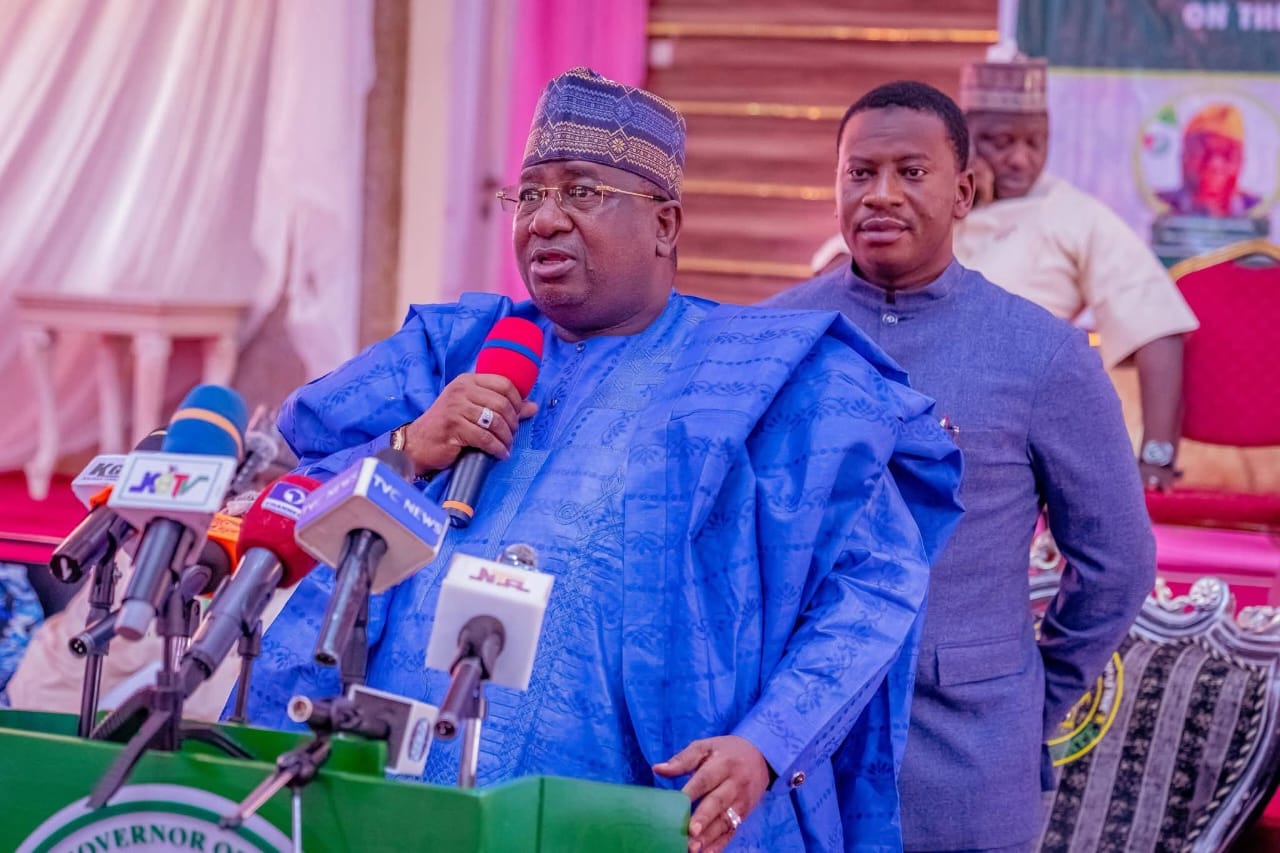
Kebbi: Gov. Nasir Sustaining The Agricultural Promise
By Sagir Musa
During electioneering campaigns, many candidates come bearing manifestoes laden with sensational promises. Some will promise the moon and the sun but won’t deliver even a clay replica of either. In Governor Nasir Idris however, the people of Kebbi appear to have struck gold.
So far, Gov. Nasir has shown that his word is bond, that the social contract he entered with the people of Kebbi State is one he intends to honour in deed and not merely in speech. From education to healthcare, through welfare and improved social governance, the governor has demonstrated that, to him, promises are promises and must be kept no matter the situation. Yet nowhere is this commitment more visible, more measurable, and more consequential than in agriculture.
And, it is in his avowed commitment to fulfil the agricultural promise, one of his cardinal campaign pledges that Gov. Nasir launched an ambitious agricultural development programme. Kebbi State is not a stranger to farming; it is one of the largest hubs for the production of grains in Nigeria. From rice to wheat, corn to guinea corn, the state possesses an undeniable comparative advantage. Vast arable land, a resilient farming population, and a history rooted in agrarian enterprise have long defined Kebbi’s economic character.
The real question, however, has never been whether Kebbi can farm. The question has always been how to ride the comparative advantage in a manner that tangibly benefits the people, raises incomes, stabilises food supply, and strengthens economic resilience. That is the question Gov. Nasir Idris has sought to answer, and he has done so emphatically.
For the third year running, the administration has sustained a large-scale distribution initiative providing incentives and subsidies in both grains and farm inputs. Why this may come off as tokenism for the unpracticed eye, it is actually a structured intervention designed to enable farmers cultivate their land with greater ease, higher morale, and an expectation of improved yields. The logic is simple. To empower the farmer, is to empower the state, strengthen production, while fighting food insecurity at its roots.
Through the Kaura Agricultural Development Agenda, Gov. Nasir has institutionalised an annual distribution plan aimed at gradually tilting farming in Kebbi towards mechanisation. The state’s investment in free farm inputs, machinery, and extension services has been both strategic and integral. It signals Kauran Gwandu’s unwavering commitment to boosting agricultural output while strengthening both the state and national economies.
This year’s package underscores the seriousness of purpose. The distribution includes 2,000 solar-powered pumps up from 1000 the previous year and the ambition to push it towards 15000, in no distant time. The package also contained 5,000 power tillers, 5,500 sprayers, 24,000 litres of herbicides, 70,000 litres of liquid organic fertiliser, and 5,000 tons of assorted fertilisers to farmers across the state. These are not abstract numbers; they translate into expanded acreage, improved soil nutrition, reduced drudgery, and ultimately, increased productivity. They also mean jobs created, incomes raised, and rural communities stabilised.
The timing of the intervention is equally instructive. The distribution coincides with the commencement of the state’s dry season farming, marking the 2026 flag-off announced by the governor. Kebbi operates two production cycles within a single dry season to maximise output, in addition to the rainy season harvest. This effectively gives the state three harvest rounds annually, a feat that positions it as a critical pillar in Nigeria’s food security architecture.
Encouragingly, earlier investments are already bearing fruit. Kebbi recorded steady growth in rice production, with annual output increasing from 3.05 million tons in 2023 to 3.15 million tons in 2024. The upward trend continued into 2025, with projections for 2026 remaining strong. As a result, Kebbi continues to rank among Nigeria’s leading rice-producing states, while production of other major crops has also witnessed measurable increases under the current administration.
What makes Gov. Nasir’s agricultural intervention unique, is not just the presence of mind to support farmers with inputs, but his insistence on transparency in the distribution process. Beneficiaries are carefully selected in collaboration with traditional rulers and farmers’ groups to avoid unfair discrimination or political patronage. In a country where agricultural schemes often collapse under the weight of opacity, this attention to process is refreshing.
To forestall mischief-makers from diverting or selling subsidised inputs in the black market, security agencies have been directed to arrest anyone found engaging in such practices. This firm stance reinforces the message that the administration is people-oriented and determined to ensure that interventions reach their intended beneficiaries. It is a clear declaration that public resources are sacred and must be treated as such.
Kebbi’s efforts must also be situated within the broader national context. States like Kebbi are doing a yeoman’s job in advancing food security as a pathway to national sovereignty and economic resilience. It is in recognition of this imperative that President Bola Ahmed Tinubu elevated agriculture to a strategic national priority. Governor Idris’ agenda aligns seamlessly with this federal mandate, strengthening domestic production and delivering measurable results.
A careful reading of the Gov Nasir’s agricultural promise will reveal that he’s operating a multi-pronged approach does not end at primary cultivation alone.
First, the state is evolving beyond raw production into structured value addition and agro-industrial growth. While Kebbi has long been a leader in rice cultivation, the current administration is ensuring that the state captures greater value along the supply chain. Investment in major rice mills processing paddy into high-quality finished products has increased, supported by the conducive investment environment engineered by the governor. This shift from subsistence and bulk supply to processing and branding is critical for long-term economic growth.
Second, the administration recognises that production without quality control can undermine market competitiveness. To this end, the state commissioned fortification and quality control equipment at Takalau Rice Mill, positioning it among the few facilities in Nigeria capable of producing fortified rice. This move bridges smallholder farmers with commercial-scale processing while meeting premium standards. It ensures that Kebbi rice competes not just in volume but in quality.
Third is partnership. Kebbi maintains a robust working relationship with the Federal Ministry of Agriculture and Food Security. Given rice’s centrality in Nigerian households and Kebbi’s prominence in its cultivation, such synergy is both logical and necessary. Beyond federal collaboration, the state has entered into a partnership agreement with Lagos State aimed at fast-tracking Kebbi rice into Lagos markets. This is a smart inter-state economic strategy linking production hubs with consumption centres and reducing reliance on imports.
The fourth leg of the approach is innovation. Farmers are being encouraged to embrace modern techniques and technology, while greater inclusion of youth and women in agricultural enterprise is actively promoted. Agriculture can no longer be left to ageing populations wielding rudimentary tools. By integrating mechanisation, irrigation technology, and extension services, the state is laying the groundwork for a more sustainable and attractive agricultural ecosystem.
Taken together, these interventions form a coherent policy architecture rather than scattered gestures. They reveal a governor who understands that agriculture is not merely about planting and harvesting; it is about systems, markets, standards, transparency, and long-term planning.
In conclusion, Kebbi State is enjoying a remarkable run of purposeful leadership since the emergence of Gov. Nasir Idris. His agricultural promise has shown it is much more than some rhetorical flourish as it can be seen and felt in the many water pumps shared, fertilisers distributed, mills commissioned, partnerships signed, and harvests recorded. And in this era where political pledges often evaporate after inauguration ceremonies, Kebbi state offers a contrasting narrative, an assurance that governance, when anchored on sincerity and strategic planning, can indeed transform campaign promises into measurable progress.
If sustained, this trajectory will not only consolidate the place of Kebbi state as Nigeria’s agricultural powerhouse but also reaffirm the simple truth that when leaders keep their words, development is bound to follow and the people will be better for it.
Sagir writes from Birnin Kebbi
