

Moon Meets the Seven Sisters: A Quiet Celestial Farewell to the Year
Moon Meets the Seven Sisters: A Quiet Celestial Farewell to the Year

Moon Meets the Seven Sisters: A Quiet Celestial Farewell to the Year
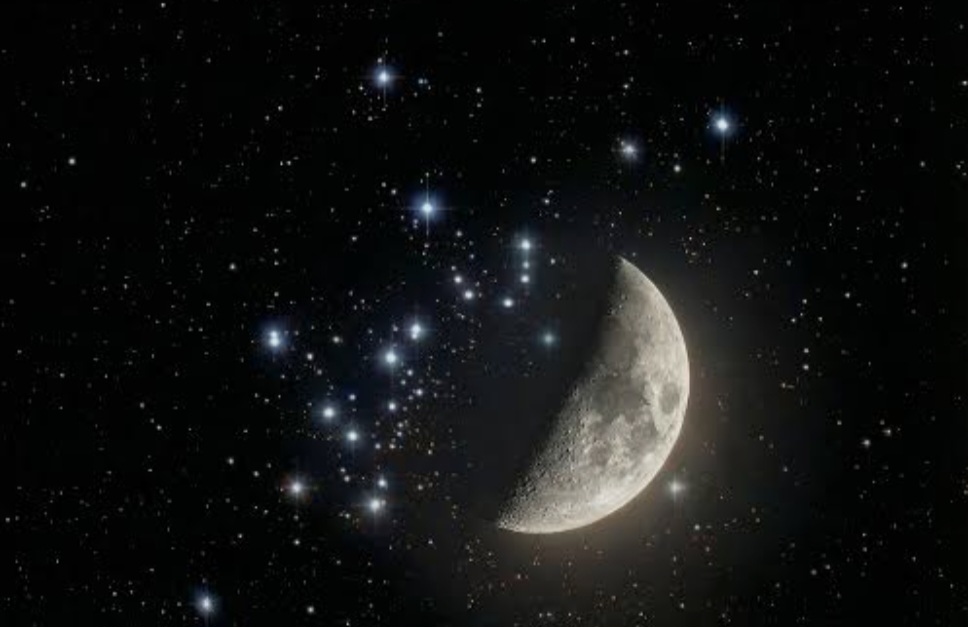
As the year draws to a close, the night sky offers a moment of calm beauty rather than spectacle. Tonight, the Moon drifts gently beside the Pleiades star cluster—also known as the Seven Sisters—creating a timeless celestial pairing that has been observed and named by civilizations for thousands of years.
ALSO READ: New York City Named World’s Wealthiest City by Number of Millionaires
The waxing gibbous Moon, shining at nearly 90 percent full, appears to glide past the compact cluster in the constellation Taurus. No telescope is required to appreciate the scene. To the naked eye, it looks as though the Moon is keeping close company with a delicate spray of blue-white stars, suspended quietly against the dark.
This is not a rare eclipse or a dramatic occultation. There is no sudden disappearance or flash of light. Instead, it is a subtle alignment—easy to overlook amid celebrations and noise, yet deeply memorable for anyone who pauses to look up. It feels less like an astronomical event and more like a gentle conversation between familiar cosmic neighbors.
The Pleiades have long held cultural and symbolic meaning, appearing in ancient myths, navigation traditions, and seasonal calendars across the world. Seeing them alongside the Moon on the final night of the year adds a reflective quality, a reminder of continuity and cycles far older than any calendar.
How to See It Observers should look toward the eastern to southeastern sky shortly after sunset. While the pairing is visible even from city centers, binoculars will reveal more of the Pleiades’ faint stars. Darker skies away from artificial light enhance the view, though the Moon’s brightness makes the scene accessible almost anywhere.
Best Viewing Times by Region
- Pacific Time (US West Coast): Approximately 6–9 p.m., after moonrise near 5 p.m.
- Eastern Time (US East Coast): Around 9 p.m.–12 a.m., with the Moon rising near 7 p.m.
- UTC (UK, parts of Europe and Africa): Roughly 2–5 a.m. on January 1
- Philippines (PHT): From about 6 p.m. onward, low but visible with clear skies
No fireworks or countdowns are needed. Just a clear night, a quiet moment, and the shared sky. As the Moon and the Seven Sisters travel together into the new year, they offer a simple reminder: sometimes the most meaningful endings are the ones that ask us to slow down and look up.
Moon Meets the Seven Sisters: A Quiet Celestial Farewell to the Year
