

PDP: Expulsion, Defection and the Shattered Dream of a 60-Year Rule
By Jerry Adesewo
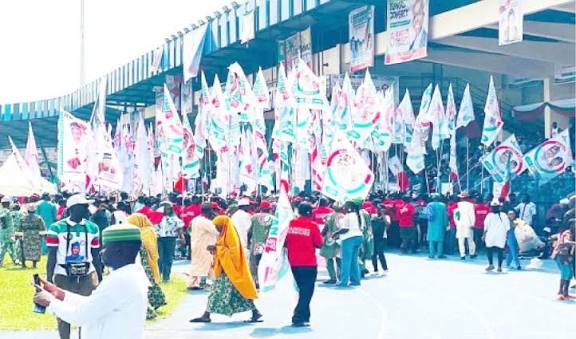
The People’s Democratic Party entered its national convention in Ibadan on Saturday, hoping to reclaim momentum, rebuild confidence, and reassert its status as Nigeria’s flagship opposition ahead of the 2027 general elections. The party had hoped to position itself for a return to power after years in the shadows of the All Progressives Congress (APC). Instead, the troubled convention deepened the crisis and exposed the fragility of what remains of the once-dominant political giant.
READ ALSO: NAHCON Flags Off 2026 Hajj Readiness With Inauguration of Nusuk Masar Team
Though, a new national chairman, Kabiru Tanimu Turaki, SAN, emerged, but rather than symbolising renewal, his election was overshadowed by the dramatic suspension of eleven members, including Nyesom Wike, the FCT Minister, former Ekiti State Governor Ayodele Fayose and the embattled National Secretary, Senator Sam Anyanwu. The move reinforced the image of a party consumed by internal strife at a time when unity is desperately needed. And even before the echoes of the convention’s closing remarks could fade, a fresh wave of defections and plots to defect began to dominate the headlines.
Defections that Cut to the Bone
Taraba State’s governor has already announced his intention to join the ruling APC by Wednesday—a blow that strikes not just at the PDP’s regional influence but at its national morale. The Governor of Osun State, Ademola Adeleke, is reportedly weighing a similar move—either to the APC or the ADC—while rumours grow louder that the Plateau State governor may also abandon the fold.
For a party that once boasted confidently of a 60-year reign, the cascading exit of sitting governors is unprecedented. It signals a profound loss of confidence not only in the leadership but in the very soul and future of the PDP.
A Convention Marked by Questions, Not Hope
Although the PDP promoted the Ibadan convention as a step toward consolidation, despite the myriads of litigations that tried to stop it, the outcomes have raised more questions than answers. The suspension of eleven key figures only underscores the deep factional fractures that have long undermined the party.
Rather than healing wounds, the convention appears to have widened them. The optics are unmistakably grim: leaders divided, members punished, and the party’s remaining pillars contemplating exits.
In fact, the Adamawa State Governor, Ahmadu Fintiri, who chaired the Convention Committee, had to walk out on the convention, citing he help organise.
The Dream of 60 Years Reduced to Political Drizzle
There is no gentler way to frame it: the PDP’s once-celebrated ambition of ruling Nigeria for 60 uninterrupted years has become a historical irony. From a party that once controlled the presidency and governed more than two dozen states, the PDP has shrunk into a weary organisation struggling to hold its structure together.
Its dominance has evaporated.
Its internal cohesion lies in tatters.
Its ideological grounding—if it ever possessed a coherent one—has been swallowed by personality cults, transactional politics, and endless power tussles.
Can a Party Bleeding This Much Survive?
The PDP’s structural foundation is under assault from within and without. Defections by sitting governors are not ordinary political movements; they are seismic shifts that reshape the political landscape. They dampen party morale, distort public perception, and strengthen rivals.
If Adeleke defects, the PDP risks losing its reclaimed foothold in the Southwest.
If the rumours in Plateau prove true, the party’s North Central influence collapses further.
And with the Taraba governor’s confirmed departure, its grip on the North East loosens even more.
The message could not be clearer: the centre is no longer holding.
A Party Running Out of Time
Nigeria needs a viable opposition. Democracy depends on it. But today, the PDP resembles an organisation that has lost its compass and refuses to admit it is lost.
Internal discipline is essential, but so is internal democracy. Strategy is critical, but sincerity is even more urgent. Renewal is possible, but not with leaders who view the party as a temporary bargaining chip rather than a long-term platform for governance.
With the Ibadan convention now behind it, the pressing question is no longer whether the PDP can win future elections—it is whether the party can survive the next twelve months without collapsing entirely.
Only yesterday, Former Governor of Kaduna State, and Secretary of PDP’s Board of Trustee, Senator Makarfi, resigned from his position. And today, just 72 hours after the Ibadan convention, the Wike-Makinde faction invaded the National Secretariat in Abuja, to hold a NEC/BOT meeting.
Conclusion
The PDP’s crisis has reached an inflection point. A new chairman alone cannot rescue a party drifting dangerously toward irrelevance. The defections—confirmed and looming—make one truth undeniable: the party that once dreamed of a 60-year reign now struggles to guarantee its stability for the next 60 weeks.
Unless the PDP confronts its internal demons, reconciles its feuding blocs, and rekindles loyalty that goes beyond transactional politics, Nigerians may soon stop debating what the party once was—and start asking whether the PDP, as a national force, still exists at all.