

Raise a Glass to What Exactly? — A Buba Galadima-Style Reading of Tinubu’s Windsor Speech

Raise a Glass to What Exactly? — A Buba Galadima-Style Reading of Tinubu’s Windsor Speech
By Jerry Adesewo
Let me say it as it is—without polishing it for television, without seasoning it for diplomatic appetite—because that is the problem with too many in power today: they speak to impress foreign audiences while their own citizens sit at home, unimpressed, unprotected, and, most painfully, unheard.
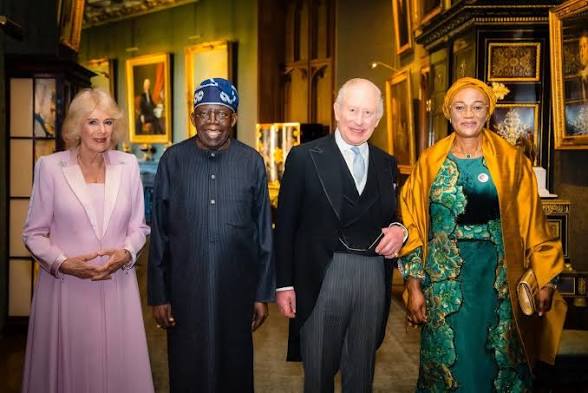
When President Bola Ahmed Tinubu stood in Windsor Castle and invited dignitaries to “raise a glass” to Nigeria–UK relations, it sounded elegant. Refined. Almost Shakespearean. One could practically hear the clinking of crystal and the approval of history itself.
READ ALSO: Beyond the Red Carpet: What Is a State Visit Really Worth for Nigeria?
But Nigerians, sitting in darkness—literal and economic—could only ask one stubborn question:
Raise a glass to what exactly?
Because if you listen carefully—not emotionally, but critically—you will notice something curious. The speech was rich—very rich—in history. It praised Britain’s Magna Carta, invoked thinkers like John Locke and Thomas Hobbes, and traced the intellectual genealogy of democracy as though Nigeria were hosting a seminar on Western political philosophy.
Very good. Very intellectual. Very Windsor.
But Nigerians are not suffering from a shortage of Magna Carta. They are suffering from a shortage of light, security, stability, and trust. The average citizen is not quoting Hobbes; he is battling hardship.
So when a president spends more time praising British history than confronting Nigeria’s present, you begin to wonder:
Was this a state visit—or a postgraduate lecture in political theory?
Let us go deeper.
The speech touched on shared values, shared destiny, and the contributions of Nigerians in the UK—doctors, professionals, athletes excelling abroad. All commendable. All true.
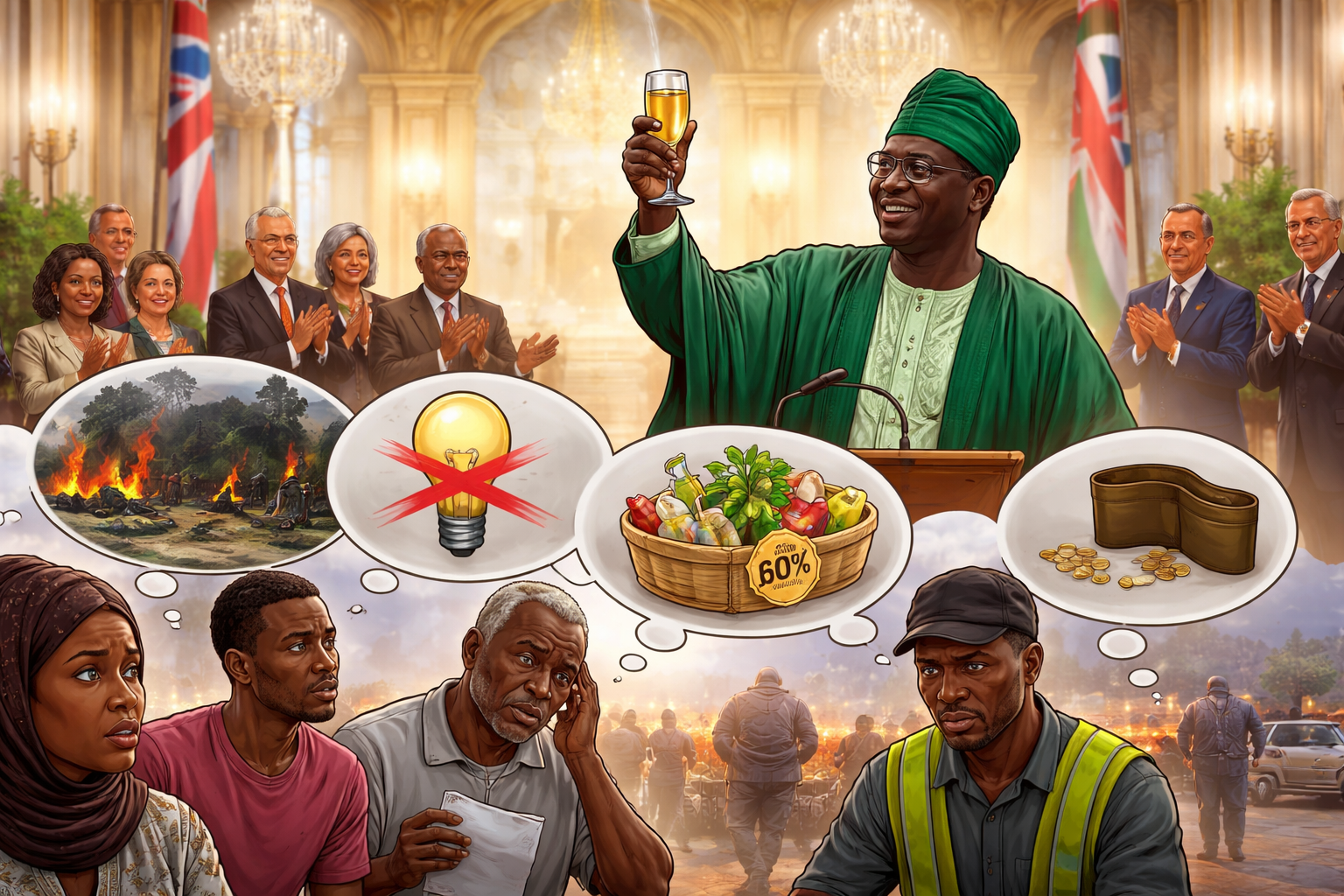 But leadership is not measured by how well your citizens are performing in other people’s countries. Leadership is measured by how well they are surviving in yours.
And here lies the irony—sharp, uncomfortable, and almost theatrical.
While the President spoke of hope, confidence, and a bright future, millions of Nigerians were busy managing a present that refuses to cooperate. Inflation is not theoretical. The naira does not respond to speeches. Security challenges do not bow to eloquence.
Yet, inside Windsor Castle, Nigeria appeared as a nation confidently marching forward—steady, composed, and glowing under diplomatic chandeliers.
Outside that hall, Nigerians are not marching. They are enduring.
So again: whose Nigeria was being toasted?
Then came the ceremonial moment:
“In the spirit of friendship… I invite you all to raise a glass…”
Ah yes—the glass.
A beautiful symbol. Except that back home, Nigerians are not raising glasses. They are raising eyebrows. Some are raising questions. Many are raising concerns. And quite a number are raising their voices—though not always heard.
In fact, for many, the only thing being raised consistently is the cost of living.
Now, let us be fair. Diplomacy is important. Nations must engage. Nigeria must maintain strong relations with the United Kingdom. No serious person disputes this.
But diplomacy without grounded reality becomes performance.
And this is where the satire writes itself.
Because while glasses were being raised in Windsor, generators were being raised in Nigeria—literally carried, fueled, and prayed over. While toasts were made to shared history, Nigerians were toasting bread in darkness, calculating how long the fuel in the generator would last.
This is not contrast. This is contradiction.
The President also spoke about how Britain shaped Nigeria’s institutions—law, governance, civil service. Again, historically accurate. But here comes the uncomfortable footnote:
Those same institutions are struggling today.
So instead of celebrating their origin story, should we not be interrogating their current performance? Should we not be asking why systems we inherited are now systems we can barely sustain?
That was the missed opportunity.
A more courageous speech would have balanced elegance with honesty. It would have said:
“Yes, we honour our shared history—but we also confront serious challenges at home, and here is how we are addressing them.”
That would have been leadership.
What we got instead was something smoother—polished, refined, internationally consumable.
In other words: a perfect diplomatic performance.
But governance is not theatre. That much I know, as a theatre maker. And Nigerians are no longer clapping for performances that do not translate into progress. That much I know, as a seasoned theatre maker.
There is also a subtle political message in that speech—intentional or not. By emphasizing continuity, shared legacy, and institutional alignment, Nigeria was presented as stable, predictable, and cooperative in the global order. Foreign partners like that.
But back home, citizens are asking a different question:
Stable for whom?
Because stability without accountability is not progress. It is stagnation wearing a well-tailored suit.
And now, let us return to the glass—the famous Windsor glass.
If we must raise anything, perhaps it should not be a glass. Perhaps it should be a mirror.
A mirror to reflect the distance between the Nigeria being projected abroad and the Nigeria being experienced at home.
Because when that distance becomes too wide, speeches begin to sound less like vision—and more like fiction.
In the end, the Windsor speech tells us something important:
Nigeria is learning how to speak fluently to the world.
The challenge is that it is still struggling to speak honestly to itself.
And until that changes, no matter how elegant the toast, no matter how refined the setting, no matter how loud the applause—the average Nigerian will not be raising a glass.
He will simply be holding on.
Tightly.