

Stakeholders Declare New Era for Traditional Medicine at North-East Commemoration in Damaturu

Stakeholders Declare New Era for Traditional Medicine at North-East Commemoration in Damaturu
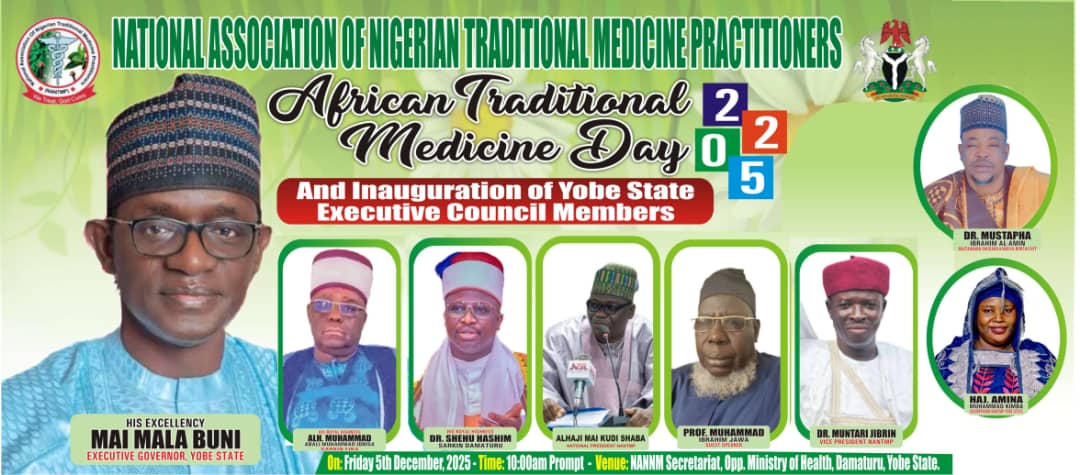
The North-East Zone of the National Association of Nigerian Traditional Medicine Practitioners (NANTMP) on Thursday converged in Damaturu to mark the 2025 African Traditional Medicine Day, renewing calls for stronger recognition, expanded research and deeper integration of African traditional medicine into Nigeria’s formal health system.
Delivering the keynote address, Prof. Muhammad Ibrahim Jawa, Founder and CEO of MIJ College of Traditional Medicine in Damaturu, emphasised that African traditional medicine remains a vibrant and evolving science capable of contributing significantly to the continent’s health needs.
He said the annual commemoration, recognized by both the African Union and the WHO African Region, continues to serve as an important platform for promoting indigenous medical knowledge and advancing evidence-based traditional healthcare practices.
Prof. Jawa noted that hosting this year’s observance in Yobe State highlights the North-East region’s commitment to preserving, modernizing and institutionalizing African traditional healing.
He commended the Federal Government for its major policy strides, including the review of the National Traditional Medicine Policy in 2024, establishment of the Department of Traditional, Complementary and Alternative Medicine under the Federal Ministry of Health, recognition of the discipline by NBTE under the NSQF, and gazetting of the Civil Service Career Structure for practitioners.
Prof Jawa added that the accreditation of institutions such as MIJ College of Traditional Medicine, Damaturu, to run ND and HND programmes marks a historic turning point for the sector.
He urged all stakeholders to recommit to documenting indigenous knowledge, strengthening institutions, expanding research and mentoring the next generation of healers and scholars.
Prof Jawa said Africa stands at the dawn of a new era in which traditional medicine must take its rightful place as a respected pillar of national and global healthcare systems.
Also speaking the Vice President of NANTMP North-East Zone, Dr. Mustapha Ibrahim Al-Amin, who served as the chief host of the event, commended the growing national recognition of traditional medicine and called for stronger collaboration between practitioners, policymakers and conventional medical institutions.
He stressed that the North-East remains a critical hub for expanding training, documentation and research in indigenous medicine, and urged practitioners to uphold professionalism and ethical standards.
He also to the Yobe State government to allowed the members of the organisation to use speakers to selled the traditional medicine in the state.
Representing the Yobe State Ministry of Health, the Director of the Traditional Medicine Board, Mr. Muktar, reaffirmed the state government’s commitment to regulating, supporting and strengthening the practice of traditional medicine.
He said Yobe State will continue to work closely with practitioners to ensure safe, standardized and culturally rooted healthcare services for citizens, adding that traditional medicine remains an essential component of primary healthcare across communities.
The Vice Chancellor of Yobe State University, represented by Prof. Ibrahim Tijjani Babalola, praised the recent reforms that have opened doors for formal academic progression in traditional medicine from certificate to PhD levels.
He noted that the university system stands ready to collaborate with training institutions, researchers and practitioners to boost scientific inquiry, curriculum development and professional training in the sector.
Speakers at the event acknowledged the wide-ranging benefits of developing African traditional medicine, including enhanced access to affordable healthcare, preservation of indigenous knowledge, job creation, drug discovery and expansion of Nigeria’s medical research landscape.
They also highlighted ongoing challenges such as inadequate funding, limited documentation, insufficient laboratory infrastructure and the lingering historical effects of colonial suppression of indigenous practices.
The event closed with renewed optimism as participants expressed confidence that the North-East region will continue to lead advocacy, training and policy reforms that promote the growth and recognition of indigenous medicine in Nigeria.
