

THE TRUTH THEY FEAR — AND THE UNITY WE MUST NOW BUILD
By Ojo Emmanuel Ademola
Introduction: When Silence Becomes Complicity
There comes a time in the life of a Church when silence becomes a form of betrayal. For more than three decades, the Christ Apostolic Church (CAC) has lived under the shadow of a crisis that should never have survived a single decade. A generation has now arisen that knows nothing of the beginning, and what they have been told is often a curated narrative designed to protect the interests of those who benefitted from confusion. The truth has been buried, distorted, and in some cases deliberately suppressed. Yet truth, like fire, has a stubborn way of burning through the layers of falsehood placed upon it.
READ ALSO: Degrees Without Jobs: Rethinking Youth Development In Plateau
As one entrusted with the Gospel, with the heritage of our fathers, and with the sacred responsibility of speaking truth to the Body of Christ, I must speak—not to reopen wounds, but to disinfect them. Not to shame men, but to free a Church. Not to divide, but to call us back to the Revival and Unity that defined our Apostolic origins. The time has come to confront the truth they fear, the truth they have buried, and the truth that alone can heal the future of CAC Nigeria and Overseas.
The Document They Pretend Never Existed
In 2015, the late Pastor E.H.L. Olusheye, former President and Trustee of CAC Worldwide, published a full‑page public notice in The Nation newspaper titled “Christ Apostolic Church: Time for Truth and Unity.” It was not a casual publication. It was not a political manoeuvre. It was not a defensive outburst. It was a confession. A repentance. A final attempt by a man who had seen the beginning of the crisis, participated in its machinery, and later sought to correct the wrongs before meeting his Maker.
In that document, he laid bare the humiliation of the founding fathers, the manipulation of legal processes, the wrongful removal of trustees, the misuse and misrepresentation of the 1995 Certificate, the betrayal of unity efforts, and the pride and falsehood that sustained the crisis. He wrote not as an outsider, but as the man who once stood at the centre of the storm. His words were not hearsay; they were testimony. His revelations were not rumours; they were confessions. His appeal was not political; it was spiritual.
Yet today, the very leaders who inherited the crisis behave as though this document never existed. They pretend not to know. They pretend not to remember. They pretend not to understand. But truth does not disappear because men close their eyes to it. Truth remains truth, even when buried under the rubble of institutional pride.
The Truth About the Certificate: What Olusheye Himself Confirmed
One of the most critical truths the late Olusheye confirmed—both publicly and privately—is that the authentic Certificate of Registration of the Christ Apostolic Church is the 1985 Certificate held by the Supreme Council. This is not speculation. This is not conjecture. This is not the opinion of one faction against another. This is the testimony of the man who knew the inside of the crisis more than anyone alive today.
On two separate occasions in his lifetime, I personally told him that what the GEC did regarding the certificate—its seizure, its manipulation, and the narrative built around it—could only have happened in the Nigeria of the military era, a period when justice was routinely suspended and institutions were easily coerced. I told him plainly that if anyone attempted such a thing abroad, every leader involved would have faced the full consequences of the law. He agreed with me. He did not defend the act. He did not justify it. He acknowledged it.
This is why the continued claim by some GEC leaders that they are “more than” the Supreme Council is not only historically false—it is morally indefensible. It is a claim rooted in pride, not truth; in convenience, not history; in institutional ego, not Apostolic humility.
The Lie of “We Are More Than Them”
The crisis in CAC was never a census competition. It was never about who had more assemblies, more pastors, or more influence. It was about truth, legitimacy, process, and obedience to the founding covenant of the Church. The late Olusheye made it clear that the crisis began with disobedience to constituted authority, that the humiliation of fathers like Pastor E.T. Latunde was unjustifiable, that the legal manipulations that followed were not inspired by the Holy Spirit, that the 1995 Certificate was misused and misrepresented, that the unity efforts were sabotaged from within, and that the 1985 Certificate remained the authentic legal foundation of the Church.
When the very architect of the crisis repented and exposed the truth, what moral ground remains for today’s leaders to continue in falsehood? When the man who once defended the actions later confessed their wrongness, what justification remains for those who cling to the same errors? When the truth has been spoken by the one who knew the truth from the beginning, what excuse remains for those who pretend not to know?
The Generation That Knows Nothing Must Not Inherit Lies
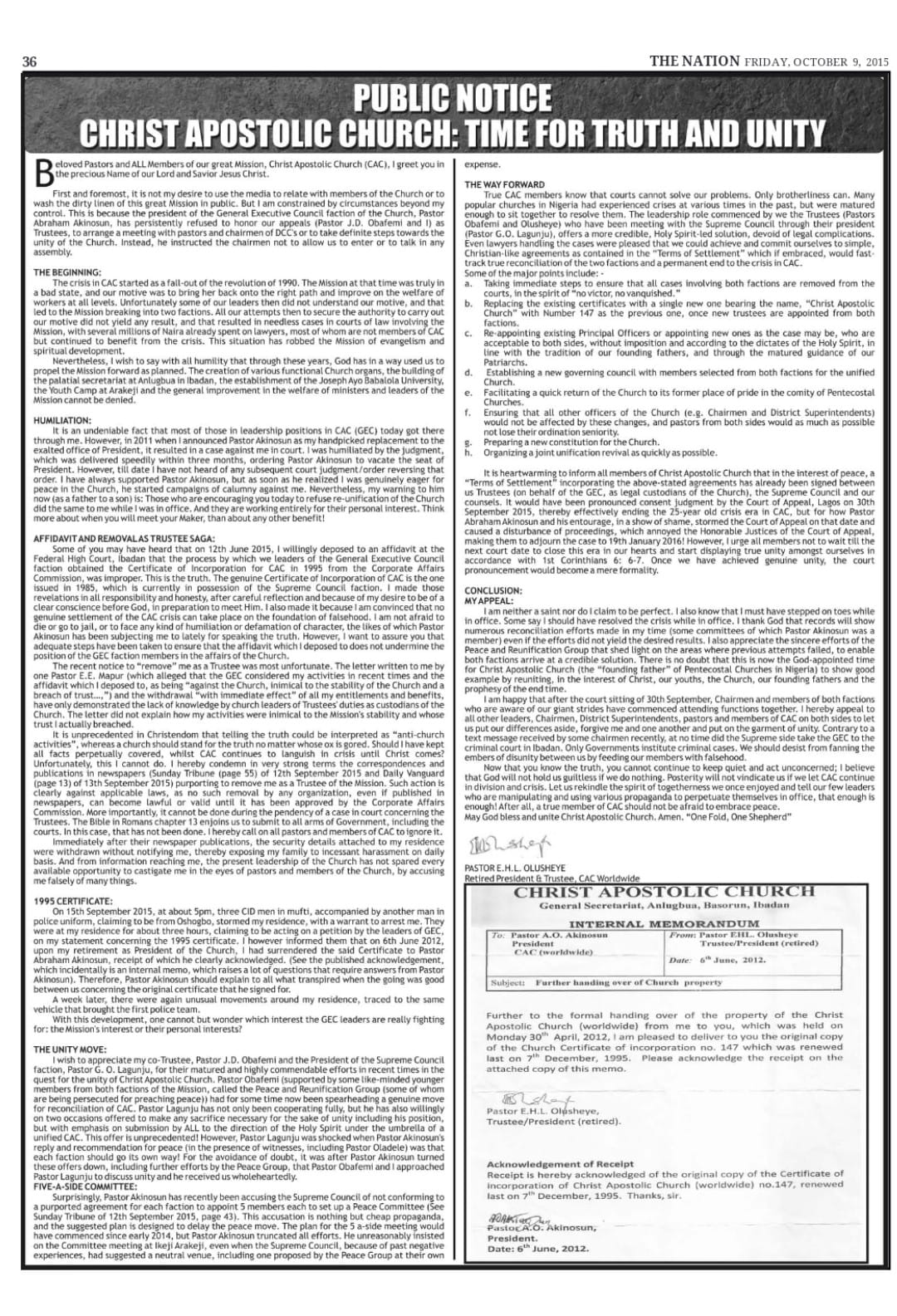
A new generation of CAC members—youths, ministers, and diaspora believers—did not witness the beginning of the crisis. Many only know what they were told, and what they were told often came from those who had something to protect. This is why truth must be restated. This is why documents like the 2015 public notice must be brought back to the light. This is why the Church must confront its own history with humility. A Church that hides its past cannot heal its future. A Church that buries its truth cannot claim revival. A Church that suppresses its history cannot claim unity.
Renewal–Pentecostal Insights: Why Truth Is a Spiritual Mandate
The call to truth is not merely administrative; it is deeply spiritual. Renewal–Pentecostal theology teaches that the Holy Spirit does not dwell where falsehood is enthroned. Scripture affirms that “God is not the author of confusion” (1 Corinthians 14:33), and that “judgment must begin at the house of God” (1 Peter 4:17). The Apostolic movement was birthed on the foundation of holiness, transparency, and obedience to divine order. Whenever Israel strayed into institutional deceit, the prophets cried out because deception always precedes decline. Jesus Himself declared that “ye shall know the truth, and the truth shall make you free” (John 8:32). Revival cannot coexist with distortion. Unity cannot flourish where truth is suppressed. The Spirit of Renewal demands that we confront the past with honesty so that the future may be healed by grace. A Church that desires Pentecostal fire must first embrace Pentecostal truth.
The Repentance of Olusheye: A Turning Point We Ignored
One of the most profound elements of the 2015 publication is that Pastor Olusheye did not write to defend himself. He wrote to correct himself. He wrote to restore the dignity of the fathers. He wrote to call the Church back to unity. He handed over the Certificate of Incorporation. He acknowledged the wrongs. He appealed for reconciliation. He warned against pride. He pleaded for truth. Yet, instead of embracing this moment of grace, some leaders doubled down on the very errors he confessed. They ignored his repentance. They dismissed his testimony. They buried his confession. But truth does not die because men refuse to hear it. Truth remains truth, even when ignored.
Why I Speak Now
As General Evangelist of CAC Nigeria and Overseas, and as the Founding Leader of the Digital Gethsemane Prayer Network (Global), I carry a spiritual responsibility to call the Church back to truth, expose the lies that hinder unity, protect the next generation from inherited confusion, honour the repentance of those who sought to correct the past, and champion revival, reconciliation, and restoration. This is not about sides. This is not about supremacy. This is not about institutional ego. This is about the soul of a Church that once led Africa in Apostolic fire and prophetic purity.
The Path Forward: Truth Before Unity
Unity without truth is hypocrisy. Unity without repentance is pretence. Unity without justice is manipulation. If CAC is to rise again, the truth of the crisis must be acknowledged publicly, the testimony of the late Olusheye must be honoured rather than buried, the prideful narrative of “we are more than them” must end, the Church must return to the founding covenant of holiness, humility, and apostolic order, and a new generation must be taught the truth rather than propaganda.
Conclusion: Revival Begins With Truth
The revival we seek will not come through noise, numbers, or new structures. It will come when we confront the truth we have avoided for decades. The unity we desire will not come through intimidation or political manoeuvring. It will come when we honour the fathers, correct the wrongs, and embrace the repentance already offered by those who knew the truth from the beginning. The future of CAC Nigeria and Overseas depends on our courage to face what others fear. And by the grace of God, I will continue to speak—not to divide, but to heal; not to accuse, but to awaken; not to destroy, but to rebuild. For the time of Revival and Unity is now.