


Vibrant Youth, Shared Voices: Art as a Bridge of Development and Cultural Exchange
By Jerry Adesewo
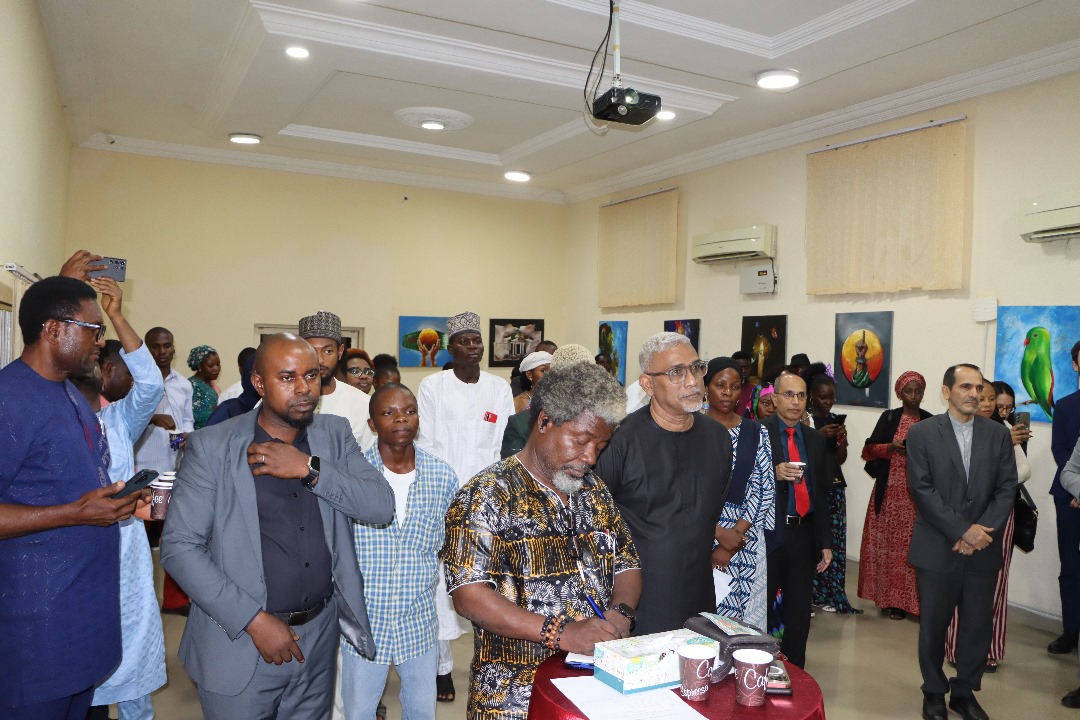
The Bangladesh High Commission’s exhibition Vibrant Youth, organized in collaboration with BEA Studio, could not have arrived at a more urgent moment—when societies everywhere are re-examining how best to prepare their young people not just for survival, but for meaningful participation in a world defined by rapid social shifts, digital acceleration, migration, identity questions, and the restructuring of global economies. Art, in this context, becomes more than a creative practice; it becomes a tool of formation, empowerment, diplomacy, and cultural literacy.
READ ALSO: Inside the Future of African Speculative Art at Aké 2025
In his welcome message, the High Commissioner describes the Youth Festival in Bangladesh as embodying “creativity, innovation, and a strong commitment to national advancement,” noting that Vibrant Youth is designed to enhance “people-to-people contacts, and promote bilateral relations and more cultural exchanges between Bangladesh and Nigeria.”
That aspiration transforms the exhibition from a gallery event into a diplomatic exercise in soft power and youth development.
Art as a Training Ground for Thinking Citizens
The curatorial statement by Bamaiyi Emmanuel, CEO of BEA Studio, builds on this, describing the participating artists as a “powerful artistic frequency” shaping tomorrow.
This phrasing is significant. It suggests that young artists are not only documenting their time but also generating the emotional and cultural intelligence that will define future societies.
Director General of the National Council for Arts and Culture, Mr. Obi Asika, could not hide his excitement at the brilliance of the young minds behind the initiative, particularly Emmanuel Baimaiyi whom he commended his commitment to channeling his youth to such initiative.
“This is a bright start, and I would look forward to see a follow-up edition that includes young artists from Bangladesh, and of course, with Emmanuel as curator,” he said adding that the NCAC is open to working with the Embassy to strengthen the bilateral relationship between both countries, from a cultural exchange point of view.
Across the works of the eight featured Nigerian artists, one sees a consistent thread: art as a lens for internal reflection and social responsibility.
Bamaiyi Emmanuel merges expressive portraiture with social symbolism, turning art into “advocacy to humanity,” using mixed media, including paper textures, to translate memory into visual language.
Hauwa Sufyan uses “bold colours, symbolic elements, and emotionally charged compositions” to narrate identity and everyday African stories.
Dada Nifemi Emmanuel’s practice blends environmental memory and community life, reflecting a concern with real-world sustainability.
What is apparent here is that the youth featured are not making art for self-display; they are using art to think publicly, to teach, to negotiate social anxieties, and to critique systems.
Cultural Exchange as Mutual Enrichment
The High Commissioner insists that the event “will help cultivate bonds of friendship between the youths of Bangladesh and Nigeria,” positioning art as a diplomatic corridor.
In an age where diplomatic language often revolves around trade and technology, this is a refreshing reminder that cultural exchange remains one of the most durable forms of international partnership.
Bangladesh and Nigeria share similar demographic realities: young populations carrying the emotional weight of rapid modernization. What Vibrant Youth does is reveal that beneath geopolitical maps and national boundaries, young creative minds are already speaking to each other—through colour, form, symbolism, and shared aspirations.
The participating artists embody this capacity: Ameh Odachi meditates on healing, vulnerability, and memory using beads, sand, and textured acrylics. Buhari Sani Junaid blends text, painting, and fabric to celebrate people and culture, connecting art with empowerment through his foundation for youth upcycling. Victor Elera interrogates cultural heritage and social justice with mixed-media detail. Udie Undie turns brushstrokes into exercises in cognitive mapping and mental health dialogue, while Favour Musa channels resilience, hope, and transformation, reminding us that even “in difficult situations, hope and beauty still exist.”
Their works suggest that youth development is not only a function of technical training but also of emotional literacy, psychological agency, and cultural confidence.
Art as Future Infrastructure
The recurring subtext of Vibrant Youth is that a society seeking to invest in its young people must also invest in their capacity to feel, interpret, critique, and create. This is infrastructure—not of roads and bridges, but of voice, empathy, and cultural self-awareness.
Art teaches complex thinking (symbolism, narrative, abstraction), communication beyond language (colour, posture, visual metaphor), global citizenship (understanding other cultures beyond stereotypes), healing and wellness (as explored by Musa, Odachi, Undie) and innovation in material use (as seen in the textured, mixed-media practices)
These skills are foundational to peace-building, diplomacy, identity stability, and community resilience.
Toward a Constructive Youth Agenda
A truly modern youth development policy cannot ignore the arts. Through events like Vibrant Youth, young Nigerians and Bangladeshis are positioned not just as observers of culture but as co-authors of a shared global imagination.
Art becomes a tool of identity affirmation, a medium of conflict resolution, a mirror for introspection, a bridge for international relationships, a language of youth empowerment and leadership.
When the High Commissioner calls for “more cultural exchanges between Bangladesh and Nigeria,” the implication is clear: nations that exchange art exchange humanity, empathy, and worldview.
Conclusion
Vibrant Youth is more than a showcase of talent. It is a living syllabus for how young creatives will shape the future—thoughtfully, collaboratively, and visually. In their colours and textures, these artists highlight a common pulse: youth everywhere are searching, building, and imagining. And when nations create room for them to do so together, cultural diplomacy becomes not performance, but shared growth.
Art, then, is not an extracurricular pastime but vital scaffolding for the next generation’s emotional, social, and civic intelligence—an instrument that teaches young people not only to see the world but to remake it with conviction and creativity.
In all, Emmanuel Baimaiyi deserves huge commendation for birthing this initiative.