


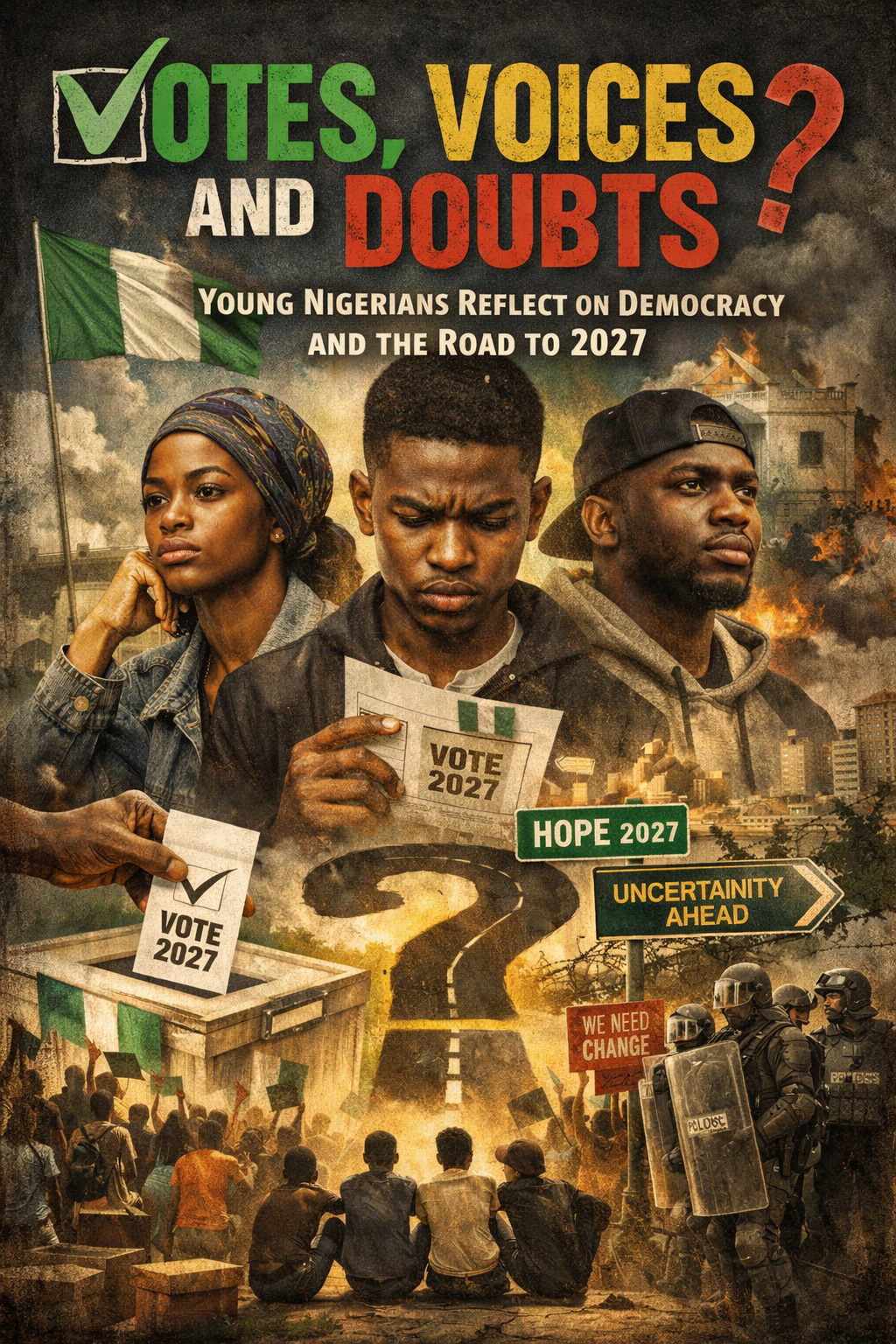
Votes, Voices and Doubts: Young Nigerians Reflect on Democracy and the Road to 2027
By Matthew Eloyi
On election mornings in Nigeria, the atmosphere around polling units often carries a mix of tension and hope. Voters arrive early, some determined to cast their ballots before the crowds swell, others curious to witness the process unfold. In recent years, young Nigerians have increasingly formed the largest share of those conversations about politics – on the streets, in classrooms, and across social media platforms. Yet behind the online debates and campaign hashtags lies a deeper question many young citizens are asking: Does the vote still have the power to bring real change?
As the country slowly begins to look toward the 2027 general elections, reflections from a cross-section of Nigerian youths reveal a wide spectrum of views about democracy, electoral integrity, and civic participation. Some remain optimistic that the ballot remains the most effective tool for change. Others say their experiences have left them doubtful about the credibility of the system. Together, their voices tell the story of a generation still searching for confidence in the electoral process.
For Titus Nyafa, a public affairs commentator and youth advocate from Benue State, the answer remains clear: participation is essential if democracy is to thrive. Nyafa believes the act of voting is one of the most direct ways citizens can influence governance and shape policy direction in Nigeria.
According to him, the health of any democratic system depends largely on how actively citizens engage in it. Even though challenges exist within Nigeria’s electoral process, he maintains that withdrawing from participation would only weaken democratic institutions further.
Nyafa recalls that during the 2023 general elections, there was a remarkable level of enthusiasm among voters, especially young people who felt energised about participating in the process. However, he also observed that the excitement was tempered by logistical challenges and delays in some polling units. Issues surrounding the transmission of results created frustration and raised concerns among voters about the transparency of the process.
Despite those setbacks, Nyafa says he remains committed to voting in future elections. Rather than discourage him, the experience reinforced his belief that Nigerians must stay engaged and continue to demand improvements to the system. For him, democracy is strengthened not by perfection but by consistent participation and accountability.
Former students’ union leader Emmanuel Bur shares a similar belief in the power of the ballot. Bur says his confidence in the voting process comes from the understanding that elections provide an opportunity for citizens to elect competent leaders capable of transforming the country.
Reflecting on the 2023 elections, he said the outcome demonstrated the power of the electorate. In several parts of the country, political parties that had previously been considered less dominant managed to secure seats in different levels of government. For Bur, that development showed that political change is possible when voters actively participate in elections.
He also points to the persistence of vote buying as evidence that votes still matter. According to him, if ballots carried no significance, politicians would not go to such lengths to influence them.
At the same time, Bur acknowledges that many young Nigerians remain hesitant about participating in elections. He attributes the gap between online political activism and physical turnout to voter apathy rooted in distrust of the electoral process. Allegations of irregularities and systemic manipulation, he says, have created doubts in the minds of many young voters about whether their votes truly count.
For Otsonu Echo Wisdom, a journalist and community mobilizer based in Abuja, his experience during the 2023 elections offered a different perspective on the electoral process because he served as a Presiding Officer.
Wisdom recalls that the experience was both challenging and revealing. One of the most pressing issues he encountered was the difficulty in transmitting results electronically from polling units due to poor internet connectivity. The delays created tension among voters who expected results to be uploaded immediately after counting.
Another issue he highlighted was the welfare of ad-hoc election staff. According to him, many of the temporary officials recruited to assist during elections received stipends that were not only low but also delayed. In some cases, workers had not been paid long after the election period had ended.
Wisdom believes such conditions could discourage young Nigerians from volunteering to assist in future elections. Nevertheless, he says confidence in the system can still be restored if electoral authorities implement credible reforms, ensure fair elections, and improve communication with the public.
For Echono Ochoche, his involvement in the 2023 elections also came through service as an ad-hoc election official. However, the experience left him with lingering doubts about the credibility of the system.
He explained that observing the electoral process closely raised concerns about the relationship between what occurred at polling units and what was eventually reported in official results. Because of that experience, he says he has decided not to serve as an ad-hoc staff member again in future elections.
Instead, he plans to participate simply as a voter. For Ochoche, casting a vote remains important, but he believes the electoral system must become truly independent if it is to earn the trust of the public.
Another voice in the conversation is Engr. Chinedum Elekwachi, who serves as the Ebonyi State Secretary of the ADC Membership Revalidation, Mobilization and Registration Committee.
Elekwachi believes that the vote still has the potential to bring meaningful change in Nigeria, but he stresses that such change cannot come from individual participation alone. According to him, transformation requires large numbers of citizens who share the same vision for progress to participate collectively in the electoral process.
Reflecting on the 2023 elections, he described the outcome as disappointing and below expectations. Elekwachi alleged that votes were suppressed in some areas and that irregularities affected the credibility of the results. He also recalled incidents in which electoral materials were allegedly seized during violent disruptions.
Despite these challenges, he says he remains committed to participating in future elections because he believes citizens have a responsibility to defend their votes and resist anti-democratic practices.
Elekwachi also believes the gap between online activism and physical participation may partly be explained by logistical issues. Many young Nigerians, he said, live outside the states where they originally registered to vote, making it difficult to travel home during elections. For this reason, he advocates reforms such as diaspora voting or electronic voting systems that would allow citizens to vote regardless of location.
For Sule Samuel Ondoma, a sociology graduate from Benue State University who now works as a freelancer, his views about the electoral process were shaped by his experience serving as an ad-hoc staff member during an election in Abuja while he was a member of the National Youth Service Corps.
According to Ondoma, he witnessed situations where the results recorded at his polling unit appeared different from figures that later emerged on official platforms. That experience left him questioning whether votes truly determine electoral outcomes.
During the 2023 elections, Ondoma also observed widespread vote buying in his home community. He described scenes where money was discreetly handed to voters while they waited in line to cast their ballots.
For him, such practices undermine the credibility of elections and discourage many people who genuinely wish to see positive change. He believes that unless transparency improves and vote buying is addressed, many voters will continue to feel that elections are merely procedural rather than transformative.
Media consultant Onoja Benedict Paul, who works in development journalism and documentary production in Kaduna State, shares a similar skepticism about the effectiveness of voting in Nigeria’s current electoral environment.
According to him, his experience during the 2023 elections reinforced his belief that the outcome of elections is often influenced by factors beyond the votes cast by citizens.
Paul recalled arriving early at his polling unit near the Kaduna South Local Government Secretariat to ensure he participated in the voting process. After casting his ballot, he remained at the polling unit to observe the counting of votes.
Although the votes were counted in his presence, he said the results were not uploaded electronically as many voters had expected. That failure, he argues, created opportunities for manipulation later in the process.
Because of this, Paul says he may not be motivated to vote again in 2027 unless electoral authorities make electronic transmission of results mandatory from polling units.
Another perspective comes from Adoyi Alfredo, who describes himself as a politically conscious young Nigerian struggling with growing disillusionment about the electoral system.
Alfredo says he finds it difficult to believe that a single vote can influence political outcomes in Nigeria. In his view, systemic corruption and entrenched political interests often determine who ultimately assumes power.
He recalls approaching the 2023 elections with genuine hope that participation could bring change. However, events that followed the election cycle left him feeling disconnected from the outcome and uncertain about the value of voting.
For Alfredo, social media has become a safer space for political expression than the polling unit. Online platforms allow young Nigerians to voice their frustrations and organise politically without the risks and uncertainties associated with physical participation in elections.
Still, he says meaningful reforms, such as transparent digital result transmission and genuine independence for electoral authorities, could restore his confidence in the process.
Not all respondents share such pessimism. A civil servant who chose to remain anonymous expressed a more optimistic view about the power of the electorate.
He points to local elections in the Federal Capital Territory where opposition candidates were able to secure victories as evidence that voter turnout can influence political outcomes.
According to him, the success of those candidates demonstrates that when voters mobilise and monitor the counting of ballots at polling units, they can protect the integrity of the electoral process.
He also believes the electoral reforms introduced in recent years, including technological innovations in the voting process, could strengthen public confidence if properly implemented.
As Nigeria gradually approaches the next general elections, the voices of these young Nigerians reveal the complex relationship between citizens and the democratic system they inhabit. Some remain hopeful that participation will gradually improve governance and accountability. Others continue to question whether the system truly reflects the will of the people.
What unites them, however, is a shared desire for transparency, fairness, and credibility in the electoral process. Whether through improved technology, stronger enforcement of electoral laws, or greater institutional independence, many believe meaningful reforms are necessary if public trust is to be restored.
Until then, Nigerian youths will continue to debate the power of the ballot – online, in communities, and eventually at polling units, where the promise of democracy will once again be tested.
