

World Poetry Day 2026: Where Words Confront Power, Freedom, and Illusion
By Jerry Adesewo
On the evening of March 19, 2026, the historic halls of the Wole Soyinka Centre for Culture and Creative Arts in Lagos will host more than a celebration of poetry. It will host a conversation—urgent, layered, and deeply reflective—about the nature of power, the meaning of freedom, and the illusions that shape both.
At the centre of this gathering is Wole Soyinka, whose presence alone transforms the event into more than a literary occasion. It becomes a symbolic meeting point between legacy and a new generation of voices navigating a complex, often contradictory world.
READ ALSO: Clara Etso Ugbodaga-Ngu and the Early Expansion of Women’s Cultural Citizenship in Nigeria
Organised by ProvidusBank under its Poetry Café initiative and curated by cultural advocate Jahman Anikulapo, the 2026 World Poetry Day event reflects a growing recognition that poetry is no longer confined to the page—it is now a space for civic interrogation.
Poetry as a Mirror of Society
The theme of this year’s celebration—“Power & Order, Freedom & Illusion”—is both philosophical and political. It speaks to a world increasingly defined by competing narratives: authority and resistance, truth and perception, freedom and its many contradictions.
In Nigeria, where questions of governance, identity, and social justice remain central to public discourse, poetry has evolved into a powerful medium for engagement. Spoken word stages, literary festivals, and digital platforms have become arenas where artists confront realities often left unspoken in formal spaces.
This event taps directly into that tradition.
It is designed not merely as a performance showcase, but as an evening of reflection—an intellectual and emotional engagement with the forces shaping society.
A Global Gathering of Voices
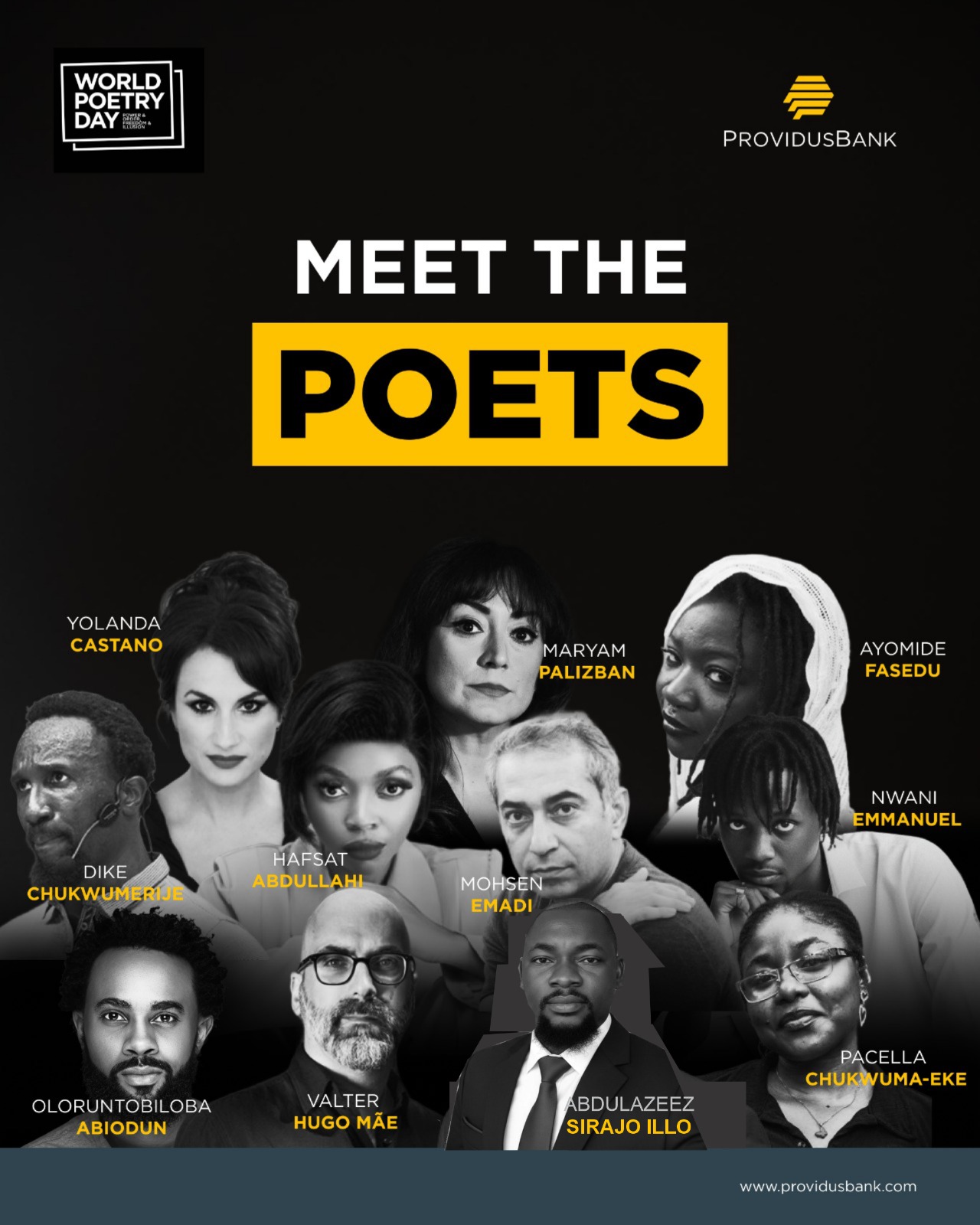
One of the defining features of the 2026 edition is its international outlook. The lineup brings together poets from Nigeria and across the world, reinforcing poetry’s role as a universal language.
Among the featured voices is Dike Chukwumerije, a leading figure in Nigeria’s spoken word movement whose work bridges performance and national consciousness.
He is joined by internationally acclaimed poets such as Yolanda Castano, known for her lyrical depth, and Valter Hugo Mae, whose literary works have earned global recognition.
From the Middle East come Maryam Palizban and Mohsen Emadi, both of whom bring perspectives shaped by histories of resistance, identity, and cultural complexity.
Nigeria’s emerging and mid-career voices are also strongly represented, including Hafsat Abdullahi, Ayomide Fasedu, Nwani Emmanuel, Oloruntobiloba Abiodun, Abdulazeez Sirajo Illo, and Pacella Chukwuma-Eke.
Together, these voices will create a bouquet of perspectives—local and global, personal and political—reflecting the diversity of contemporary poetic expression.
The Soyinka Factor
The inclusion of Wole Soyinka is both symbolic and strategic.
As Africa’s first Nobel Laureate in Literature, Soyinka represents a tradition of intellectual courage and artistic resistance. His work has consistently engaged themes of power, justice, and human dignity—making his presence particularly resonant given this year’s theme.
In many ways, Soyinka’s career embodies the very questions the event seeks to explore: What is power? Who defines freedom? And how do societies sustain illusions that shape collective reality?
For younger poets sharing the stage, his presence serves as both inspiration and challenge—a reminder that art carries responsibility.
The Rise of Poetry as Public Discourse
Nigeria’s poetry scene has undergone a quiet but significant transformation over the past decade.
Once confined largely to academic and literary circles, poetry has moved into mainstream cultural consciousness. Spoken word performances now draw large audiences, while digital platforms have expanded reach beyond traditional boundaries.
More importantly, poetry has become a tool for engagement.
From conversations around governance and corruption to identity, gender, and mental health, poets are increasingly positioning themselves as commentators on society.
Events like World Poetry Day reflect this shift.They provide a platform where artistic expression intersects with public discourse, allowing audiences to engage with ideas in ways that are both accessible and profound.
Beyond Performance: A Space for Reflection
While the lineup promises compelling performances, the deeper value of the event lies in its ability to create space for reflection.
In a fast-paced world dominated by headlines and soundbites, poetry offers something different: pause.
It invites audiences to listen, to think, and to feel.
The 2026 edition, with its focus on power and illusion, is particularly timely. Across the globe, societies are grappling with questions about truth, authority, and the nature of freedom.
In Nigeria, these questions are even more immediate.
By framing these issues through poetry, the event creates an opportunity for engagement that is both critical and creative.
A Cultural Statement
ProvidusBank’s continued investment in poetry through its Poetry Café initiative signals a broader shift in how corporate institutions engage with culture.
Rather than treating art as peripheral, such initiatives recognise its central role in shaping identity, dialogue, and national consciousness.
The World Poetry Day event, therefore, is not just a literary gathering. It is a cultural statement—one that affirms the relevance of art in understanding and shaping society.
Where Words Become Action
As the evening unfolds in Lagos, what will emerge is more than a series of performances.
It will be a convergence of voices—each bringing a unique perspective, yet united by a shared commitment to expression and truth.
In that space, poetry will do what it has always done at its best:
Challenge power. Question illusion.
And remind us that freedom, in all its complexity, must continually be defined, defended, and reimagined.
For those who gather at the National Theatre on March 19, the experience will not simply be about listening to poetry. It will be about encountering ideas. And perhaps, leaving with new ways of seeing the world.