



Dele Jegede and the Chromatics of Dissent
By Rowland Goyit
Democracy as we know it today, is often measured in ballots and court rulings. Yet long before political parties register their strain and displeasure with electoral processes, colours have begun to shift in the direction of brushes on canvas, while satire intensifies as a creative narrative, and caricature stretches further to humour us as the palette grows restless.
READ ALSO: art as Art: Nigeria’s Civic Mirror
In recent months, as public discourse in Nigeria oscillates between economic anxiety, policy recalibration, and generational impatience, I have found myself returning to the work of Dele Jegede not out of nostalgia, but out of necessity. His artistic practice offers a lens through which we can read the present civic climate with unusual clarity. Dele Jegede is one of Nigeria’s most intellectually formidable cultural figures, a rare hybrid of artist, political cartoonist, art historian, curator, and public intellectual.
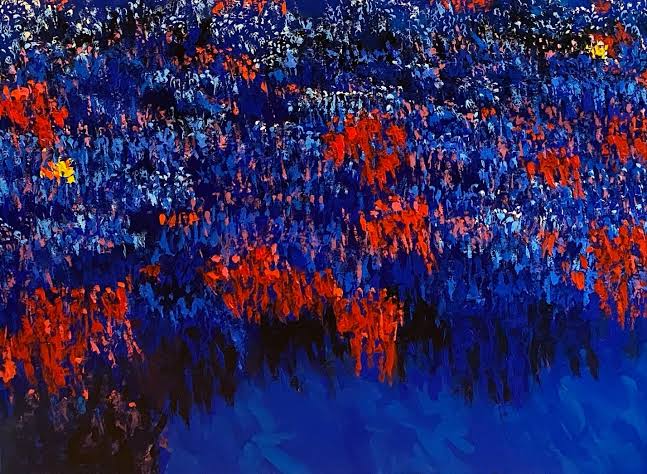
Jegede’s protest is rarely austere and does not cloak itself in monochrome solemnity. Instead, it radiates chromatic energy where reds flare like alarm signals, yellows vibrate with ironic brightness, and the blues cools off the tense surface that simmers beneath. Usually, the viewer is first drawn in by colour, then confronted by critique. I can assure you that this is not decorative exuberance. It is Jegede’s strategy of annotating society in the margins, underlining contradictions in ink, and occasionally circling hypocrisy with a red pen
Whenever I reflect on Nigeria’s present civic texture and chromatic atmosphere, I am usually confronted with a complex rather than singular perception of reality. When economic reforms promise restructuring but generate lived strain. Where youth populations are hyperconnected yet institutionally impatient. A reality where public trust wavers in cycles and the national mood is neither revolutionary nor complacent; it is just watchful.
In such climates, art does not retreat. At least, not as means of livelihood but as civic responsibility which recalibrates and seeks forms that can hold contradiction without collapsing into noise. This is where satire becomes one of the most precise instruments available to pierce without inciting panic and question without declaring war. Obviously, Jegede mastered this equilibrium decades ago.
As both artist and art historian, Jegede operates with double consciousness where he constructs images while simultaneously understanding their theoretical implications. His figures often elongated into metaphors that make authority swells into caricature. The crowded compositions in his works are a mirror of crowded governance structures. The faces are distorted not for spectacle but for revelation.
He draws from is layered tradition of newspaper cartooning during periods of military rule where coded intelligence was required. During this time, humour functioned as camouflage. One could not always speak directly, but bend the line, twist the body, or amplify the absurd.
Obviously, that elasticity remains visible in his work. One can clearly see how proportion becomes commentary, gesture becomes argument and colour becomes rhetoric.
Unfortunately, many viewers mistake this satire for levity, but it is not. For Jegede, it is a disciplined compression where a single exaggerated limb can critique an entire policy culture, or a grin stretched too wide can expose institutional vanity. Laughter, as the outcome of humour, in this sense, becomes civic oxygen that allows society to inhale critique without suffocating.
There is something pedagogical in his chromatic insistence, even though protest art is often imagined as dark, heavy, and tragic. Jegede resists that script. Brightness in his paintings becomes a refusal of despair, and his palette declares that critique need not extinguish vitality.
I have argued consistently that if we treat art as evidence, then Jegede’s practice documents not only past military anxieties but an enduring civic methodology. It proposes that democracy survives not merely through confrontation but through interpretive agility.
Interestingly, today’s digital landscape thrives on exaggeration and rapid visual commentary. The meme culture, political animation, and satirical skits are descendants of the same logic Jegede refined in his ink and brushstrokes. The difference is velocity. What once appeared in newspapers now circulates in seconds.
Yet velocity is not depth. The challenge for contemporary Nigerian artists, today, is to sustain critical intelligence within accelerated media ecosystems. Brightness must not become superficiality. Satire must not flatten into mockery.
Jegede’s legacy offers a counter-model, while his images demand decoding that require viewers to linger and provoke laughter that carries intellectual residue.
There is also a structural lesson embedded in his dual identity as practitioner and scholar. Nigeria’s art ecosystem often separates production from criticism, yet, Jegede refused that division by theorizing while creating. He historicized while drawing, and in doing so, he demonstrated that protest art can be both aesthetically compelling and intellectually rigorous.
The civic question facing Nigeria is not simply whether artists will critique the system. Of course, they will always do. The deeper question is whether society will cultivate the interpretive infrastructure to understand such critique in its full complexity.
In Jegede’s universe, colour is not cosmetic, but constitutional, expanding the emotional vocabulary through which citizens interpret power, while insisting that protest can be intelligent, joyful, unsettling, and precise at once. Here, democracy is negotiated not only in parliament but in pigment of brushstrokes, exaggerated lines, deliberate distortion and chromatic refusal to fade into grey.
As Nigeria navigates its present recalibrations, artists must continue to edit the cultural text of governance. While some whisper and others shout, Jegede’s method reminds us of the option to illuminate. And illumination, when handled with wit and discipline, can be one of the most enduring forms of protest.