

EDU-INT: WHY EDUCATION INTELLIGENCE IS NORTHERN NIGERIA AND THE SAHEL’S MISSING SECURITY SYSTEM

EDU-INT: WHY EDUCATION INTELLIGENCE IS NORTHERN NIGERIA AND THE SAHEL’S MISSING SECURITY SYSTEM
EDU-INT: Education Is The Early Warning System Northern Nigeria and the Sahel Never Had
From Borno to Zamfara, from Gao to Tillabéri, low education made communities vulnerable, insurgents attacked schools, and attacks on schools made communities even more vulnerable. A new framework by a Nigerian scholar with PhDs in Education and Military Studies, now pursuing a PhD in Gender and Security Studies, argues that education data is security intelligence.
By: Dr. MS Abubakar, PhD (Education), PhD (Military Studies), PhD Candidate in Gender and Security Studies, African Advanced Center for Gender and Security Studies | Founder, EDU-INT
Abuja / Maiduguri / Niamey — November 2026
For 25 years, Nigeria and West Africa have tried to silence the guns with guns.
We have deployed soldiers to Borno, Zamfara, Sokoto, Katsina and Kaduna. We have created the Multinational Joint Task Force (MNJTF). We have spent billions on military operations. ECOWAS has issued sanctions. The African Union has launched Silencing the Guns.
Yet terrorism has not gone down. It has gone up.
The Global Terrorism Index for the Sahel rose from 1.92 in 2002 to 7.82 in 2025. Borno still bleeds. Zamfara still bleeds. Coups returned to Mali, Burkina Faso and Niger. Three countries left ECOWAS to form the Alliance of Sahel States.
Why? Because we have been fighting the symptom, not the cycle.
That is why I developed EDU-INT — Education Intelligence.
> WHAT IS EDU-INT? — DEFINITION
> EDU-INT (Education Intelligence) is a security framework that treats education data as security intelligence.
> Definition: EDU-INT is the systematic collection, analysis, and use of 12 education and human development indicators — including school closure rate, girls’ enrolment, mean years of schooling, teacher presence, youth unemployment, and digital literacy — to predict, prevent, and respond to terrorism, banditry, insurgency 2 to 3 years before they erupt.
> Core Principle: HDI is Security. Education is Prevention.
> Core Claim: A community with RED EDU-INT indicators today will become a security RED zone tomorrow, unless education is restored.
> Founder: Dr. MS Abubakar, PhD (Education), PhD (Military Studies), PhD Candidate in Gender and Security Studies, African Advanced Center for Gender and Security Studies.
The Vicious Cycle, Not A Simple Cause
Let me be precise, because precision matters in security.
It is not true to say simply, “Schools closed, then Boko Haram came.” The truth is more dangerous, and more useful.
The truth is a vicious cycle:
Step 1: Low Education Makes Communities Vulnerable. Where schooling is 1.8 to 3.2 years, where girls are out of school, where teachers are absent, youth cannot verify propaganda, cannot get jobs, and lose trust in the state.
Step 2: Insurgents Exploit The Vacuum. Boko Haram, ISWAP, JNIM, IS Sahel, and bandit groups move into that vacuum. They offer what the state did not offer: money, food, a motorcycle, a wife, belonging, courts, clinics, and madrasas.
Step 3: Insurgents Attack Education. Because they know education is the state’s best weapon, they attack it. They kill teachers, abduct students, burn schools, and threaten parents.
Step 4: Schools Close, Vulnerability Deepens. After attacks, states order schools closed to protect children. That closure, while well-intentioned, leaves thousands out of school, idle, and even more exposed to recruitment.
Step 5: More Recruitment, More Attacks. The cycle repeats.
EDU-INT breaks this cycle by monitoring the cycle early — at Step 1 and Step 2 — before Step 3 and Step 4 become irreversible.
The Proof: What Actually Happened
Borno and Northeast Nigeria — Boko Haram Targeted Education First
Boko Haram literally means “Western education is forbidden.” From 2009 onwards, Boko Haram deliberately targeted schools, teachers, and students as a strategy, documented by UNICEF, UNESCO, and the Global Coalition to Protect Education from Attack (GCPEA).
On 14 April 2014, Boko Haram abducted 276 girls from Government Secondary School, Chibok, while the school was _open_. It did not close before. It closed after.
After Chibok and hundreds of similar attacks, UNICEF documented over 1,400 schools damaged, destroyed, or closed in Borno, Yobe, and Adamawa. Teachers fled. Parents withdrew children, especially girls, out of fear.
The result: Children pushed out of school became more vulnerable to recruitment — as fighters, informants, wives, and suicide bombers. Low education made the community vulnerable. Attack on education made it more vulnerable.
That is the EDU-INT cycle in Borno.
*Zamfara, Sokoto, Katsina, Kaduna — Banditry Created School Closures, Which Created More Banditry*
Banditry in North-West Nigeria did not start as ideology. It started around 2011-2016 as a criminal economy: cattle rustling, illegal mining, kidnapping for ransom, and farmer-herder conflict.
Then came mass school kidnappings: Kankara, Katsina (December 2020), Jangebe, Zamfara (February 2021), and Kaduna (March 2021). After those kidnappings, state governments ordered hundreds of boarding schools closed to protect children.
In Zamfara alone, over 500 schools were affected. In Kaduna, over 1,500 teachers left rural schools between 2021 and 2023 after kidnappings.
That closure, while meant to protect, left thousands of youth out of school, with no jobs, and with no state presence. Bandit groups then offered what the state did not: N100,000 from one kidnapping, a motorcycle, and belonging. Youth NEET (not in education, employment, or training) in Zamfara reached 62%.
Again, the cycle: Low education + criminal economy → Bandits attack schools → Schools close → More youth vulnerable → More banditry.
EDU-INT says: Operation Hadarin Daji will fail without EDU-INT. You cannot shoot banditry out of Zamfara if you do not school Zamfara out of banditry.
Central Sahel — Mali, Burkina Faso, Niger — Weak Schools, Then Insurgent Takeover
In the Central Sahel, UNESCO and UNICEF recorded school closures rising from about 4,100 in 2021 to over 8,800 in 2023, as JNIM and IS Sahel threatened and killed teachers.
In Mopti, Mali, 60% of teachers fled after threats. In Sahel Region, Burkina Faso, 78% of schools closed by 2023. In Tillabéri, Niger, 61% closed.
But many of those schools were _already_ weak before JNIM arrived — with mean schooling of 1.8 years in Sahel Region, 2.1 years in Gao, 2.4 years in Tillabéri. Enrolment was already low. Teachers were already absent.
JNIM exploited that weakness. It presented itself as an alternative authority: providing madrasas, dispute resolution, and protection where the state provided nothing.
Again, the cycle: Weak education → Insurgent exploitation → Attack on teachers → School closure → More vulnerability.
EDU-INT would have flagged Gao, Tillabéri, and Sahel Region as RED 2 to 3 years before they became security RED zones.
Why Northern Nigeria and the Sahel?
Northern Nigeria and the Sahel are not just poor. They are the epicentre of a global security crisis.
Northern Nigeria has 19 states, over 120 million people, and the lowest education indicators in Nigeria. The Sahel — Mali, Niger, Burkina Faso, Chad, and northern Nigeria — has the lowest Human Development Index (HDI) in the world, the highest terrorism in the world, and the highest number of coups in the world since 2020.
Look at the contrast inside one country:
– Lagos: HDI 0.721, Mean Schooling 9.8 years, Poverty 12%
– Borno: HDI 0.322, Mean Schooling 2.8 years, Poverty 72%
– Zamfara: HDI 0.381, Mean Schooling 3.2 years, Poverty 71.4%, ACLED deaths 4,215 (2020-2024)
– Sokoto: HDI 0.344, Mean Schooling 2.9 years, Girls’ Secondary Enrolment 18%
– Katsina: HDI 0.392, Mean Schooling 3.6 years
Now look across the border:
– Gao, Mali: HDI 0.311, Mean Schooling 2.1 years, School closures 68%
– Tillabéri, Niger: HDI 0.328, Mean Schooling 2.4 years, School closures 61%
Sahel Region, Burkina Faso: HDI 0.298, Mean Schooling 1.8 years, School closures 78%
Diffa, Niger: HDI 0.315, Mean Schooling 2.2 years, Boko Haram / ISWAP presence high
These are not just education statistics. These are recruitment maps.
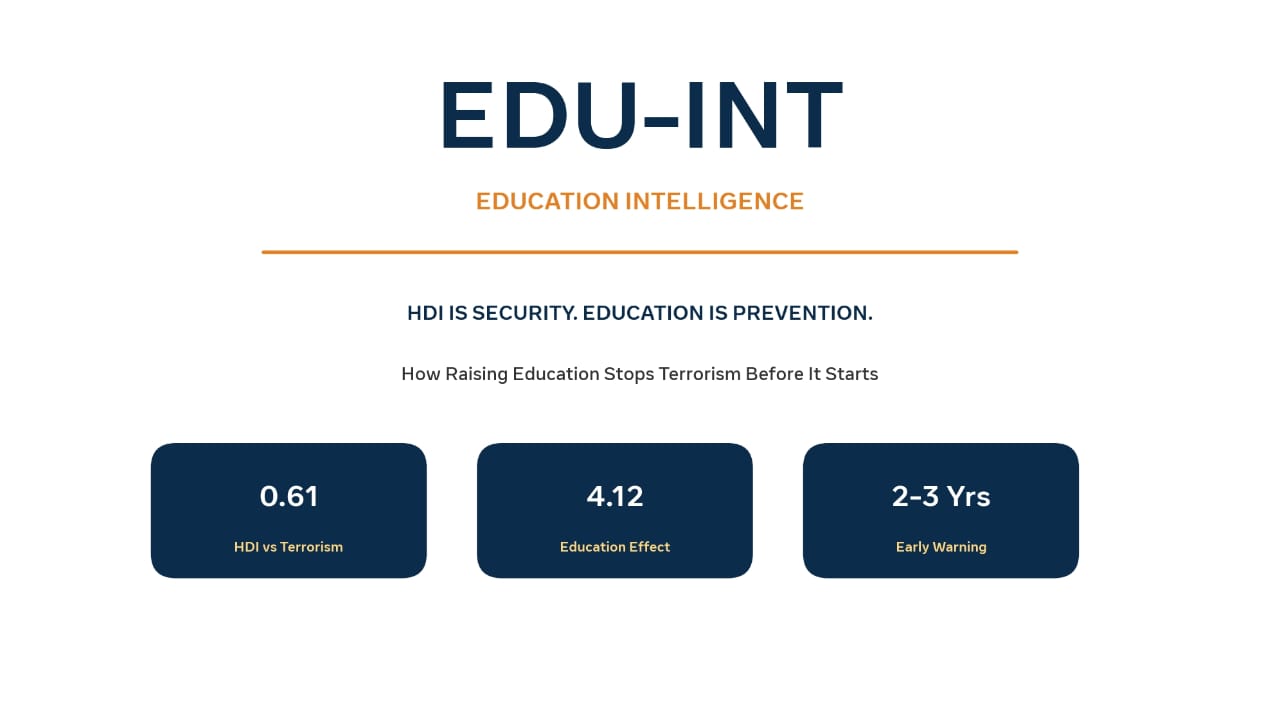
Research on 44 Sub-Saharan African countries (2000-2025, 1,080 country-year observations) proves it: Low HDI predicts high terrorism (r = -0.61). Education is the strongest predictor (coefficient -4.12), stronger than income (-1.95) or health. And education predicts terrorism 2 to 3 years ahead. Military intervention alone does not reduce terrorism. Intervention + education does.
The 12 EDU-INT Indicators — Explained
EDU-INT monitors 12 indicators. Each one is a security signal. Here they are, explained in plain language, with Northern Nigeria and Sahel examples:
1. School Closure Rate
What it is: Percentage of schools closed due to insecurity, teacher flight, or destruction.
Why it is security: A closed school is an open recruitment centre. When a school closes in Borno or Tillabéri, children stay home, idle, angry, and visible to recruiters.
Example: Sahel Region, Burkina Faso: 78% closed (2023). Borno: Over 1,400 schools damaged/destroyed/closed. Zamfara: Over 500 schools affected.
Threshold: GREEN: <5% closed. YELLOW: 5-15%. ORANGE: 15-40%. RED: >40% — Act immediately.
2. Girls’ Secondary School Enrolment
What it is: Percentage of girls aged 12-17 enrolled in secondary school.
Why it is security: Girls in school mean families are stable, early marriage drops, and the whole community resists extremism. When girls drop out, it signals parents have lost faith in the state to protect them. As a Gender and Security scholar, I stress this: Gender is security.
Example: Sokoto: 18%. Zamfara: 21%. Borno: 22%. Gao, Mali: 16%. Tillabéri: 19%. Compare Lagos: 68%.
Threshold: RED if <25%.
3. Mean Years of Schooling (Age 15+)
What it is: Average number of years adults have spent in school.
Why it is security: Low schooling means low critical thinking, low ability to verify propaganda, and low employability. A youth with 2 years of schooling cannot easily question a WhatsApp video from JNIM or ISWAP claiming the state is anti-Islam.
Example: Sahel Region: 1.8 years. Gao: 2.1 years. Borno: 2.8 years. Zamfara: 3.2 years.
Threshold: RED if <3.0 years.
4. Teacher Presence and Retention
What it is: Percentage of teachers present, and teacher-pupil ratio.
Why it is security: When teachers flee, the state has fled. In Northern Nigeria, teachers are targeted for kidnapping. When they leave, the school collapses, and insurgents move in to provide their own madrasas.
Example: Kaduna: Over 1,500 teachers left rural schools (2021-2023). Mopti, Mali: 60% of teachers fled.
Threshold: RED if teacher absence >30% or pupil-teacher ratio >80:1.
5. Youth Unemployment (Age 15-29) / NEET
What it is: Percentage of youth not in education, employment, or training.
Why it is security: This is the economic recruitment indicator. ISWAP offers N500,000 per month, a motorcycle, and a wife. JNIM offers $1,000 and belonging. Bandits offer N500,000 from one kidnapping. If the state offers nothing, the offer from the gun is economic, not just ideological.
Example: Borno youth NEET: 58%. Zamfara: 62%. Tillabéri: 64%. Sahel Region: 67%.
Threshold: RED if >50%.
6. Digital Literacy and WhatsApp Vulnerability
What it is: Ability to verify information, spot fake news, and resist online recruitment.
Why it is security: In low-education zones, WhatsApp and Facebook are the new recruitment grounds. JNIM, ISWAP, and IS Sahel use WhatsApp groups in Hausa, Fulfulde, Bambara, and French. Low education = low digital literacy = high vulnerability.
Example: In Borno and Zamfara, recruiters send voice notes in Hausa claiming “the government has abandoned you, join us.” A youth with 2 years of schooling cannot verify it.
Threshold: RED if <20% of youth can correctly identify a fake message in a test.
7. Child Malnutrition and Food Insecurity (IPC Phase 3+)
What it is: Percentage of children stunted, and households in food crisis.
Why it is security: Hungry children mean desperate parents. Desperate parents accept food from insurgents. ISWAP in Lake Chad provides food, courts, and protection where the state provides nothing. Boko Haram did the same.
Example: Borno: 48% stunting. Diffa, Niger: 52%. Sahel Region: 55%.
Threshold: RED if stunting >40% or IPC 3+ >30%.
8. Primary Healthcare Access (Clinic Functionality)
What it is: Percentage of clinics functional, with staff and drugs.
Why it is security: When clinics close, trust in the state collapses. Al-Shabaab in Somalia provides clinics. ISWAP provides clinics in Lake Chad. When the state fails to provide a clinic, insurgents provide one — and win loyalty.
Example: Borno: Only a fraction of clinics functional after insurgency. Zamfara: 40% of rural clinics closed due to banditry.
Threshold: RED if <40% clinics functional.
9. Displacement (IDPs and Refugees)
What it is: Number of internally displaced persons per 10,000 population.
Why it is security: Displacement breaks social fabric, separates children from schools, and creates camps that are recruitment pools.
Example: Borno: Over 2 million IDPs. Tillabéri: 300,000 IDPs. Mopti: 400,000 IDPs.
Threshold: RED if >5% of population displaced.
10. Child Marriage and Early Pregnancy
What it is: Percentage of girls married before 18.
Why it is security: Child marriage is both a symptom and a cause of insecurity. It signals families have lost faith in school as protection, and are using marriage as protection. It also removes girls from school permanently.
Example: Zamfara: 62% child marriage. Sokoto: 58%. Sahel Region, Burkina Faso: 54%.
Threshold: RED if >40%.
11. Attacks on Education (ACLED / GCPEA)
What it is: Number of attacks on schools, teachers, and students per year.
Why it is security: This is the direct violence indicator. It shows education itself is a target, because insurgents know education is the state’s best weapon.
Example: Nigeria: 200+ attacks on schools (2020-2024). Burkina Faso: 300+ attacks. Mali: 180+.
Threshold: RED if >10 attacks per 100 schools per year.
12. Trust in State Institutions (Afrobarometer)
What it is: Percentage of citizens who trust the government, police, and army to provide security and welfare.
Why it is security: This is the social contract indicator. When trust collapses, citizens welcome coups, as they did in Bamako, Ouagadougou, and Niamey — not because they love military rule, but because civilian rule did not deliver schools, clinics, and security.
Example: In Mali, trust in civilian government fell to 28% before the 2020 coup. In Niger, 62% of youth supported the 2023 coup.
Threshold: RED if trust <30%.
How EDU-INT Works In Practice
Borno: All 12 indicators RED in 2014-2016. Military operation alone cleared territory, but without EDU-INT, Boko Haram returned. EDU-INT says: Reopen schools, rebuild clinics, create jobs — that is security.
Zamfara: EDU-INT explains banditry the same way. School closures due to kidnapping → teachers fled → youth NEET 62% → bandits offered money → trust collapsed → banditry became a parallel state. EDU-INT says: You cannot shoot banditry out of Zamfara if you do not school Zamfara out of banditry.
Sahel Corridor — Gao, Tillabéri, Sahel Region: These three form one corridor, one language (Fulfulde, Bambara), one recruitment pool. When schools closed in Gao, children crossed to Tillabéri. When they closed in Tillabéri, they crossed to Sahel Region. EDU-INT says: Do not treat them as three countries. Treat them as one EDU-INT Corridor, with joint schools, joint teachers, joint digital literacy.
Why AU and ECOWAS Missed It
The AU’s Continental Early Warning System (CEWS) monitors 45 indicators. Zero are EDU-INT indicators.
ECOWAS’s ECOWARN also has zero EDU-INT indicators. The ECOWAS Conflict Prevention Framework mentions HDI zero times. The AU’s Silencing the Guns Roadmap mentions HDI zero times and military 32 times.
That is why they were surprised by coups. They were watching protests. They were not watching schools closing 12 to 24 months earlier.
EDU-INT would have warned them. EDU-INT is the missing layer.
What EDU-INT Proposes for Northern Nigeria and the Sahel
1. For Nigeria (Federal and State Governments):
Create an EDU-INT Unit in the Office of the National Security Adviser, linked to Federal Ministry of Education and Defence. Publish a Monthly EDU-INT Bulletin with a RED / ORANGE / YELLOW / GREEN map for all 774 LGAs. If an LGA is RED for 3 months, trigger automatic action: school protection, teacher deployment, girls’ scholarships, youth jobs.
2. For ECOWAS:
Add EDU-INT as Component 15 to the ECOWAS Conflict Prevention Framework. Publish ECOWARN EDU-INT Bulletin. Offer a $2 billion HDI Compact to Sahel states — schools, clinics, jobs — not just sanctions.
3. For AU:
Create a Joint EDU-INT Unit in CEWS (Addis Ababa). Allocate 40% of AU Peace Fund to EDU-INT in RED regions. Merge Silencing the Guns with Investing in People.
4. For Communities, Parents, and Religious Leaders:
Protect schools. Report closures. Demand girls’ education. Teach children to verify WhatsApp messages. A school that stays open is a barrack that does not need to be built. An Imam or Pastor who preaches education is a security officer.
Conclusion: HDI Is Security. Education Is Prevention.
Northern Nigeria and the Sahel do not need more guns alone. They need more teachers, more classrooms, more girls in school, more clinics, and more jobs.
We cannot shoot our way out of a problem that schooling would have prevented. We cannot sanction our way out of a problem that teachers would have solved.
EDU-INT is not a slogan. It is a system. Monitor the 12 indicators. Act when they turn RED. Prevent conflict before it erupts.
HDI is security. Education is prevention. EDU-INT is the way.
About the Author:
Dr. MS Abubakar holds a PhD in Education and a PhD in Military Studies, and is currently pursuing a PhD in Gender and Security Studies at the African Advanced Center for Gender and Security Studies. He is the Founder of EDU-INT (Education Intelligence). His research covers 44 Sub-Saharan African countries (2000-2025) and focuses on Northern Nigeria, the Sahel, Lake Chad Basin, and Cabo Delgado.
© EDU-INT 2026. All Rights Reserved. The author owns full rights to the EDU-INT concept and article. Reproduction with credit to EDU-INT is permitted.
Sources for fact-checking: UNICEF Education Under Attack (2023), UNESCO Sahel Education (2023), GCPEA Education Under Attack (2024), ACLED (2024), Afrobarometer (2023), UNDP Human Development Report (2024), Institute for Economics and Peace Global Terrorism Index (2024).
