


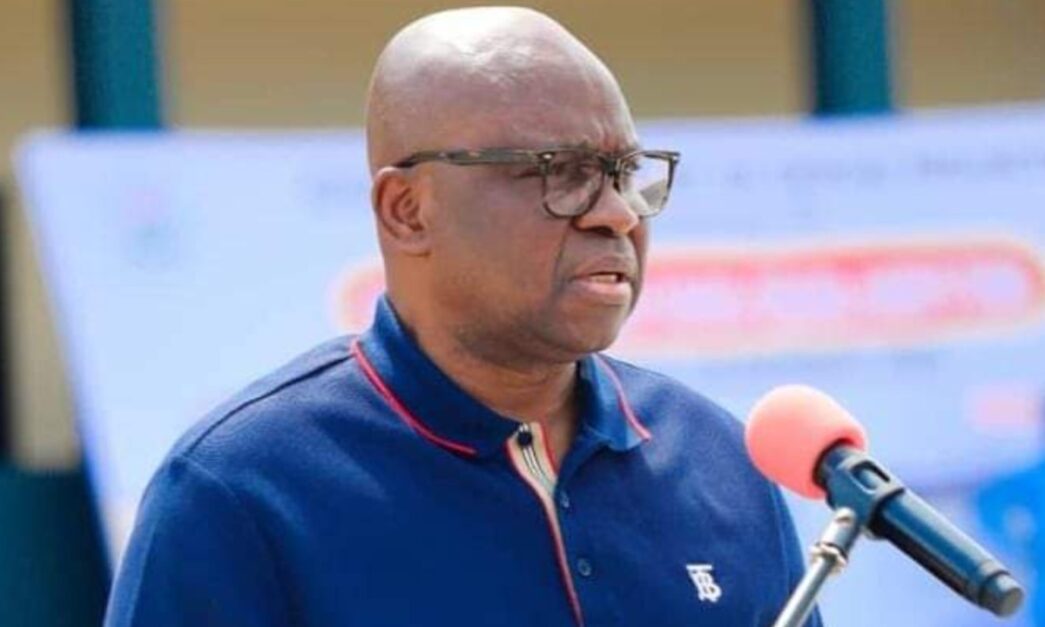
Fayose Links Obasanjo’s Attack on Tinubu to Failed Governorship Bid for Daughter
By Matthew Eloyi
The frosty relationship between former President Olusegun Obasanjo and President Bola Tinubu may have taken a new dimension following allegations by former Ekiti State Governor, Ayodele Fayose, that the former president’s criticism of the current administration was triggered by the rejection of his daughter’s governorship ambition in Ogun State.
Fayose, who made the allegation during an interview on TVC on Monday, claimed that Obasanjo had initially enjoyed a cordial relationship with Tinubu but turned against the President after an alleged attempt to secure political support for his daughter, Iyabo Obasanjo, to become governor of Ogun State failed.
The former Ekiti governor was responding to questions about growing criticism of the Tinubu administration, particularly Obasanjo’s recent assessment that the President’s economic reforms had made Nigerians poorer by 300 per cent.
In his characteristic blunt manner, Fayose dismissed the former president’s criticisms, describing him as someone who craves attention and struggles to acknowledge the achievements of others.
According to him, Obasanjo has a history of falling out with successive administrations whenever their leaders fail to defer to his political influence and expectations.
“We are overrating Obasanjo. That is the truth. It is a style. Nobody gets it done better than Obasanjo in life. If anybody wants to talk, it is either Obasanjo or nobody,” Fayose said.
“Obasanjo still wants attention and he sees no good in no one. That is the truth. If you look at Obasanjo, he criticised Yar’Adua and Jonathan.
“In fact, he made himself an enemy of Jonathan. The moment he does not follow a day-to-day taking of permission from him, Obasanjo becomes uncomfortable.”
Fayose argued that Obasanjo’s political disposition was not new, recalling how the former president had criticised the administrations of the late Umaru Musa Yar’Adua and Goodluck Jonathan, despite having played significant roles in the political environment that produced them.
However, his most striking allegation centred on the events surrounding Tinubu’s visit to Ogun State in April 2026 for the inauguration of the Gateway International Cargo Airport.
According to Fayose, Obasanjo was among those who received the President during the visit, appearing in a matching outfit with Tinubu and speaking favourably about him.
He claimed that the former president’s warm reception of Tinubu was not necessarily an endorsement of the administration but part of an alleged political calculation aimed at securing the President’s support for Iyabo’s governorship ambition.
Fayose alleged that Obasanjo had approached former Ogun State Governor, Olusegun Osoba, to help persuade Tinubu to support his daughter’s aspiration to govern the state.
“You know Iyabo Obasanjo, Obasanjo’s daughter. Obasanjo went to Chief Aremo Olusegun Osoba to help him beg Tinubu so that Iyabo Obasanjo will become governor of Ogun state,” he said.
“That was the reason Obasanjo came to welcome President Tinubu.
“The moment that did not work. Obasanjo simply remembered what Osoba wrote about him in his book and went to reply to him because what he wanted did not fly.
“He will go and be begging behind the scene, when he does not get it, he will attack you.”
The allegation, if viewed against the backdrop of Nigeria’s intricate political relationships, offers another explanation for the apparent shift in Obasanjo’s attitude towards Tinubu. However, Fayose’s claims remain allegations and have not been independently established.
The development is particularly interesting given the longstanding rivalry between Fayose and Obasanjo. Their relationship has been characterised by public disagreements, personal attacks and counter-accusations spanning several years.
Indeed, the two politicians have rarely missed an opportunity to exchange verbal blows, making Fayose’s latest intervention part of a much longer history of political antagonism.
Meanwhile, Iyabo Obasanjo had emerged as one of the prominent governorship hopefuls in Ogun State under the platform of the All Progressives Congress (APC).
She declared her interest in the governorship race in February 2026, raising expectations about her possible return to frontline politics. However, her ambition was subsequently put on hold after the APC adopted Senator Solomon Adeola as its consensus candidate for the 2027 governorship election.
Her decision to suspend the ambition came amid the party’s efforts to settle on a preferred candidate ahead of the election.
Whether Obasanjo’s reported political disappointment has anything to do with his subsequent criticism of Tinubu remains a matter of speculation. But Fayose’s intervention has added a fresh political dimension to the debate over the former president’s relationship with the current administration.
Beyond the allegations, the episode once again highlights how personal relationships, political expectations and succession calculations continue to shape alliances and rivalries within Nigeria’s political establishment.
