


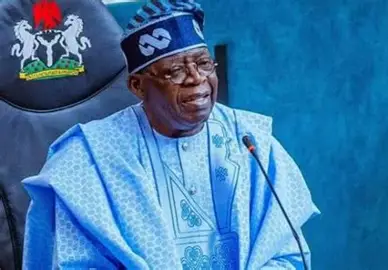
Hunger, Anger, and the Pelting of a President
By Jerry Adesewo
The incident involving President Bola Tinubu’s convoy in Abuja may have lasted only moments, but the images, official denials, police confirmation, and the subsequent release of 78 suspects have raised a deeper question: how far has the distance between Nigeria’s political leadership and its struggling citizens widened?
There is something deeply symbolic about what happened outside the Shehu Shagari Central Mosque in Garki, Abuja, on Friday, November 13. A President had gone to observe Jumu’ah prayers, an occasion that ordinarily brings people together in worship, reflection, and fellowship. Yet, as his convoy prepared to leave, sections of the crowd reportedly turned their displeasure towards him. There were angry chants, jeers, and, according to the police, stones and other dangerous objects thrown at the departing motorcade.
READ ALSO: When Rats Befriend the Snake
The incident was remarkable not simply because President Bola Tinubu was at the centre of it, but because of what it appeared to communicate: a growing impatience among sections of the population with the government and the conditions under which they are living.
The Presidency initially pushed back against reports of an attack. Presidential aide O’tega Ogra dismissed the circulating accounts as a narrative being promoted by the opposition and shared footage showing the President leaving the mosque. Other presidential officials also disputed the reports. But the matter did not disappear with the denial. Videos circulated, eyewitness accounts emerged, and on November 16, the FCT Police Command issued a statement confirming that the President’s departing convoy had been attacked with stones and other dangerous objects. Several vehicles were reportedly damaged, and some security operatives were injured.
The distinction is important: available reports establish that the convoy was attacked but do not establish that the President himself was struck or injured. Still, the official confirmation made it difficult to dismiss the incident as merely an opposition fabrication.
But perhaps the more important question is not whether a stone reached the President’s vehicle. It is why a presidential convoy, leaving a place of worship in the nation’s capital, encountered such open hostility.
An eyewitness account published by Premium Times attributed some of the anger to the security arrangements surrounding the President’s visit. Worshippers were reportedly prevented from entering the mosque after his arrival, while roads were blocked and some people were held back from leaving until the convoy departed. Chants of “Ba ma yi, ba ma so” and “Tinubu Must Go” reportedly followed.
That explanation deserves attention. It suggests that the immediate confrontation may have been triggered partly by the experience of ordinary worshippers whose movement and access to their place of worship were restricted. Yet the wider political and economic environment cannot be ignored.
Nigeria is going through a difficult period. For millions of households, the cost of food, transportation, housing, education, and healthcare has made everyday survival an increasingly demanding exercise. Families are adjusting meals, postponing essential purchases and struggling to make incomes stretch further. Small businesses are contending with rising operating costs, while young people continue to confront the frustrations of unemployment and limited opportunities.
The anger of a hungry citizen is not always expressed in a policy paper, a newspaper editorial, or a carefully organised protest. Sometimes it appears in a chant, a refusal to cheer, an angry confrontation, or an unplanned public outburst. This does not mean that every angry crowd represents the entire country, or that every act of hostility can be justified by economic hardship. It does mean that political leaders should pay attention when public frustration becomes visible in unexpected places.
The response to the incident has introduced another dimension. The FCT Police Command announced that 78 people had been arrested in connection with the attack, following an initial security response and subsequent intelligence-led operations. Yet, in a surprising turn, the Presidency directed that the suspects be warned and released after President Tinubu extended clemency to them. The police subsequently confirmed that arrangements for their release were underway.
The decision may be interpreted as an act of restraint, but it also raises questions. Who were the 78 people? Were all of them directly involved in the incident? What evidence connected each individual to the attack? Were some arrested during subsequent raids rather than at the scene? The public deserves answers, particularly where such a large number of citizens have been taken into custody.
There is also a lesson for the Presidency in the handling of the incident. Government communication must be guided by candour. When an event occurs, and official voices rush to dismiss it, only for the police to confirm substantially the same incident days later, public confidence suffers. A government cannot demand trust while appearing reluctant to acknowledge uncomfortable realities.
Equally, citizens must understand that dissatisfaction does not confer a licence for violence. Throwing objects at a presidential convoy, damaging vehicles, or injuring security personnel is dangerous and unacceptable. The right to protest and express displeasure must be exercised peacefully. A democracy must protect both the right of leaders to move securely and the right of citizens to express their grievances without intimidation.
But the larger message should not be lost in arguments about stones, videos, and political propaganda. A President should not need to encounter a hostile crowd before recognising the depth of public anxiety. Nor should a government mistake the absence of street protests for evidence of public satisfaction.
The mosque incident was more than a security embarrassment. It was a moment that exposed the fragile relationship between power and public sentiment. The chants may have come from a section of the crowd, and the immediate trigger may have been the security restrictions, but the national conversation they have provoked is much bigger.
A government that listens only to applause may eventually be surprised by anger. The challenge before President Tinubu is to listen beyond the noise, confront the economic pressures confronting households, and demonstrate through policy and action that the sacrifices Nigerians are making are not being ignored.
A stone thrown at a presidential convoy may damage a vehicle. But the anger behind it, if left unaddressed, can damage something far more important: the trust between a government and the people it governs, which I believe is already the case.