

Yet Another Feather to the Many Caps of TY Buratai
By Jerry Adesewo
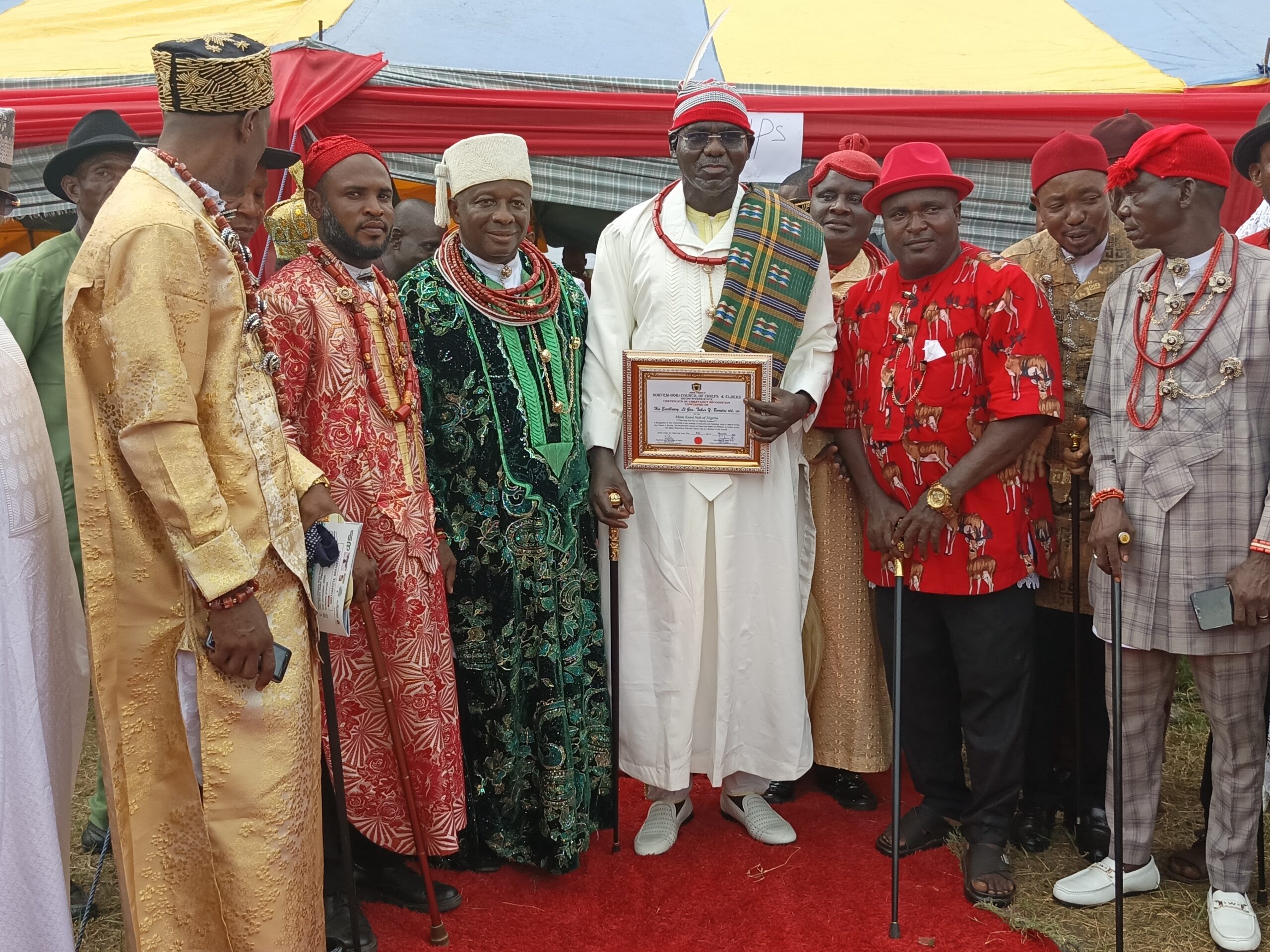
The former Chief of Army Staff, Lieutenant General Tukur Yusuf Buratai (rtd), CFR, has added another traditional honour to his growing collection of titles, following his recognition by the Nortem Bori Council of Chiefs and Elders in Rivers State on Saturday, November 21, 2026.
For a man whose public life has taken him from the barracks to the highest levels of military command, diplomacy, and national service, the honours continue to come from an increasingly diverse range of communities and institutions.
READ ALSO: Jimmy Odukoya Remaining a Pastor: What Happened to the Woke?
The latest chieftaincy recognition, which brings the number of traditional titles conferred on him to 17, is another addition to a remarkable collection of honours accumulated over the years. It also offers an interesting glimpse into how communities across Nigeria recognise individuals whose careers and public engagements have extended beyond their immediate ethnic and geographical backgrounds.
The ceremony brought Buratai into the cultural setting of the Ogoni people, where traditional authority remains an important expression of identity, heritage, and communal belonging. For Buratai, the honour is more than an addition to an already impressive list of titles. Traditional titles carry a particular significance in Nigerian society. They are often expressions of a community’s appreciation, a symbolic acceptance into its cultural fold, and an acknowledgement of an individual’s relationship with its people.
Speaking at the investiture, the former military tactician expressed profound gratitude to HRM King Sir Lenu Tsaro-Igbara and the people of the Nortem Bori Community for finding him worthy of the recognition. Clearly caught by surprise, Buratai said he had arrived at the occasion simply as Chairman of the event, without anticipating that he would leave with a traditional title.
“I am honoured. I am humbled. I came here only as the Chairman of this occasion, but here I am, returning as a decorated Chief,” he remarked, describing the honour as an unexpected but deeply appreciated gesture. He also recalled his years of military service in Port Harcourt, during which he developed enduring relationships with communities in Rivers State. He disclosed that he had previously been offered two other chieftaincy titles in the state, both of which he had accepted, although he was yet to receive them formally.
The fact that the recognition comes from an Ogoni traditional institution is particularly noteworthy. Nigeria’s traditional landscape is rich in distinct histories, customs, and systems of authority. To be recognised by a community outside one’s immediate cultural background speaks to the capacity of traditional institutions to acknowledge service and build relationships across ethnic boundaries.
Buratai’s public career has provided several platforms for such engagement. As Chief of Army Staff from 2015 to 2021, he occupied one of the most consequential positions in Nigeria’s military establishment during a period marked by significant security challenges. His subsequent diplomatic appointment as Ambassador to the Republic of Benin extended his public service into international relations.
Beyond these formal responsibilities, his continued engagement with traditional rulers, cultural institutions, and community leaders has helped broaden his public profile. The growing number of traditional titles he has received suggests that his recognition is no longer confined to the military and political spaces in which much of his career was built.
Yet, traditional honours are not simply trophies to be displayed. They come with expectations, however symbolic, of respect for the culture, values, and aspirations of the people conferring them. A title is most meaningful when it strengthens the relationship between its recipient and the community and when the recognition translates into continued interest in the welfare and development of the people.
For the Northern Bori Council of Chiefs and Elders, the conferment is an opportunity to identify with a distinguished Nigerian and acknowledge his place within its traditional community. For Buratai, it is an invitation to deepen that relationship and appreciate the cultural heritage represented by the title.
There is also a broader national significance in such recognitions. At a time when ethnic divisions and questions of identity frequently dominate public discourse, traditional institutions can serve as important bridges of cultural understanding. Their ability to honour individuals from different parts of the country reinforces the idea that national belonging can be built through mutual respect, service, and shared responsibility.
Seventeen traditional titles are certainly a remarkable collection. But the more enduring value of each honour will depend on the relationship it establishes and the legacy it encourages its recipient to sustain.
For the former Army Chief, the latest recognition from the Nortem Bori Council of Chiefs and Elders is yet another feather in his many caps. More importantly, it is a reminder that beyond military ranks, official appointments, and public positions, the enduring currency of leadership is the regard in which a person is held by people and communities.
And in a country as culturally diverse as Nigeria, that recognition, when genuinely earned, remains an honour worth cherishing.