


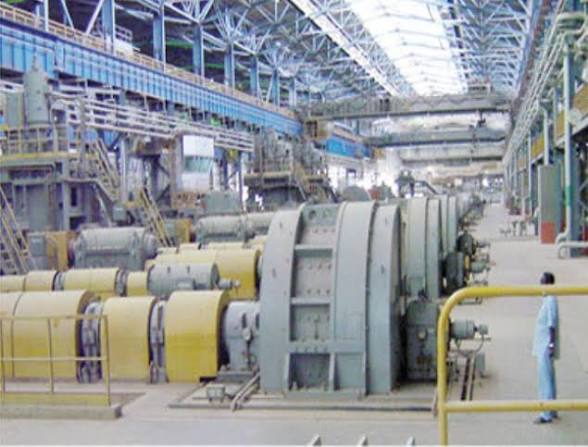
Ajaokuta Is Not an Economic Puzzle – It Is a Managerial Failure in the Digital Age
By Professor Ojo Emmanuel Ademola
When economists project that the privatisation of Ajaokuta Steel Company could add over $115 billion to Nigeria’s Gross Domestic Product and create tens of thousands of jobs, the numbers understandably capture public attention. In a country long desperate for industrial revival, such figures sound like salvation. Yet figures, however impressive, only skim the surface of a much deeper crisis. The prolonged failure of Ajaokuta is not fundamentally an economic mystery; it is a managerial collapse, aggravated by decades of weak governance and an inability to adapt to the realities of the Digital Age.
READ ALSO: Remodeled Osogbo stadium to have 15,000 sitting capacity – Gov Adeleke
As the first African Professor to be awarded Chartered Manager status, my engagement with Ajaokuta’s story is neither ideological nor sentimental. It is professional. For over four decades, Nigeria has poured billions into a steel complex that has produced ambition, litigation and disappointment, but not steel. The reflexive prescription has always been the same: more funding, new ownership, fresh political promises. What has remained curiously absent is a rigorous interrogation of how leadership, management capability and institutional design have consistently failed this project.
Why Money Has Never Been the Problem
Ajaokuta stands as perhaps the clearest illustration of a truth many governments struggle to accept: capital does not create value; management does. Nigeria began funding this project in the 1970s, when revenues were plentiful and national confidence was high. By the early 1990s, the complex was described as being near completion, yet decades later it remains idle. This is not because the country lacked financial commitment, but because it lacked a management system capable of translating investment into execution.
Economics alone cannot explain why successive administrations retained bloated payrolls for a non-producing enterprise, why boards were frequently reshuffled without accountability, or why operational goals were rarely measured, let alone achieved. These are not fiscal failures. They are failures of professional management discipline.
The Digital Age Nigeria Ignored
Another uncomfortable reality is that Ajaokuta has remained conceptually frozen in the industrial logic of the twentieth century. It was designed for an era of centralised planning, analogue processes and politically mediated decision-making. Modern steel production, by contrast, is defined by digitised operations, real-time data analytics, integrated supply chains and predictive maintenance systems. Industrial relevance today depends as much on information architecture as on furnaces and ore.
Nigeria’s policy debate has largely ignored this shift. Attempts at revival still speak the language of physical completion and ownership transfer, while neglecting digital transformation. Without a deliberate transition into Industry 4.0 practices, reviving Ajaokuta in its existing managerial form would merely reactivate an obsolete industrial model, incapable of competing regionally or globally.
Governance Failure Disguised as Industrial Policy
International experience shows that state‑owned enterprises do not fail simply because the state owns them. They fail when governance is weak, boards are politicised, performance incentives are absent and transparency is optional. Ajaokuta fits this pattern perfectly. Ownership was never clearly separated from regulation. Management contracts lacked measurable outcomes. Consequences for failure were virtually non‑existent.
Each collapse was blamed on changing governments, external conspiracies or technical complexity. Rarely was the question asked: who, exactly, was accountable for delivery? In professional management terms, the answer was almost always nobody. Where everybody is in charge, nobody truly is.
The deeper tragedy is that Ajaokuta became a symbol of institutional evasion—an enterprise where responsibility was endlessly transferred but never accepted. Instead of a disciplined governance framework, it operated on shifting political loyalties and episodic interventions. No strategic continuity, no performance culture, no independent oversight. The result was predictable: chronic underperformance masked by optimistic rhetoric. Until accountability is structurally embedded, competence is prioritised over patronage, and governance is insulated from political turbulence, Ajaokuta will remain a case study in how not to run a national asset.
The Risks of Privatisation Without Management Reform
Advocacy for privatisation, while understandable, carries its own dangers if pursued uncritically. Nigeria’s history contains ample evidence that poorly designed privatisation merely transfers public failure into private stagnation. Without strong contractual governance, robust performance metrics and enforceable leadership standards, privatisation risks becoming an exit strategy rather than a reform strategy.
Selling an asset does not automatically confer managerial competence on its buyer. Nor does it ensure long‑term national value. In the absence of professional management standards, transparent oversight and digital performance tracking, even private operators can underperform while extracting rents from the system.
The hard truth is that privatisation is not a magic wand; it is a governance instrument that succeeds only when discipline, accountability and regulatory clarity are non‑negotiable. Where institutions are weak, privatisation can entrench monopolies, deepen inefficiencies and create new centres of unregulated power. Nigeria has witnessed cases where assets were sold without clear turnaround plans, resulting in operators who lacked both the capital and the competence to deliver. Reform must therefore be anchored on capability, not ideology. Without a performance‑driven framework, privatisation risks becoming a recycling of failure under a different name.
A Chartered Manager’s Lens on What Must Change
From a Chartered Fellow perspective, the debate about Ajaokuta needs urgent reframing. The central issue is not whether the project should be publicly or privately owned, but whether it can be competently governed in the Digital Age. That competence rests on leadership standards, not slogans.
Any credible revival must begin with professionalised governance structures, where board appointments are based on skills rather than politics. Management contracts should be explicitly tied to digitally verified performance indicators. Operational processes must be redesigned for automation, data integration and efficiency. Critically, leadership must be accountable to outcomes, not intentions.
Steel production is not merely a manufacturing activity; it is an ecosystem. Mining, energy, transport, defence, construction and export markets are all interconnected. Managing such complexity requires systems thinking, not siloed administration. Without this integrated approach, even a functioning plant would struggle to sustain relevance.
The deeper challenge is that Ajaokuta cannot be revived with analogue governance in a digital economy. Modern industrial competitiveness depends on real‑time data visibility, predictive maintenance, transparent supply‑chain coordination and leadership capable of interpreting complex operational intelligence. Nations that run successful steel ecosystems do so through disciplined governance, digital integration and relentless performance management. Unless Nigeria embraces this standard, ownership debates will remain a distraction from the real issue: governance capacity determines destiny.
The Question Nigeria Must Finally Answer
After forty years of failure, Nigeria must confront a more uncomfortable question than whether Ajaokuta should be privatised. Does the country now possess the managerial maturity required to operate complex industrial systems in a digitally driven global economy? Until this question is answered honestly, reform efforts will remain cosmetic.
Ajaokuta has become a mirror, reflecting not a lack of resources, but a deficit of leadership capability and institutional seriousness. Industrialisation is not achieved by pouring concrete or signing concession agreements. It is achieved by building management systems strong enough to endure political change, technological disruption and economic uncertainty.
The uncomfortable reality is that no nation industrialises beyond the quality of its governance architecture. Steel plants do not fail because machines are old; they fail because the leadership frameworks are weak, decision‑making is reactive, and accountability is negotiable. Ajaokuta exposes a deeper national challenge: the absence of a disciplined, performance‑driven culture capable of managing large‑scale, high‑complexity enterprises.
Until Nigeria develops leaders who can integrate technology, strategy, operations and long‑term planning—supported by institutions that reward competence rather than proximity to power—Ajaokuta will remain a monument to unrealised potential rather than a catalyst for national transformation.
Conclusion: Management Is the Missing Infrastructure
Nigeria often speaks of infrastructure as roads, power and factories. Yet the most critical infrastructure of all is management capability. Without it, physical assets decay and investments evaporate.
Ajaokuta’s story should therefore serve not as a cautionary tale about economics, but as a national lesson on leadership. Until Nigeria treats professional management as a public good and a strategic priority, industrial dreams will continue to rust, no matter how many billions are announced on paper.
By Professor Ojo Emmanuel Ademola is the irst African Professor of Cybersecurity and Information Technology Management, Global Education Advocate, Chartered Manager, UK Digital Journalist, Strategic Advisor & Prophetic Mobiliser for National Transformation, and General Evangelist of CAC Nigeria and Overseas