

Inside the $1.35 Billion Refinancing Deal to Boost Local Fuel Supply, Job Creation and Economic Stability

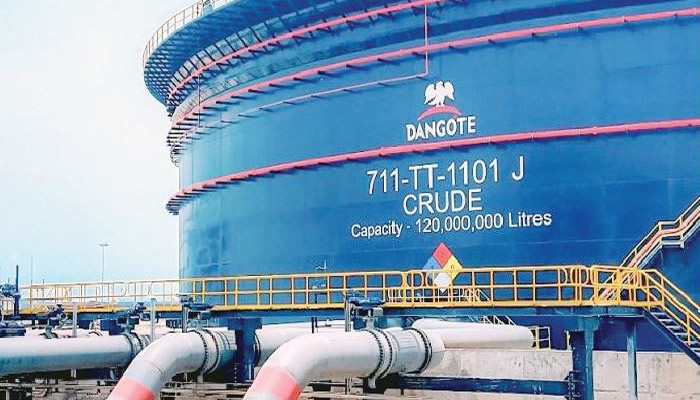
Inside the $1.35 Billion Refinancing Deal to Boost Local Fuel Supply, Job Creation and Economic Stability
Jerry Adesewo
In a move expected to strengthen Nigeria’s energy security and stimulate economic development, the African Export-Import Bank (Afreximbank) has signed a $1.35 billion financing facility with Dangote Industries Limited (DIL) as part of a broader $4 billion syndicated refinancing package for the 650,000 barrels-per-day Dangote Petroleum Refinery and Petrochemicals Complex.
This major financial injection is poised to ease the burden of operational costs, improve supply of refined petroleum products, and significantly impact both domestic markets and the broader African economy. Experts say the deal marks a shift toward Africa-led infrastructure financing, with far-reaching consequences for fuel availability, foreign exchange stability, and job creation.
READ ALSO: A Week of Impact: Dangote Steps Up for Food Security in Niger and Ogun States
The Dangote Refinery, located in Ibeju-Lekki, Lagos, is the largest single-train refinery in the world and has already begun operations as of February 2024. With this latest deal, its production capacity is expected to stabilize and expand, potentially reducing Nigeria’s overdependence on imported refined fuel.
Relief at the Pump: Domestic Market Stands to Benefit
The agreement, signed last week, comes at a crucial time for Nigerians, who have been burdened by fluctuating fuel prices and recurrent supply shortages. With the financing now bolstering the refinery’s operations, the availability of locally refined petrol, diesel, aviation fuel, and other products is expected to increase in the coming months.
“This is a game-changer,” said an industry analyst. “If implemented effectively, this will drastically cut Nigeria’s import bill, stabilise pump prices, and improve energy availability for homes and industries.”
Aliko Dangote, President and CEO of DIL, echoed this sentiment. “This refinancing strengthens our balance sheet and accelerates the refinery’s supply of high-quality petroleum products across Africa,” he stated.
Local Jobs and Industrial Growth
Beyond stabilising fuel supply, the deal is expected to drive employment and industrial growth. The refinery, when operating at full capacity, is projected to support over 100,000 direct and indirect jobs. The renewed financing means contractors, suppliers, and transporters—many of whom are Nigerian—will see increased demand, while ancillary industries such as petrochemicals and logistics will receive a much-needed boost.
The Chairman, Editorial Board of OurNigeria News, Sir. AK Peters noted, “With steady and more affordable fuel, manufacturers can finally plan production cycles with confidence. This means more output, more jobs, and fewer layoffs.”
Africa Financing Africa: A Paradigm Shift
Described as one of the largest syndicated deals in recent African financial history, the facility was led by Afreximbank, which contributed the largest tranche of $1.35 billion. Its President and Chairman, Prof. Benedict Oramah, described the agreement as more than a financial arrangement—it is a statement of African ownership and resilience.
“With this landmark deal, we once again demonstrate that Africa’s development can only be meaningfully financed from within,” Oramah said. “We are enhancing the capacity of the Dangote Refinery to produce and supply high-quality refined petroleum products to Nigeria, the continent, and the world.”
The involvement of multiple African and global financial institutions in the syndication reflects growing confidence in local industrialisation and Dangote’s leadership in reshaping the continent’s energy landscape.
Foreign Exchange Stability and Regional Trade
The refinery’s improved output also has implications for Nigeria’s foreign exchange market. With less money spent on importing refined products, the naira is expected to gain some stability. Exporting refined goods to neighbouring African nations could further strengthen Nigeria’s trade balance and create new trade routes under the African Continental Free Trade Area (AfCFTA).
Economic commentator Nasir Mahmoud noted, “We are not just talking about fuel availability. This will free up billions of dollars previously used to import refined petrol. That’s money that can now go into education, health, and infrastructure.”
Hope on the Horizon
The announcement has been met with cautious optimism among ordinary Nigerians, who have endured months of fuel scarcity, inflation, and energy rationing.
“It’s been tough lately with fuel prices fluctuating and blackouts. If this refinery can really change that, then we support it,” said, Prince Anayochukwu Onukhagha, an Abuja based school administrator.
For Dangote Industries, this deal is not just about balance sheets—it is about legacy. “Our shared vision is to industrialize Africa from within,” Dangote affirmed. “We’re ready to deliver lasting impact.”
As the refinery ramps up toward full capacity and its operations stabilise under this new financing, many will be watching to see whether this landmark agreement truly translates to better days for ordinary Nigerians—and a step closer to energy sovereignty for Africa.
Inside the $1.35 Billion Refinancing Deal to Boost Local Fuel Supply, Job Creation and Economic Stability