


Maga, Papiri: Two Abductions And the Christian Genocide Debate
By Jerry Adesewo
The ink on the Maga abduction was barely dry when Papiri happened, right in the midst of the Christian genocide debate that has drawn the attention of the world to Nigeria.
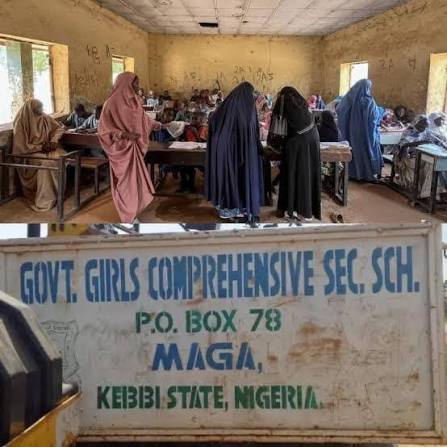
In the early hours of Monday, November 17, gunmen stormed Government Girls Comprehensive Secondary School in Maga, Kebbi State, killing the vice principal and abducting 25 schoolgirls from their dormitory. Four days later, between 2:00 a.m. and 3:00 a.m. on November 21, terrorists invaded St. Mary’s School, a Catholic boarding school in Papiri community, Agwara Local Government Area of Niger State, and kidnapped an as-yet unconfirmed number of students and staff.
READ ALSO: Soyinka Slams Trump: “Guns-A-Blazing Isn’t the Way”
These two incidents—Maga and Papiri—are already being folded into a larger, emotionally charged question: are Christians in Nigeria facing a form of genocide?
This is not an abstract debate. It is unfolding against the backdrop of grieving parents, traumatised students, and communities who had assumed that boarding school should be a place of safety, not a frontline.
A Fresh Abduction, Not a Recycled Story
One of the more disturbing side-notes of the Papiri attack has been confusion in public discourse. Some early commentary tried to frame the Papiri incident as a recycled story from 2021, another case of “old news being pushed as new.”
The facts say otherwise.
Daily Trust, Premium Times, and several other outlets all confirm that the Papiri attack occurred in the early hours of Friday, November 21, 2025, at St. Mary’s School, a Catholic institution in Niger State. Local church sources and Niger State officials confirm that the school is still compiling the list of missing students and staff.
In other words, Papiri is not a ghost of the past. It is fresh blood on an already stained map. That freshness matters because it places the abduction in direct conversation with Maga—and together they sharpen the Christian genocide debate.
Maga and Papiri: Different Profiles, Same Fear
On paper, the Maga and Papiri attacks are part of a broader pattern of mass kidnappings in northern Nigeria, often attributed to “bandits” and other armed groups whose motives range from ransom to territorial domination.
But there are crucial differences in how they are perceived.
In Maga, 25 schoolgirls were abducted and the vice principal killed during a pre-dawn raid on a government girls’ secondary school. Some sources indicate that most of the abducted girls are Muslim, complicating any simple narrative that this particular attack was targeted at Christians as Christians.
In Papiri, the target was a clearly identifiable Christian institution: St. Mary’s School, a Catholic boarding school. The symbolism is unmistakable: terrorists walked into a Catholic school in the dead of night and took children and staff away. For many Christian observers, this is not just “banditry”; it is a message.
When you place these two incidents side by side, the Maga abduction feeds into the broader crisis of insecurity in northern Nigeria, while the Papiri abduction plugs directly into longstanding fears that Christian spaces—churches, seminaries, Christian schools—are being singled out.
Why “Christian Genocide” Is on the Table
The phrase “Christian genocide” is not neutral. It implies a deliberate, organised intent to destroy a religious group, in whole or in part. Yet for many Nigerian Christians—especially in the Middle Belt and parts of the North—this is precisely how the pattern of violence feels.
They point to:
– Repeated attacks on churches and Christian-majority communities.
– Mass killings and displacements in parts of Plateau, Benue, Southern Kaduna and elsewhere.
– Waves of kidnappings targeting priests, pastors and Christian schoolchildren.
– A state that appears either unwilling or unable to protect them.
The Maga and Papiri abductions are therefore not seen in isolation; they are read against years of cumulative trauma. In that context, Papiri is particularly explosive: terrorists did not just attack “a school,” they attacked a Catholic school, in a state where Christian communities already feel precarious.
The fact that the Papiri abduction came just days after Maga, and in the same week that more than 50 schools were reportedly shut down in parts of Kwara State because of bandit attacks, only deepens the sense of siege.
State Response: Security Crisis or Faith Crisis?
The Nigerian government has been eager to frame these incidents as part of a broader security challenge rather than a religious war. Federal and state officials repeatedly attribute such attacks to criminal gangs and terrorists motivated by money and power, not theology. Rescue operations have been announced; the president even postponed foreign trips to coordinate security responses after the Maga abduction.
But for many Christians, perception is now outrunning official explanations.
When terrorists can storm a girls’ school in Maga, abduct 25 children, and then just days later attack a Catholic school in Papiri with apparent ease, the message that filters down to ordinary people is simple: Christian communities, Christian children, Christian institutions are not safe—and the state cannot guarantee their protection.
That perception is fuelled not only by the attacks themselves, but by the slow pace of rescues, the opacity around casualty and victim data, and a long history of impunity in similar cases.
The Complexity We Cannot Ignore
Analytically, calling what is happening in Nigeria “genocide” requires more than outrage. Under international law, genocide demands proof of specific intent to destroy a religious, ethnic, or national group. In a mixed landscape of jihadist insurgency, banditry, herder–farmer conflicts, ransom economics and state failure, intent is notoriously hard to pin down.
Maga illustrates this complexity sharply: if most of the victims there are Muslim girls, then the attack, however horrific, does not neatly fit into a narrative of exclusively anti-Christian violence.
Yet Papiri, and a long chain of attacks on Christian communities, pull the argument in the opposite direction. For those who use the word “genocide,” the key is not that every attack is anti-Christian, but that a disproportionate share of severe, uncompensated, and unpunished violence falls on Christian communities, and that this is happening in a context of rising radicalisation and weak state response.
The truth is likely more layered than either side of the debate admits. There is clearly a national security crisis that affects Nigerians of all faiths. But there is also a specific Christian vulnerability that Maga and Papiri have thrown back into the headlines.
Maga, Papiri and the Weight of Symbols
It is possible that investigators will eventually conclude that the Maga and Papiri attackers were motivated “only” by ransom. But that will not erase the symbolic power of these events.
Maga is a reminder that girls in public schools remain the softest of targets in northern Nigeria—ten years after Chibok. Papiri is a reminder that Christian institutions can be attacked with impunity, even after multiple warnings and “security directives.”
Together, they push the Christian genocide debate out of academic and diaspora circles and back into the everyday fears of parents, pastors, teachers and students. Whether or not the term “genocide” ultimately applies in the strict legal sense, the reality on the ground is that many Nigerian Christians now feel hunted—and that feeling is not baseless.
If the Nigerian state wants to prevent the “Christian genocide” label from hardening into accepted truth, it must do more than issue statements and launch belated manhunts. It must:
– Protect schools and religious institutions in practice, not just in policy.
– Provide transparent data on victims and perpetrators.
– Deliver visible justice, not quiet files.
– Show, consistently, that Christian lives are valued and defended with the full weight of the law.
Until then, Maga and Papiri will stand as twin markers in a grim narrative—a narrative in which Nigerian Christians are not merely collateral damage, but a community increasingly convinced that they are under organised, existential threat.