

Navigating Leadership, Innovation, and Ethics in the Digital Age: A Review of ‘Leading the Digital Future’ by Professor Ojo Emmanuel Ademola

Navigating Leadership, Innovation, and Ethics in the Digital Age: A Review of ‘Leading the Digital Future’ by Professor Ojo Emmanuel Ademola
1. Major Themes and Ideas
The book is anchored in the intersection of leadership, technology, and ethics, with a strong emphasis on:
– Digital Transformation: How leaders can navigate rapid technological change while maintaining ethical and human-centered values.
– Global and African Perspectives: A deliberate focus on the Global South, particularly Africa, offering context-specific insights often overlooked in Western discourse.
– Ethical Leadership: The necessity of moral courage, integrity, and purpose-driven leadership in the digital age.
– Cross-Cultural Communication and Collaboration: The importance of cultural intelligence in globalized digital environments.
– Sustainability and Inclusive Development: Linking digital innovation to sustainable economic and social progress.
– Future of Work: Preparing for shifts in employment, skills, and organizational structures driven by AI, automation, and digital tools.
These themes are woven throughout the 50 chapters, creating a cohesive narrative about responsible and visionary leadership in a connected world.
2. Language and Writing Style
– Accessible yet Scholarly: Professor Ademola writes in clear, engaging prose, making complex concepts approachable without oversimplifying. The tone is reflective, authoritative, and occasionally pastoral, reflecting his dual background in academia and ministry.
– Blend of Personal and Professional: The prologue and chapters often draw from his personal experiences—as a professor, pastor, columnist, and public intellectual—which adds authenticity and relatability.
– Persuasive and Inspiration: The language is often motivational, urging readers to act with purpose, integrity, and courage. Phrases like “moral courage,” “purpose-driven leadership,” and “be the change” recur, reinforcing the book’s aspirational tone.
– Structured and Systematic: Each chapter follows a logical flow—introducing concepts, exploring challenges and opportunities, and offering practical strategies or theory
3. Structure and Flow
– Well-Organized: The 50 chapters are grouped thematically, covering communication, innovation, globalization, democracy, market strategies, cybersecurity, and more. The table of contents is detailed and clear.
– Modular yet Cohesive: Chapters can be read independently (many originated as columns), but together they build a comprehensive framework for digital-age leadership.
– Prologue and Foreword Add Depth: The foreword by Mallam Kashifu Inuwa (NITDA DG) sets the tone, while the prologue personalizes the author’s journey and mission.
– Progressive Buildup: Early chapters focus on foundational skills (communication, teamwork), moving toward complex topics (AI, cybersecurity, sustainable development).
4. Key Strengths and Contributions
– African-Centered Perspective: One of the book’s most significant contributions is its focus on Africa and the Global South, offering practical proposals like Nigeria’s Multidimensional Prosperity Index.
– Interdisciplinary Approach: Ademola seamlessly integrates insights from cybersecurity, ethics, theology, governance, and business, reflecting the multifaceted nature of digital leadership.
– Practical and Theoretical Balance: Each chapter combines academic theories (e.g., Hofstede’s cultural dimensions, game theory) with real-world applications and case studies.
– Emphasis on Ethics and Spirituality: The integration of ethical and spiritual dimensions into digital discourse is rare and valuable, especially in technology leadership literature.
– Forward-Looking and Action-Oriented: The book doesn’t just diagnose problems—it offers pathways, strategies, and “calls to action” for leaders at all levels.
5. Overall Impact and Relevance
– Timely and Necessary: In an era of AI expansion, digital divides, and ethical crises in tech, this book provides a much-needed framework for humane and responsible leadership.
– Broad Audience Appeal: Relevant to students, professionals, policymakers, educators, and faith leaders—anyone navigating digital transformation.
– Inspirational yet Grounded: It inspires without being utopian, acknowledging challenges (e.g., digital exclusion, corruption, cybersecurity risks) while advocating for hope and agency.
– Contribution to Global Dialogue: By centering African voices and experiences, the book enriches global conversations on digital futures and inclusive innovation.
The Book Cover
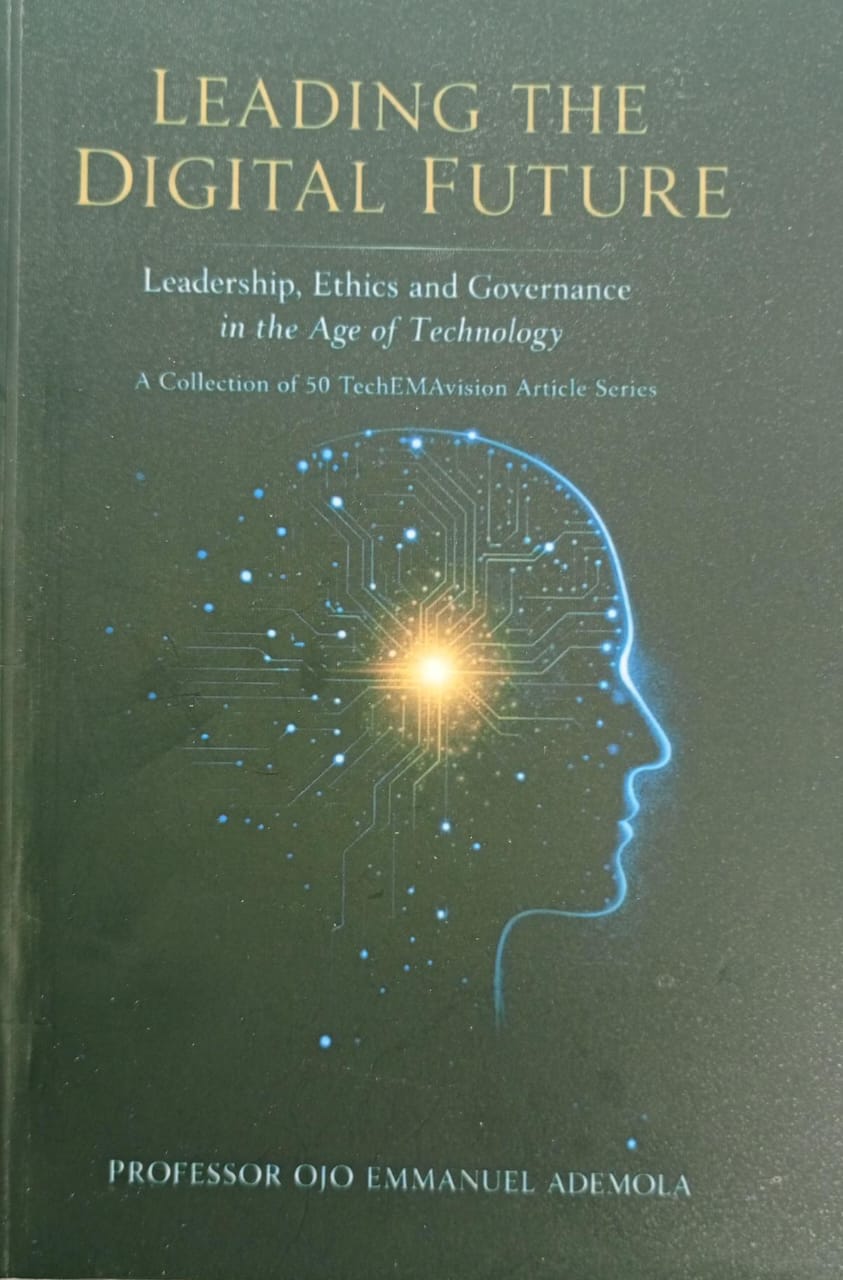
The cover of Leading the Digital Future is both visually striking and thematically aligned with the book’s central concerns. The silhouetted human profile filled with intricate circuit-like patterns immediately evokes the fusion of human intelligence and digital technology, suggesting the evolving relationship between leadership and innovation in a tech-driven world. The glowing focal point within the head symbolizes insight, ethical consciousness, and strategic vision—key qualities the book advocates for navigating the complexities of modern governance.
The dark, cosmic background paired with luminous digital lines creates a sense of depth and futurism, reinforcing the idea of an unfolding digital frontier. Meanwhile, the elegant gold typography lends authority and seriousness, positioning the work as a scholarly yet accessible contribution to discussions on technology, ethics, and leadership. Overall, the cover effectively captures the book’s essence: a thoughtful exploration of human-centered leadership in an increasingly digital age.
Final Impression
Leading the Digital Future is a thoughtful, comprehensive, and urgently relevant work that bridges theory and practice, ethics and innovation, local and global contexts. Professor Ademola’s unique voice—both as a scholar and a spiritual leader—adds depth and authenticity to the discourse on digital leadership. The book is not just a guide but a manifesto for conscious, culturally aware, and ethically grounded leadership in the digital age. It is a significant contribution to the literature on technology and society, particularly from an African perspective, and deserves wide readership across sectors and regions.
I hereby recommend for Leaders, policymakers, academics, entrepreneurs, and anyone interested in the ethical and practical dimensions of digital transformation.
Om’Oba Jerry Adesewo, fta is the Editor-in-Chief of OurNigeria Magazine and Artistic Director of Aronah Royal Theatre