

10-Year-Old Japanese Boy’s Butterfly Experiment Suggests Memories May Survive Metamorphosis
10-Year-Old Japanese Boy’s Butterfly Experiment Suggests Memories May Survive Metamorphosis

10-Year-Old Japanese Boy’s Butterfly Experiment Suggests Memories May Survive Metamorphosis
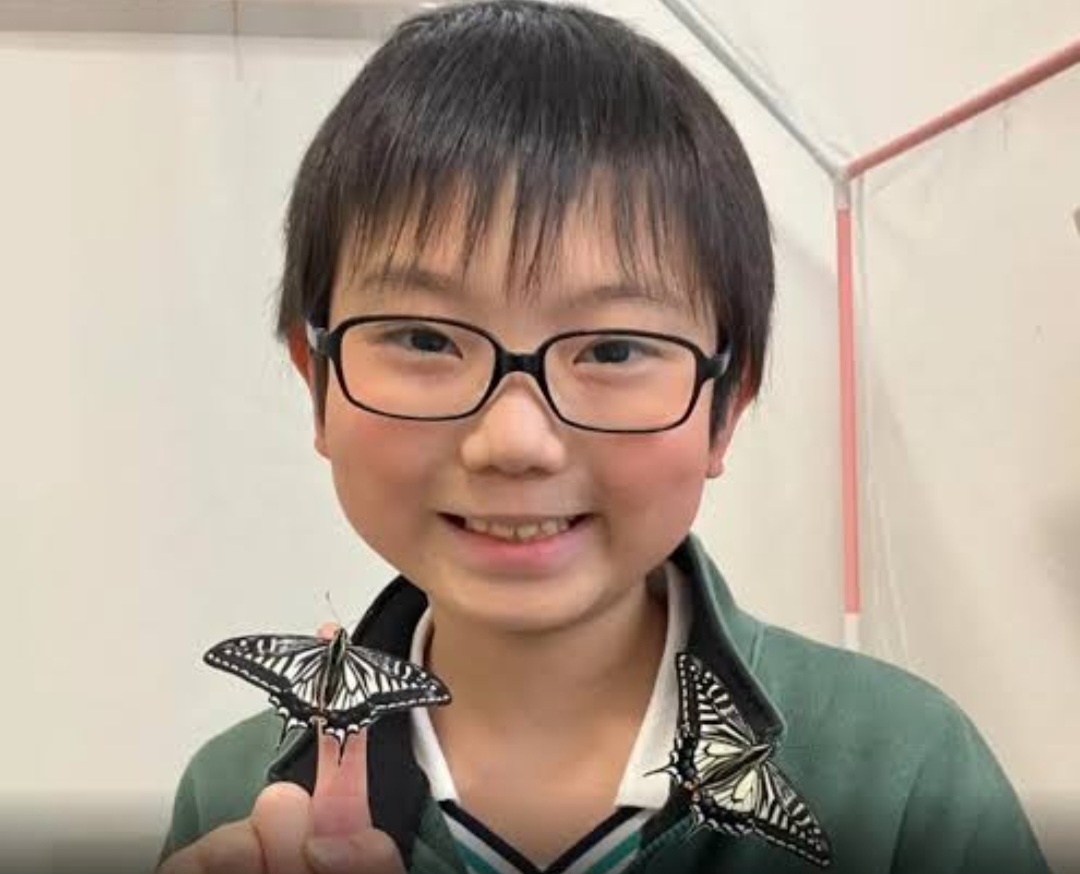
A 10-year-old boy from Kobe, Japan, has attracted attention for an experiment investigating whether butterflies can retain memories formed during their earlier lives as caterpillars.
Jo Nagai, who had been raising swallowtail butterflies at home for years, became curious after noticing that some butterflies he had cared for appeared to linger around him or return to him after being released. His observations led him to investigate whether experiences from the caterpillar stage could influence behaviour after metamorphosis.
Metamorphosis is one of nature’s most remarkable transformations. A caterpillar enters a chrysalis and undergoes extensive biological changes before emerging as a butterfly, with a different body structure and lifestyle. This raises a fascinating scientific question: can an insect retain something it learned before that transformation?
Rather than relying on observation alone, Nagai sought scientific guidance from Dr Martha Weiss, an entomologist at Georgetown University in the United States whose earlier research had examined memory retention in moths.
How the experiment worked
With guidance from Weiss, Nagai adapted the approach used in earlier insect-memory research. He trained caterpillars to associate the smell of lavender with a mild, unpleasant vibration delivered using a muscle-therapy device. A separate group served as a control.
After the caterpillars transformed into butterflies, he tested their responses using a Y-shaped maze, offering a choice between a lavender-scented route and one without the scent.
Reports on the experiment indicate that approximately 80 per cent of the trained butterflies avoided the lavender scent, suggesting that the learned association persisted through metamorphosis. Nagai documented his work in a 33-page research report.
What the findings mean
The results are consistent with earlier scientific research showing that some moths can retain learned responses after metamorphosis. A 2008 study co-authored by Weiss found that moths trained as caterpillars to avoid a particular odour could retain that response as adults.
Nagai’s experiment is notable because it explores whether a similar phenomenon occurs in swallowtail butterflies. However, the findings should be interpreted cautiously: further independent testing and publication in a peer-reviewed scientific journal would help establish how reliably the result can be reproduced.
The experiment also does not mean butterflies remember every experience from their caterpillar lives. It examines a specific learned response to an odour, rather than memory in the broad human sense.
Curiosity that crosses generations
Beyond its scientific question, Nagai’s work highlights how curiosity can lead to meaningful investigation, even at a young age. His collaboration with an experienced researcher demonstrates the value of mentorship and encouraging children to ask questions about the natural world.
The research also offers a glimpse into the complexity of insect behaviour and the processes that may preserve certain learned responses despite dramatic physical changes.
Whether further studies confirm the findings, the experiment raises an intriguing possibility: a butterfly’s transformation may change almost everything about its body without necessarily erasing every trace of what it learned as a caterpillar.
10-Year-Old Japanese Boy’s Butterfly Experiment Suggests Memories May Survive Metamorphosis
