


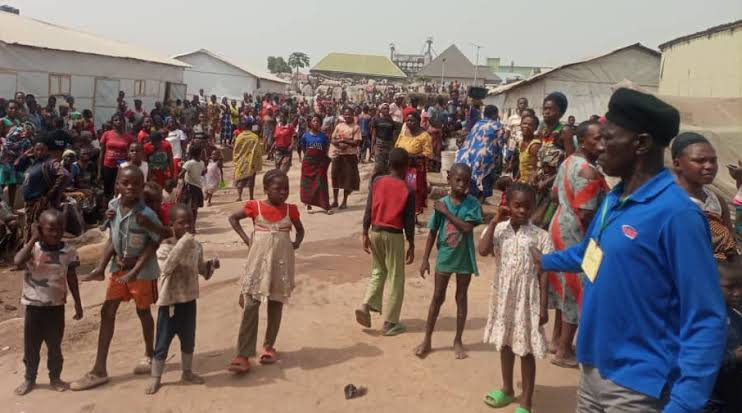
Displaced and Forgotten: Inside Benue’s Growing Humanitarian Crisis
By Matthew Eloyi
In the sprawling camps and host communities scattered across Benue State, displacement is no longer a temporary condition; it is fast becoming a way of life.
Families who once depended on farming now live in uncertainty, uprooted by repeated attacks that show no sign of slowing. Children, who should be in classrooms or on farmlands with their parents, now make up a significant portion of those displaced, their futures increasingly shaped by instability rather than opportunity.
New data released by the National Human Rights Commission paints a troubling picture: Benue remains one of the country’s most persistent flashpoints for internal displacement, driven largely by ongoing insecurity and repeated violence in rural communities.
At a recent presentation in Abuja, the commission revealed that thousands of people were displaced within just two months (January and February) with Benue accounting for the highest number of affected persons. The figures are not just statistics; they represent disrupted lives, broken livelihoods, and communities struggling to survive.
According to the commission’s Executive Secretary, Tony Ojukwu, the situation reflects a “persistent and growing protection crisis.” His remarks underscore a reality that residents of affected communities have long understood: displacement in Nigeria is no longer episodic; it is continuous.
The data shows that more than 10,000 internally displaced persons were reached within the reporting period, spread across thousands of households. Alarmingly, children make up a large share of this population, highlighting the long-term social consequences of the crisis. For many of them, displacement means interrupted education, exposure to health risks, and increased vulnerability to exploitation.
While Benue leads in the number of displaced persons, it is not alone. Borno State continues to grapple with insurgency-related displacement, where attacks and instability have restricted access to farmland and forced repeated movements of entire communities. In both states, the underlying driver remains the same: insecurity that disrupts daily life and erodes any sense of stability.
Beyond internal displacement, the report also points to a wider regional movement of people. Hundreds of asylum seekers have been documented, particularly in Taraba State and Borno, alongside over a thousand refugees and more than two thousand returnees, the majority of whom are children. These movements reflect not just internal pressures, but cross-border and cyclical patterns of displacement that complicate humanitarian response efforts.
Yet, perhaps the most sobering aspect of the report lies in the human rights conditions surrounding these populations.
Over 5,000 human rights violations were documented within the same period, cutting across critical areas such as access to education and healthcare, food security, shelter, and personal safety. For displaced families, survival often comes at the cost of basic rights, a trade-off that leaves them vulnerable long after the initial violence has passed.
Gender-based violence, child protection concerns, and restrictions on freedom of movement further deepen the crisis. In many cases, displacement does not merely remove people from danger; it exposes them to new forms of risk.
Even within detention facilities, concerns persist. Monitoring visits to police and military centres revealed issues such as prolonged detention, inadequate feeding, and poor sanitation – conditions that raise additional human rights questions, particularly in states like Taraba and Benue.
Behind every data point is a story: a family forced to flee, a child missing school, a farmer unable to return to land that once sustained them.
And in places like Benue, those stories are becoming far too common.
