


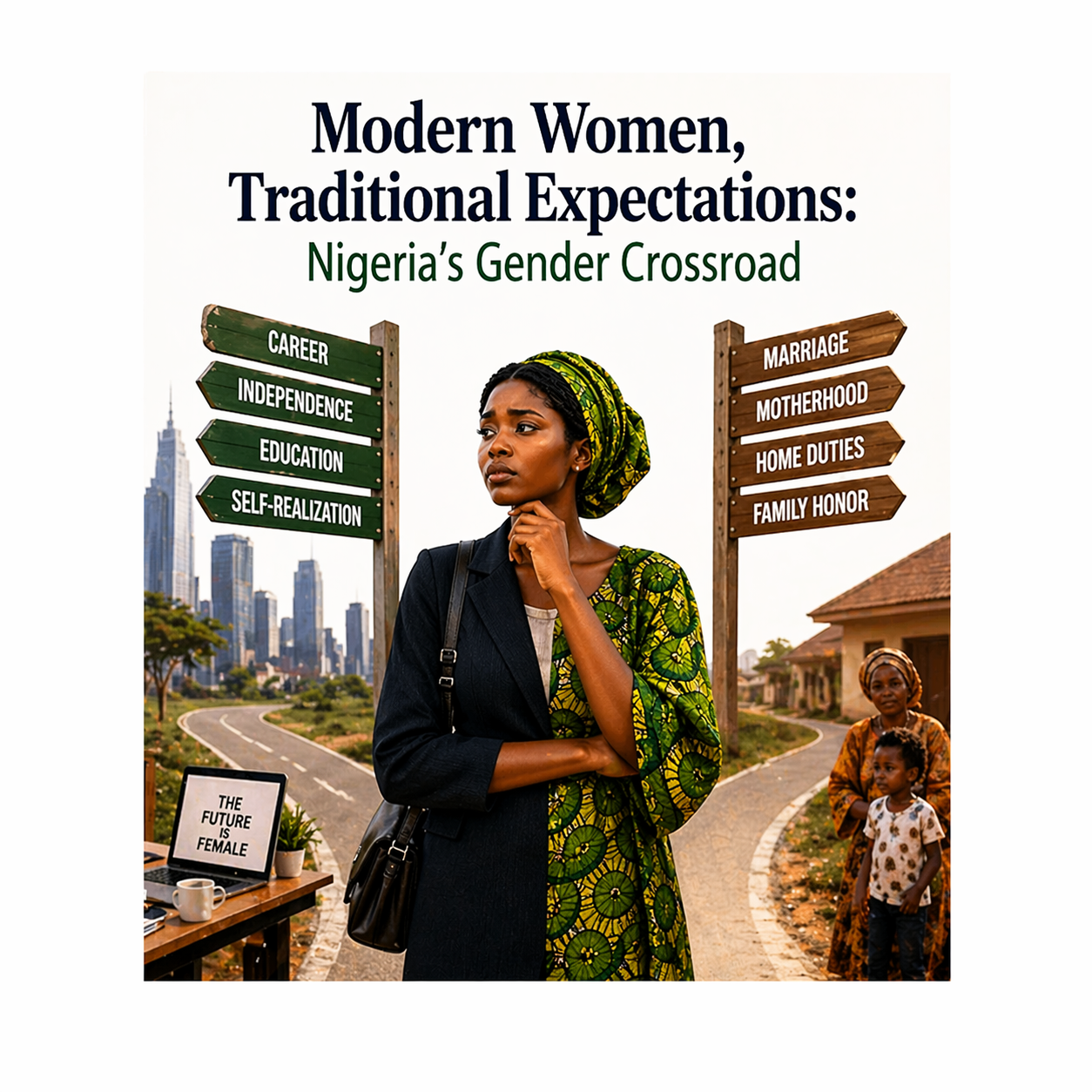
Modern Women, Traditional Expectations: Nigeria’s Gender Crossroad
By Comfort Pius
On a typical weekday morning in Jos, Gloria is already exhausted before midday. She has responded to emails, attended a virtual meeting, and coordinated a project deadline. Yet, as the day unfolds, another shift awaits her. One that begins the moment she steps back into her home. There, expectations change instantly. She is no longer just a professional; she becomes everything else caretaker, homemaker, and, in many ways, the silent anchor of the household.
READ ALSO: Kaduna Governor Uba Sani Bags NIPR Honorary Fellowship Ahead of Investiture
Gloria’s experience reflects a growing national contradiction: a society where women are modern in ambition but still traditional in expectation. This tension is not just personal it is structural. It captures what can best be described as Nigeria’s unresolved gender transition, where progress has entered homes and workplaces, but expectations have remained largely unchanged.
Across the country, more women are attaining higher education, building careers, and achieving financial independence. Yet societal expectations have not evolved at the same pace. Many are still evaluated not only by professional success but also by how well they conform to traditional domestic roles. The result is a quiet imbalance: success is encouraged, but only within limits defined by long-standing cultural norms.
This creates what many now recognise as a double burden. Women are expected to excel in their careers while simultaneously carrying primary responsibility for domestic life. Importantly, success in one sphere does not reduce expectations in the other—it often intensifies them. One of the key observations in this evolving reality is that Nigerian society has expanded women’s opportunities without adjusting the weight of expectations attached to them.
However, this conversation is incomplete if it focuses on women alone. Nigerian men are also navigating shifting expectations in an equally unstable environment. Traditionally assigned the role of provider and protector, many now face economic realities that make those expectations increasingly difficult to sustain. Rising costs, job insecurity, and changing income structures have created a quiet pressure point in many households, where identity is still tied to financial capability, even when circumstances no longer support it.
What emerges is not a gender war, but a mismatch of timelines. Society is changing, but not evenly. Women are adapting rapidly to new opportunities, while cultural expectations remain anchored in older definitions of roles. Men, meanwhile, are expected to maintain traditional standards of provision in an economy that is itself unstable. This uneven evolution creates tension not necessarily rooted in conflict, but in confusion.
A more subtle but important observation is that Nigeria is not lacking in role change it is lacking in role clarity. People are adjusting individually, but society has not collectively redefined what fairness, partnership, and responsibility now mean. This is why many relationships today feel like negotiations between inherited expectations and present realities.
Social media has intensified this gap. Idealised portrayals of relationships, success, and gender roles circulate widely, subtly shaping perceptions of what life “should” look like. For young Nigerians, this creates a constant comparison between curated perfection and lived reality. One of the unintended consequences is the quiet pressure to perform roles rather than define authentic balance.
Religion and culture continue to reinforce long-standing expectations around gender. In many communities, these frameworks remain deeply respected and emotionally significant. However, another important observation is that while these systems preserve identity, they often struggle to absorb rapid social change. This creates a delay between lived reality and cultural acknowledgment of that reality.
At the centre of all this is a critical question: how does a society manage transformation without clear rules for transition? Nigeria’s situation is not simply about conflict between men and women. It is about a society undergoing rapid change without a matching adjustment in expectations, language, and structure.
To understand this more clearly, consider the everyday emotional weight carried by individuals like Gloria. Her reality is not defined by lack of ambition or lack of support, but by the constant negotiation between two systems—one modern, one traditional operating simultaneously within the same space. This duality is increasingly becoming a defining feature of many Nigerian households.
There is also a broader implication that cannot be ignored. When expectations outpace adaptation, pressure accumulates quietly in relationships, workplaces, and families. It does not always manifest as open conflict; sometimes it appears as fatigue, dissatisfaction, or silent withdrawal. This is one of the most overlooked dimensions of Nigeria’s evolving gender landscape.
The challenge, therefore, is not to choose between tradition and modernity, but to redefine the terms of coexistence between them. Culture is not static; it evolves with lived experience. However, when evolution is uneven, confusion replaces clarity, and expectation replaces fairness.
Another key observation is that Nigeria’s gender conversation is often framed as binary men versus women but the reality is far more layered. It is about systems, timing, economics, and cultural adjustment happening at different speeds. This complexity is often missed in simplified debates, but it is central to understanding the lived experience of many Nigerians today.
Ultimately, Nigeria’s gender crossroads is not defined by whether roles are changing they already are. The real issue is whether society is willing to acknowledge that change openly and build a more realistic framework around it.
Until that happens, many like Gloria will continue to live between two worlds: progress in one hand, expectation in the other, and a society still learning how to reconcile both.