


Direct Primaries: Democratic Reform or Organised Theatre?
By Matthew Eloyi
For years, Nigerians complained that political parties had become private estates controlled by governors, godfathers, and wealthy power brokers. Candidate selection was often reduced to midnight negotiations, delegate bribery, and carefully scripted “consensus” arrangements in which ordinary party members had little or no influence.
Then came the promise of direct primaries. The idea sounded revolutionary. Instead of a few hundred delegates deciding who gets party tickets, all registered party members would participate directly in choosing candidates. Supporters described it as the long-awaited democratisation of Nigeria’s internal party politics – a grassroots rebellion against elite manipulation.
But the recent primaries conducted by the ruling All Progressives Congress have forced a difficult national question into the open: Are direct primaries genuinely deepening democracy, or are they simply organised political theatre performed under the language of reform? The answer, unfortunately, appears increasingly uncomfortable.
On paper, direct primaries are one of the most democratic innovations in Nigerian electoral politics in recent years. The Electoral Act 2026 significantly narrowed the options available to parties by recognising direct primaries and consensus arrangements while eliminating the traditional delegate system that had become synonymous with corruption, bribery, and elite bargaining. Supporters argued that involving all party members would weaken the power of moneybags and reduce manipulation by political godfathers.
The logic was compelling. If millions of party members participate in candidate selection, it becomes harder for governors and party elites to impose favourites through small groups of delegates. The grassroots, at least theoretically, regain political relevance.
Many Nigerians embraced the reform because the delegate system had become deeply discredited. Ticket allocation was often less about popularity and competence than about who could finance delegate negotiations. Primaries became marketplaces rather than democratic contests.
Direct primaries promised something different: wider participation, greater legitimacy, and a restoration of internal democracy. But Nigerian politics has always possessed a dangerous talent for transforming reform into ritual.
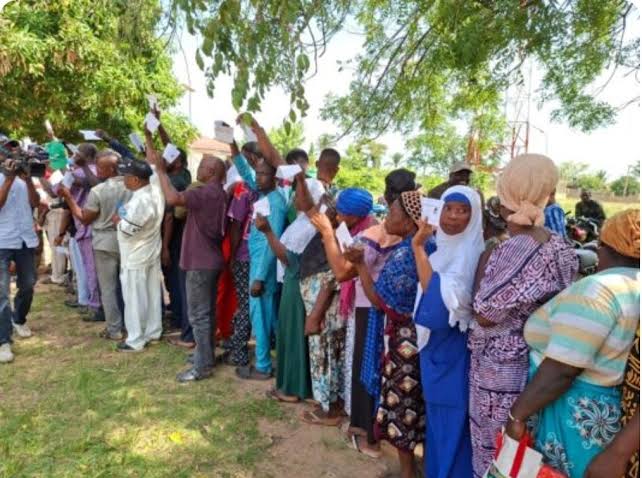
The APC primaries exposed the enormous gap between democratic theory and political reality. Across several states, what should have been transparent grassroots exercises quickly descended into controversy. Aspirants complained of manipulated membership registers, selective accreditation, intimidation, parallel voting exercises, and outright candidate imposition.
In Yobe State, governorship aspirants openly rejected the emergence of a consensus candidate and demanded transparent direct primaries instead, arguing that any attempt to impose candidates violated both the Electoral Act and the party constitution.
Elsewhere, internal tensions exploded as governors and party leaders attempted to force consensus arrangements on unwilling aspirants. Reports emerged from states including Rivers, Lagos, Edo, Benue, Kano, and Adamawa alleging that party machinery was manipulated to favour preferred candidates.
The ruling party eventually shifted toward direct primaries in many constituencies, not necessarily because it fully embraced democratic openness, but because resistance to consensus arrangements became politically dangerous.
The APC did not move decisively toward direct primaries out of ideological conviction. In many cases, it moved because aspirants rebelled against elite arrangements already perceived as unfair. That is not democratic transformation. That is crisis management.
Perhaps the greatest illusion surrounding direct primaries is the assumption that expanding participation automatically weakens elite control. In reality, Nigerian governors still dominate political structures at ward, local government, and state levels. They influence party executives, control patronage networks, mobilise security leverage, and shape grassroots structures long before voting begins.
As one APC chieftain bluntly admitted, even direct primaries may still favour governors because they already control the local political machinery required to influence outcomes. This is the contradiction at the centre of Nigeria’s democratic reform debate.
You cannot democratise candidate selection merely by changing voting procedures while leaving political structures captured by entrenched power blocs.
If governors control party registers, accreditation processes, mobilisation structures, and local leadership, then direct primaries risk becoming broader but still carefully managed exercises. The theatre becomes larger. The script, however, remains largely unchanged.
One of the most serious weaknesses exposed during the APC primaries was the unreliable nature of party membership databases. Direct primaries depend entirely on credible membership registers. Without accurate records, the entire process becomes vulnerable to manipulation.
Who is a legitimate party member? Who verifies the register? Who controls accreditation? Who decides which names appear or disappear? These questions became central controversies during the APC exercises. In several states, aspirants alleged that registers were selectively altered or inaccessible.
Without transparent digital membership systems and independent verification mechanisms, direct primaries can easily become statistical fiction. A party may claim that “all members voted,” even when nobody can independently confirm who those members actually are. This creates fertile ground for organised manipulation disguised as mass participation.
Ironically, many of the so-called direct primaries still carried the fingerprints of consensus politics. In numerous states, aspirants reported pressure to step down before voting commenced. Preferred candidates allegedly emerged through negotiations among governors, ministers, and influential party leaders before ordinary members participated in any process.
By the time voting began in some areas, the outcome already appeared politically predetermined. This is why critics increasingly describe parts of the process as “organised theatre.” The optics suggest democracy. The internal mechanics often suggest elite choreography.
Nigerian political parties have mastered the art of procedural democracy without substantive openness. They conduct congresses, issue result sheets, hold accreditation exercises, and announce vote totals. Yet many participants remain convinced that outcomes are settled long before ballots are cast. That perception alone is dangerous for democratic legitimacy.
Supporters of direct primaries argue that expanding participation naturally empowers grassroots members. But participation alone does not equal influence. A poor party member voting in a ward where local structures are financially dependent on state power is not necessarily politically free. Nigerian politics operates within deeply unequal patronage systems where loyalty is often tied to economic survival.
This is why internal party democracy cannot be reduced to voting procedures alone. Democracy requires institutional independence, transparent rules, credible dispute resolution, equal opportunity, and genuine uncertainty about outcomes. Without those conditions, even mass participation can become performative. The ordinary party member may queue to vote, but still remain excluded from meaningful power.
Nigeria’s political history offers repeated warnings about flawed primaries. The APC’s Zamfara disaster in 2019 remains one of the clearest examples. Internal disputes and controversies surrounding party primaries eventually led to Supreme Court rulings that nullified the party’s electoral victories in the state. That precedent still haunts political parties.
Already, aggrieved aspirants from the recent APC exercises are threatening litigation and rebellion. This exposes another paradox of direct primaries: while they aim to reduce disputes, poorly managed exercises may actually multiply them.
A badly organised direct primary can produce confusion on a much larger scale than delegate contests because the process involves wider participation, more polling locations, and more administrative complexity. If party institutions remain weak, expanding participation also expands the opportunities for conflict.
The debate over direct primaries is ultimately about something larger than the APC itself. It is about whether Nigerian democracy genuinely allows citizens, even within political parties, to influence political outcomes.
Many Nigerians increasingly view political parties not as ideological institutions but as elite bargaining platforms. Public cynicism toward party politics continues to deepen because internal processes often appear manipulated regardless of formal reforms.
That cynicism is dangerous. When citizens lose faith in internal party democracy, they begin to lose faith in democracy itself. The crisis does not begin on election day. It begins long before then – during candidate selection.
If candidates emerge through opaque internal arrangements, voters are already choosing from pre-approved elite options during the general election. In that sense, flawed primaries quietly weaken democracy before the public even enters the voting booth.
Direct primaries remain a potentially important democratic reform. The idea itself is not the problem. The problem is that Nigeria’s political class often adopts democratic language without surrendering political control. And so the central question remains unresolved.
Can direct primaries truly empower ordinary party members in a political system still dominated by governors, patronage networks, and elite bargaining?Or are they simply expanding participation without redistributing power?
The recent APC primaries suggest that the answer may depend less on electoral laws and more on whether political institutions are willing to tolerate genuine internal competition. Because democracy is not merely about how many people vote. It is about whether their votes can genuinely alter outcomes.
And until that question is answered honestly, Nigeria’s direct primaries may continue to look less like democratic reform and more like organised political theatre.
