

Beyond Paper Promises: Nigeria’s Education Data Overhaul Faces the Real Test of Execution

Beyond Paper Promises: Nigeria’s Education Data Overhaul Faces the Real Test of Execution
By Matthew Eloyi
Nigeria’s education sector is once again placing its hopes on technology, with the Federal Ministry of Education set to unveil the Digital National Education Management Information System (DNEMIS) on July 1. On paper, it is a bold step toward modernising how the country collects, manages and uses education data. In practice, it represents a long-standing struggle to turn fragmented information systems into a coherent foundation for policy.
At its core, DNEMIS is being introduced not merely as a digital upgrade, but as an attempt to fix a structural weakness that has shadowed education planning for years: unreliable and inconsistent data. Officials say this gap has repeatedly undermined decision-making, weakened accountability, and limited the sector’s ability to respond to changing realities.
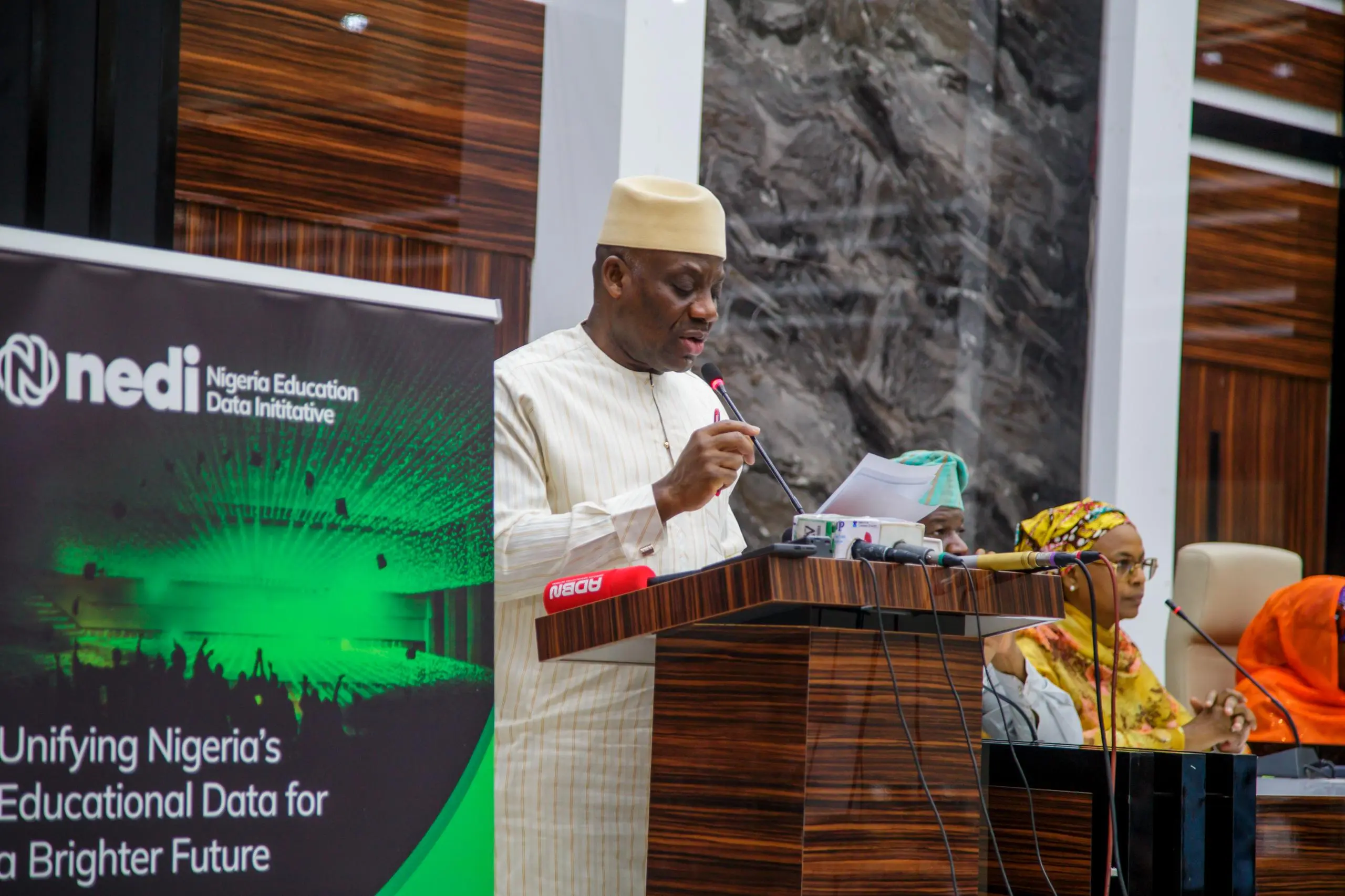
Speaking at a briefing in Abuja, Mr Adebayo Onigbanjo, National Project Coordinator of the Special Programmes Operations and Implementation Unit (SPOIU), described the reform as part of a broader effort under the Nigeria Education Sector Renewal Initiative (NESRI). He framed the problem as systemic rather than technical.
“For many years, education planning and administration relied on fragmented systems, inconsistent reporting processes and limited access to reliable and timely data.
“These challenges constrained effective planning, weakened accountability and limited the sector’s ability to respond to emerging realities,” he said.
The government’s response is the Nigeria Education Data Infrastructure (NEDI), a coordinating framework designed to unify data collection across all levels of education. DNEMIS sits at the centre of this structure, intended to serve as the operational platform where planning, budgeting, monitoring and evaluation are anchored.
The ambition is sweeping: every learner, teacher, school and education investment captured in a single system designed to support evidence-based governance. If achieved, it would mark a significant departure from the current patchwork of administrative records that often differ across agencies and states.
Officials insist the reform is also about institutional discipline. Onigbanjo emphasised that the ministry is attempting to move beyond announcements to measurable implementation.
“The progress recorded through NEDI and the implementation of DNEMIS reflects the ministry’s broader commitment to ensuring that reforms are not only announced but effectively coordinated, implemented and measured.
“Data is no longer a back-office function. It is becoming the engine of education reform in Nigeria,” he said.
But the significance of DNEMIS extends beyond internal government use. According to Ms Mojoyin Adebajo, Special Assistant to the Minister on Digital Communications and E-Learning, the platform introduces a new level of public access to education data.
It will digitise the Annual School Census and, for the first time, provide selected official data through an interactive public portal. This, she argued, opens up education statistics to wider scrutiny and participation.
“This represents an important step towards expanding access to information and encouraging broader participation in conversations that shape the future of education in Nigeria,” she said.
The move signals a shift toward transparency, but also raises questions about how data openness will be managed in a system still consolidating its digital foundations.
READ ALSO: NELFUND Raises Alarm Over Tuition Refund Delays, Fee Hikes by Tertiary Institutions
Security and data protection have therefore become central to the conversation. Abubakar Isah, the NEDI Coordinator, said compliance with Nigeria’s data protection laws has been built into the system’s design from the outset.
Beyond national borders, development partners are also viewing DNEMIS as part of a broader push toward integration. UNICEF Education Specialist Saka Ibraheem described the long-term vision as the consolidation of multiple education databases into a unified system.
“Before next year, we hope to have the Education Management Information System (EMIS), Teacher Management Information System (TMIS) and individual learner records in one system.
“One system for education and one system for Nigeria,” he said.
The integrated model would assign unique identifiers to learners, enabling more precise tracking of enrolment and dropouts—an issue that continues to challenge Nigeria’s education system.
Yet the deeper question is not whether the technology exists, but whether institutions can align around it. Nigeria’s history of reform is filled with promising systems that struggled with coordination, funding continuity and inter-agency cooperation.
DNEMIS, in that sense, is less a technological milestone than a governance test. Its success will depend on whether data becomes a genuinely shared resource across federal, state and local structures, and whether decision-makers consistently use it to shape policy.
For now, the launch signals intent. The real measure will come later, in how fully Nigeria’s education system is willing and able to convert information into action.
