


From Thesis to Transformation: Echono’s Roadmap for Rescuing University Leadership
By Ameh Abraham
It was not just another public lecture. When the Executive Secretary of the Tertiary Education Trust Fund (TETFund), Arc. Sonny S. T. Echono, PhD, mounted the podium at the Faculty of Law Lecture Theatre, University of Abuja, on Thursday, June 18, 2026. He was not merely delivering a speech; he was presenting a diagnosis. And like any good physician, his diagnosis came with a prescription that, if implemented, could fundamentally alter the health of Nigeria’s federal university system.
READ ALSO: Baloch Rights Activist Mahrang Baloch Nominated for Nobel Peace Prize Amid Legal Battle
The lecture, the maiden edition of the Abuja Leadership Centre’s Public Lecture Series on Research Findings, was a presentation of Echono’s doctoral research on the “Leadership Selection Process and Governance of Federal Universities in Nigeria (1993-2024).” a study supervised by a leading scholar in public governance and Leadership, Prof. Ukertor Gabriel Moti. But as the dust settles on the event, beyond the headlines and the applause, lie deeper, more complex questions that demand our collective attention.
The Central Thesis: A Question of Process
Echono’s research, meticulously outlined in his thesis, posits a simple yet profound argument: the method of selecting a university leader is not a mere administrative formality but the sine qua non of institutional governance and academic excellence. His study, employing a mixed-methods approach across 20 federal universities, establishes a strong positive correlation between transparent, inclusive selection processes and effective governance.
The inverse, he argues, is equally true, as reiterated later by the Panelists: Professors K.S Waziri, Alanana Otaki, and Philip Dahida. Political interference, nepotism, ethnic bias, and corruption, the “negative influences” as he terms them, are not just stains on the process; they are pathogens that infect the entire university system, leading to a decline in quality, an erosion of trust, and an impediment to progress. The evidence? Nigeria’s university system, once a beacon in Africa, now languishes at 191st globally and 23rd in Africa for educational advancement, with no university in the global top 100.
The lecture hall, however, was not an echo chamber of agreement. The very location of the event, the University of Abuja, served as a potent backdrop, reminding everyone of the controversies that have recently plagued leadership selection in Nigeria’s ivory towers.
The Uncomfortable Echoes: UNIABUJA, UNILAG, and the Spectre of Crisis
Echono’s academic findings are not abstract theories; they are grounded in the lived realities of Nigerian universities. While the presenter did not delve into specific cases, his analysis prompts us to ask difficult questions about recent events at institutions like the University of Abuja itself, the University of Nigeria, Nsukka (UNN), and the University of Lagos (UNILAG).
Take, for instance, the University of Abuja. Just last year, the institution was in the eye of a storm. The Federal Government dissolved the entire governing council and removed the vice-chancellor, Prof. Aisha Maikudi, following a protracted crisis over her appointment. This led to the appointment of an acting VC, Prof. Lar Manko, with a strict mandate that he would not be eligible for the substantive role. This decision, intended to quell the crisis, itself raises questions about the tension between ensuring administrative continuity and the danger of creating a “lame-duck” leadership that lacks full legitimacy and authority.
The situation at UNN has been similarly fraught. The selection process for a substantive vice-chancellor has been marred by delays and controversies, with the university management forced to publicly deny reports that a candidate had been appointed. The delay in inaugurating new governing councils, which are central to the selection process, has further complicated matters. These events are textbook examples of what Echono’s research identifies as the “distortion” of the process, where “departure from merit-based, federal-character appointments bred deepening localization, nepotism, and manipulation of universities’ extant laws.”
Perhaps the most glaring example, albeit from 2020, is the infamous UNILAG crisis. The removal of Prof. Oluwatoyin Ogundipe by the governing council, chaired by Dr. Wale Babalakin, was a public spectacle that laid bare the raw power struggles, allegations of corruption, and political manoeuvring that can consume a university when governance breaks down. As one analysis noted, the crisis seemed “about everything but the students”. The UNILAG affair, in many ways, was a prophecy of the crisis that Echono’s research now seeks to prevent. It showed how a process, once it becomes a vehicle for personal or political agendas, can transform an “ivory tower” into a “tower of babel”.
A Clinic in Leadership: The Fawehinmi Model vs. The Ghost of the Past
In stark contrast to these tales of crisis, the atmosphere at the public lecture was one of order and academic decorum. A significant part of the credit for this was given by the Director of the Abuja Leadership Centre, Prof. Abdulhamid Ozohu-Suleiman, to the Vice-Chancellor and chief host of the event, Prof. Hakem Babatunde Fawehinmi.
In his opening remarks, Prof. Ozohu-Suleiman painted a picture of a university at peace. He applauded Prof. Fawehinmi for his focused leadership, which, he noted, had brought “peace and stability to the University of Abuja within just months of his assumption of office.” He explicitly linked this stability to the Vice-Chancellor’s “open door management policy and his capacity to give fair hearing to all” .
This is a powerful statement. The narrative of the University of Abuja in 2026 is one of a turnaround from the crisis of 2025. Prof. Fawehinmi’s leadership, presented as inclusive and transparent, serves as a living embodiment of the principles Echono’s research champions. It suggests that the path to stability is, in fact, the path Echono prescribes: one of inclusivity, fairness, and stakeholder engagement.
Yet, this very narrative invites a crucial question: if the principles are so clear, why do they remain so difficult to institutionalize? The answer, Echono’s research suggests, lies in the pervasive power of negative external influences.
The Director’s Vision: More Than Just a Lecture
Prof. Ozohu-Suleiman’s speech also highlighted the broader mission of the Abuja Leadership Centre, a TETFund Centre of Excellence in Public Governance and Leadership. He noted that this public lecture series was an innovation designed to “expand the banquet for the communion of Town and Gown, and also to reverse the age-long practice of trapping intellectual works in inaccessible bookshelves where they are consigned to the vagaries of the elements and rodents”.
This is a profound statement on the role of the university in society. It moves beyond the traditional view of the university as a cloistered institution and positions it as an active partner in national development. By presenting cutting-edge doctoral theses publicly, the Centre aims to bridge the gap between academic research and public policy, ensuring that scholarly work informs practical solutions to national challenges. The Centre’s audacious vision is to “establish a world-class institute on Nigerian soil, deeply rooted in the complex realities of our nation and continent”. This vision is being made manifest, with construction of the Centre’s state-of-the-art facility now underway.
It is important to recognise the contributions of previous Directors of the Centre, Prof. Philip Afaha, Prof. Ukertor Gabriel Moti, and Prof. Philip Dahida, who laid the foundation for this audacious vision. Their efforts, along with those of the current team, have been instrumental in building the Centre into the formidable institution it is becoming.
The Prescription for a Healthier System
Echono’s lecture was not just a diagnosis; it was a detailed treatment plan. His recommendations, outlined in his thesis, are comprehensive:
Clear and Standardised Guidelines: Selection processes must be codified, publicly accessible, and strictly adhered to.
Transparency in Action: The entire process, from vacancy announcement to final appointment, must be open. Technology, portals, e-voting, and blockchain should be leveraged to enhance integrity.
Stakeholder Engagement: Search committees must be inclusive, bringing in representatives from faculty, students, alumni, and the community.
Combating Corruption and Interference: Legislative reforms, whistleblower protections, and oversight bodies are essential to curb political meddling and bribery.
Leadership Development: There is an urgent need for capacity-building programmes and mentorship initiatives to prepare future university leaders for the rigours of ethical and strategic governance.
The findings also highlight a worrying trend: the role of staff unions, which, according to Echono, can be a “guardrail” against impropriety or a source of “conflict and crisis.” This duality is a critical area for further study and a reminder that institutional governance is a complex web of competing interests.
A Framework for the Future: The Immediate Acknowledgment
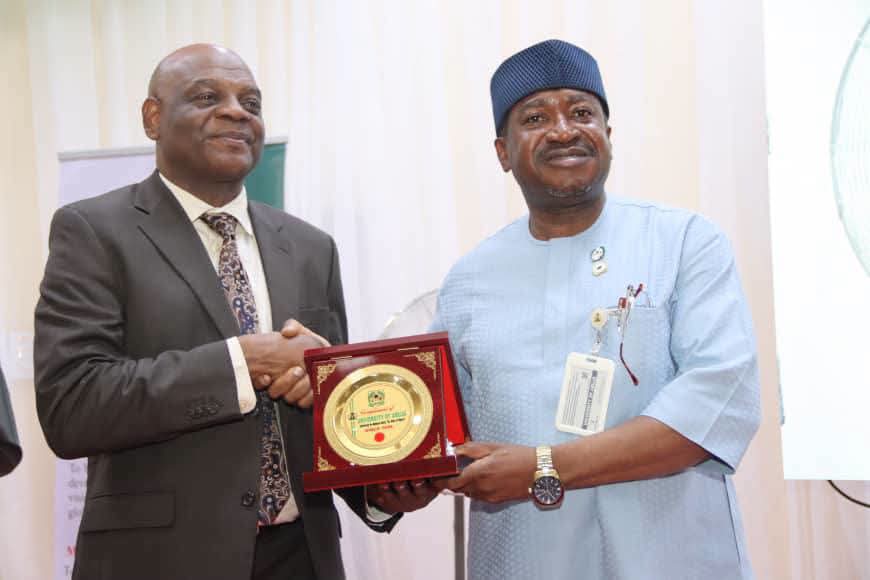
Perhaps the most powerful validation of Echono’s work came in the moments after his presentation. In a move that was both symbolic and practical, Vice-Chancellor Prof. Hakem Babatunde Fawehinmi, on behalf of the university, immediately awarded the TETFund boss a Visiting Scholar. This is not just a ceremonial honour; it is a commitment to institutionalising the dialogue that Echono has initiated. It signifies that the University of Abuja intends to be at the forefront of implementing the very reforms its leadership is championing.
The public lecture served as a significant gathering of minds, drawing a diverse and distinguished assembly of participants from across the academic, professional, and policy spheres. The event provided a valuable platform for networking and intellectual exchange, with a notably supportive contingent from the Idoma nation, led by Gen. Onoja Lawrence (rtd), PhD, a respected faculty member of the Abuja Leadership Centre. The Centre’s academic community was well-represented by its distinguished faculty, including Professors U.G. Moti, Banjo Adewale, Joseph Golwa, and Yusuf Lawal, alongside other esteemed members. The audience was further enriched by the presence of lecturers from within and outside the University of Abuja, alumni and current students of the Centre, as well as a broad spectrum of other stakeholders, including captains of industry and members of the media, all of whom contributed to the vibrant and engaged atmosphere of the occasion.
For our other universities, the message is clear: the old ways are failing. The path to relevance and excellence lies in the principles Echono’s research has empirically validated. The question is no longer if reform is needed, but how quickly it can be implemented, and how much political will exists to see it through. For as Echono’s work powerfully demonstrates, the future of Nigeria’s universities and by extension, the nation’s future, depends on it.
