


Gaddafi’s Ghost Returns on 100,000 Ecstasy Pills
By Matthew Eloyi
More than a decade after his violent overthrow and death, Muammar Gaddafi has unexpectedly resurfaced in Libya — not in politics, but on thousands of illicit ecstasy pills seized by security authorities.
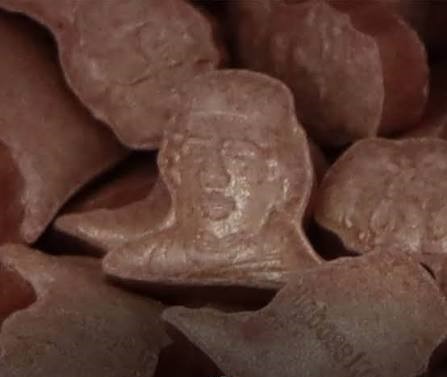
Libyan authorities say they have intercepted about 100,000 ecstasy tablets bearing the image of the country’s former leader, in a shipment allegedly smuggled from Europe and destined for the Libyan market.
According to Al Rada for Combating Terrorism and Organised Crime, security agents acted on intelligence that a drug gang planned to move the consignment into Libya by sea. Officers reportedly tracked the shipment until it reached a Libyan port, where they intercepted a cargo van and discovered the drugs concealed inside.
Photographs released by the security agency showed brown tablets moulded in the shape of Gaddafi’s head and shoulders. His facial features and the distinctive robes associated with his public image were reportedly pressed into the surface of the pills, transforming the former ruler’s likeness into an unusual trademark for an illegal narcotics operation.
The authorities said the drugs originated from an unspecified European country and that several suspects had been handed over to prosecutors for further investigation and possible prosecution.
Beyond the bizarre imagery, however, the seizure points to a much larger problem confronting Libya and the wider North African region: the growth of illicit synthetic drug trafficking amid years of political instability.
A United Nations report released in January identified Libya as an increasingly important transit hub for synthetic drugs and other narcotics destined not only for domestic consumers but also for markets across North Africa and the wider continent.
The United Nations Office on Drugs and Crime (UNODC) attributed the expansion of criminal networks partly to the prolonged instability that followed the 2011 uprising that toppled Gaddafi. The collapse of central authority, fragmented security structures and porous borders have created opportunities for organised criminal groups to exploit Libya’s strategic position between Europe, North Africa and the Sahel.
The latest seizure also comes against the backdrop of Libya’s continuing political fragmentation. The country remains divided between the UN-recognised Government of National Unity (GNU) based in the west and authorities aligned with military commander Khalifa Haftar, who controls large parts of the east and south.
The Tripoli-based Presidential Council has served as the country’s head of state since the UN-facilitated political dialogue of 2021, but efforts to establish lasting political unity have remained difficult.
In that fractured environment, the appearance of Gaddafi’s image on ecstasy pills carries an unsettling symbolism. The former leader once projected an image of absolute political control over Libya. Today, his likeness has become a commercial emblem on a commodity moving through networks that thrive on the very instability that followed the collapse of his regime.
The seizure therefore tells two stories at once. One is about an international drug trafficking network moving synthetic narcotics into a vulnerable market. The other is about a country still struggling with the consequences of political fragmentation, where the image of a former ruler can be repurposed by criminal enterprises for profit.
For Libyan authorities, the challenge extends far beyond confiscating one shipment. Disrupting the networks behind such consignments requires intelligence sharing, stronger border and port controls, effective prosecution and sustained cooperation among national, regional and international security agencies.
The 100,000 pills may eventually disappear into evidence rooms and court proceedings. But the image stamped onto them offers a disturbing reminder of Libya’s unresolved past: more than a decade after Gaddafi’s fall, his shadow still hangs over a country grappling with instability, political division and the expanding influence of organised crime.
