

WHEN LITERATURE WINS, WHO REALLY CELEBRATES?
From prize money and the controversy over artificial intelligence to the 40th anniversary of Wole Soyinka’s Nobel Prize in Morocco, Nigeria must confront what it means to value its writers beyond the moment of recognition.

WHEN LITERATURE WINS, WHO REALLY CELEBRATES?
By Jerry Adesewo
There is something revealing about the way we celebrate literature. We applaud when a Nigerian wins a major prize, circulate photographs of the award ceremony, debate the judges’ decision and congratulate the publisher. For a few days, the books become news. Then the excitement fades, and the writer returns to the familiar struggle of finding readers, securing publishers and persuading a society increasingly distracted by other things that literature still matters.
The recent literary season offers Nigeria an opportunity to look beyond the glamour of awards and examine the institutions, values and contradictions shaping our literary culture.
READ ALSO: EU, UN Reaffirm Partnership to Advance Nigeria’s Development Priorities
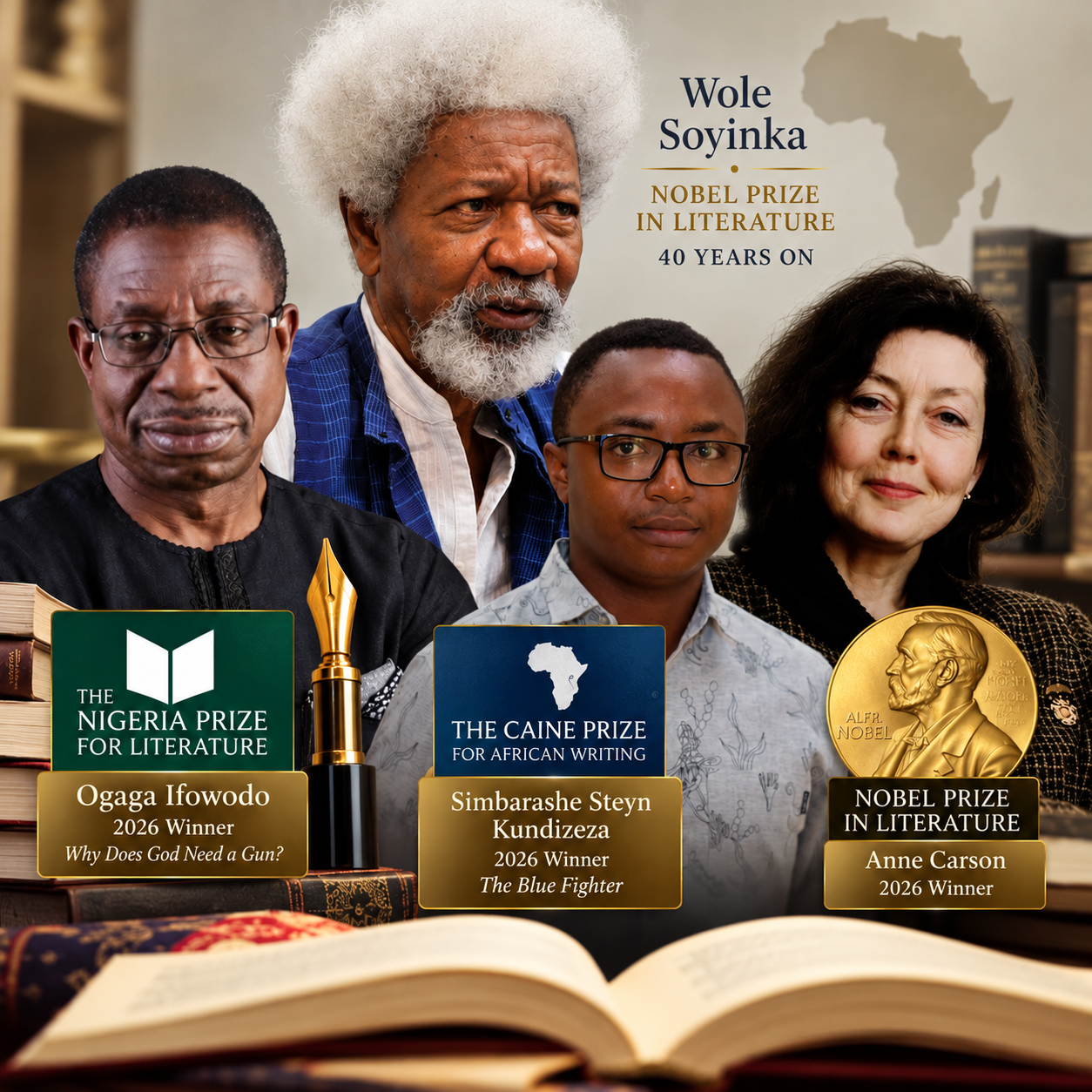
On October 9, poet, lawyer and activist Ogaga Ifowodo won the 2026 Nigeria Prize for Literature, sponsored by Nigeria LNG Limited, for his collection ‘Why Does God Need a Gun?’. Selected from 223 entries, the book confronts religious and political violence in Nigeria. The $100,000 prize is substantial recognition of literary excellence, but the winning collection also reminds us that literature is more than an ornament of national identity. It can question the nation, interrogate power and confront the violence that public discourse sometimes struggles to explain.
Across the continent, the Caine Prize for African Writing has continued its mission of bringing African short fiction to international attention. This year, Zimbabwean writer Simbarashe Steyn Kundizeza won for ‘The Blue Fighter’, a story exploring family hardship, sacrifice and the consequences of pursuing personal ambition.
The Nobel Prize in Literature, meanwhile, went to Canadian writer Anne Carson, recognised for work that creates new forms through a dialogue with classical traditions.
These prizes operate at different scales, but each demonstrates the power of literary recognition to bring a writer’s work before a wider public.
Yet the literary world is confronting a question that cannot be settled by prize money or the prestige of a shortlist: what happens when the very idea of authorship becomes contested?
The AI controversy and the meaning of originality
The Caine Prize has found itself at the centre of that question. Days after Kundizeza was announced as its 2026 winner, allegations emerged that his winning story, ‘The Blue Fighter’, may have been produced using artificial intelligence. The writer has denied using AI, and the prize organisers have said they are investigating the claims. The allegations must not be treated as proof of misconduct; the process needs to establish what happened before conclusions are drawn.
The controversy nevertheless raises important questions for publishers, literary journals and award committees. If a work is suspected of being generated by a machine, what evidence should be required? Can AI-detection tools reliably establish authorship? What happens when an accusation damages a writer’s reputation before an investigation is complete?
These questions are particularly important because artificial intelligence has made the distinction between assistance and substitution more complicated. Writers may use digital tools to research, edit, translate or test their prose. Others may use generative systems to produce substantial portions of a manuscript. Those practices are not identical, and a serious literary institution must be able to distinguish between them.
The concern is not simply that machines can generate sentences. It is whether a work submitted under a writer’s name genuinely represents the writer’s creative labour, judgement and imagination, and whether the rules governing a competition are transparent enough to protect both authors and readers.
At the 2026 Nigeria Prizes awards night, Nobel laureate Wole Soyinka also warned that artificial intelligence could erode human creativity if its development proceeded without ethical boundaries. He called for the humanities to help guide technological progress, cautioning against allowing machines to replace independent thought and imagination.
His warning should not be interpreted as a demand to reject every technological tool. Literature has always adapted to changes in how people communicate and produce texts. The challenge is to ensure that technology expands human creativity rather than disguising the absence of it.
Literary prizes will need clear disclosure rules, fair investigation procedures and an understanding that AI detectors alone cannot settle questions of authorship. Writers deserve protection from unsubstantiated allegations, while readers and fellow contestants deserve confidence that the work being rewarded meets the competition’s standards.
The Soyinka anniversary: Morocco’s moment, Nigeria’s reflection
This brings us to an irony that deserves more than a passing mention. October 16, 2026, marked 40 years since Wole Soyinka became the first African to win the Nobel Prize in Literature. A major anniversary ceremony was held in Rabat, Morocco, through a partnership between the Academy of the Kingdom of Morocco and the Pan-African Writers Association (PAWA). The programme brought together writers, scholars and prominent literary figures and coincided with the launch of the House of the Worlds of Books, connected to Rabat’s designation as UNESCO World Book Capital 2026.
There is nothing objectionable about Morocco celebrating Soyinka. His achievement belongs to Africa and to world literature, not to Nigeria alone. Indeed, Morocco’s willingness to use the anniversary to promote literary exchange and institutional development deserves recognition.
The irony is that the anniversary of one of Nigeria’s most consequential cultural achievements has become an occasion to ask whether other countries are doing more to turn literary heritage into a sustained public resource.
To be fair, Nigeria has not ignored the milestone. The ‘Timeless Memories: Elastic Effects of Wole Soyinka’ project, in partnership with the Lagos Book and Art Festival and the Committee for Relevant Art, has announced an anniversary programme under the theme ‘Ake to Stockholm’. It is planned to include an archival exhibition, documentary film, illustrated comic book and discussions on preserving Soyinka’s literary legacy.
The question, therefore, is not whether Nigeria has celebrated Soyinka at all. It is whether the country has built enough enduring institutions around his work and the works of other Nigerian writers.
Can students readily access his plays, essays and poetry in well-maintained libraries? Are literary archives adequately preserved? Do schools and universities make his works available beyond examination requirements? Are his ideas discussed in public spaces, theatres and community reading programmes? Does the country invest consistently in translation, publishing, literary festivals and the next generation of writers?
A Nobel anniversary should not end with a ceremony. It should renew a national commitment to reading, preserving and critically engaging with the work that earned the recognition.
Beyond the prize ceremony
The Nigeria Prize for Literature, the Caine Prize and the Nobel Prize serve different purposes. One supports Nigerian literary excellence with a major financial award; another brings African short fiction to a wider international audience; the third recognises work judged to have exceptional significance in world literature. None can, by itself, build a healthy literary ecosystem.
That responsibility is shared by governments, publishers, schools, universities, libraries, private-sector sponsors, cultural organisations and readers. Prizes can open doors, but institutions must ensure that writers find audiences after the ceremony. Publishers need viable markets. Libraries require current books. Schools need teachers equipped to make literature meaningful. Writers need spaces to experiment, debate and develop their craft.
Nigeria should also resist the temptation to measure literary achievement exclusively by international recognition. Awards matter, but the absence of a Nobel medal does not make a writer insignificant, just as winning a prize does not exempt a work from criticism. A living literary culture requires readers who can celebrate excellence and still argue seriously about the books they encounter.
The AI controversy adds another responsibility: to protect the integrity of authorship without allowing suspicion to become a substitute for evidence. The Soyinka anniversary adds a different one: to preserve literary achievement as a continuing public resource rather than an occasional source of national pride.
Ultimately, the true value of a literary prize is not exhausted by the cheque, the trophy or the headline. It lies in whether the winning book is read, debated, preserved and allowed to influence how society understands itself.
Nigeria has writers whose work deserves global attention. It has prizes capable of recognising that work, and cultural organisations willing to preserve the achievements of its literary giants. What it needs is a stronger commitment to connecting these achievements to everyday cultural life.
We should celebrate our writers when they win. But we must also build a country in which their books are read when they are not winning, their archives are preserved when anniversaries are not approaching, and their creative labour is respected when technology makes imitation easier than imagination.