

2027: Gombe women push for greater political inclusion, demand action beyond campaign promises

2027: Gombe women push for greater political inclusion, demand action beyond campaign promises
By Umar Ahmad, Gombe
Women leaders, education advocates and judicial authorities in Gombe State have called for increased female participation in governance, stronger legal protection and sustainable investment in the education and economic advancement of women and girls.
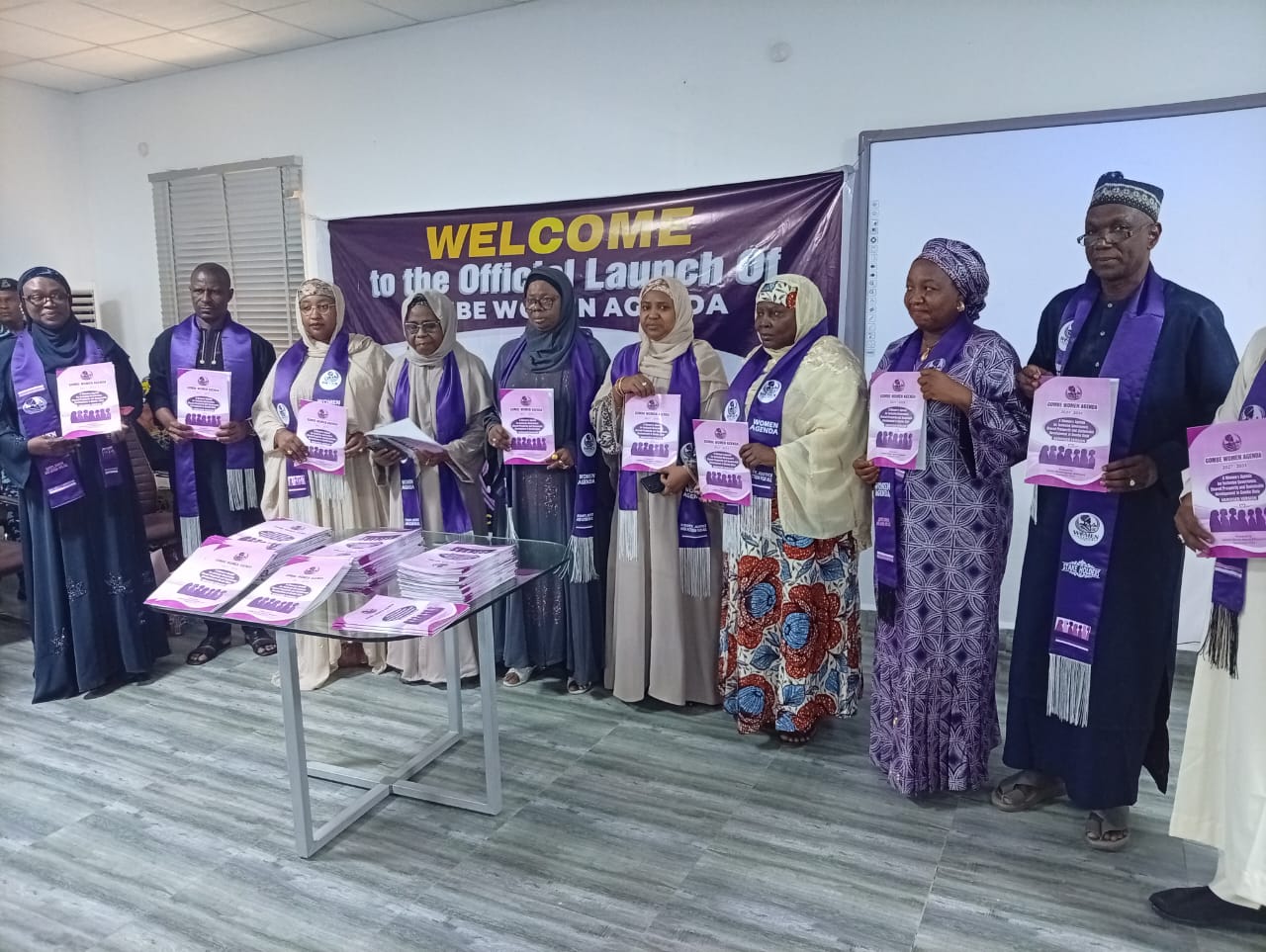
The demands were made at the unveiling of the Gombe Women Agenda 2027–2031, a policy advocacy initiative designed to influence government priorities and hold political leaders accountable for commitments to gender-inclusive development.
Speaking at the event, the Chairman of the Gombe State Civil Service Commission, Hajiya Rabi Shuaibu Jimeta, challenged women to build a united front and assert their place in political leadership and public decision-making.
She argued that fragmented efforts and individual ambitions would undermine the struggle for equitable representation, emphasising the importance of solidarity among women.
“The advancement of Gombe State cannot be complete without the meaningful participation, contributions and leadership of women,” she said.
Drawing from her personal experiences, Jimeta recalled growing up at a time when educating female children was unpopular in some communities.
She explained that her father defied societal pressure in the early 1960s by enrolling his daughters in school, a decision that laid the foundation for her professional journey, which culminated in her retirement as a Federal Permanent Secretary.
According to her, women who have attained leadership positions must deliberately create opportunities for younger generations to succeed.
Jimeta acknowledged the strides made by the current administration in expanding women’s representation in public institutions, citing the appointments of a female Chief Judge, three female commissioners and women to head the State Internal Revenue Service and Teachers Service Commission.
She, however, urged political parties and candidates seeking elective positions in 2027 to present clear policy commitments backed by measurable implementation strategies rather than mere campaign assurances.
The President of the Gombe Women Agenda Movement, Zariyatu Abubakar Hashidu, described the initiative as a roadmap for addressing longstanding barriers limiting women’s participation in governance and socioeconomic development.
Hashidu explained that the document reflected the priorities and aspirations of women drawn from the state’s 11 local government areas.
She identified political inclusion, access to education, economic opportunities, healthcare, prevention of gender-based violence, peacebuilding and social inclusion as some of the issues addressed by the initiative.
According to her, the agenda comprises 10 strategic pillars, complemented by a Charter of Policy Commitments, the Gombe Women Governance Compact and an Accountability Framework.
She maintained that the movement was independent of partisan interests and would engage political stakeholders regardless of their affiliations to ensure that commitments made before elections translate into concrete outcomes between 2027 and 2031.
On education, the Gombe State Coordinator of the Adolescent Girls Initiative for Learning and Empowerment (AGILE), Dr Amina Haruna Abdul, raised concerns over the sustainability of educational interventions benefiting vulnerable girls.
She disclosed that scholarship schemes and other support mechanisms introduced under AGILE had enabled many girls who previously abandoned their education to resume learning.
Abdul, however, warned that the gains could be threatened if adequate arrangements were not made to support beneficiaries after the intervention programme winds down.
“Our fear is what will happen to these children after AGILE. When the scholarships are no longer available, what will happen to them? I believe this agenda will fill that gap if we collectively accept and implement it,” she said.
She also recognised the contributions of civil society organisations, particularly WILDAN, in implementing the Second Chance Education programme, which provides alternative learning opportunities for adolescent girls and young women who missed formal schooling.
In her contribution, the Chief Judge of Gombe State, Justice Halima Shamaki Muhammad, advocated a more responsive legal system capable of addressing the challenges confronting women and children.
She expressed concern over the incarceration of vulnerable children whose involvement in criminal activities could be linked to deprivation, parental neglect and inadequate social protection.
The Chief Judge urged relevant authorities to prioritise interventions that address the root causes of juvenile offending rather than relying solely on punishment.
She equally called for stronger legislation against rape and indecent assault, pointing out that sexual violence affects boys as well as women and girls.
Justice Muhammad emphasised that legislative reforms must reflect prevailing socioeconomic conditions and be accompanied by institutional mechanisms capable of guaranteeing effective enforcement.
The launch concluded with calls for sustained collaboration among government institutions, civil society organisations, political actors and community leaders to ensure that the Gombe Women Agenda becomes a practical instrument for advancing gender equality, rather than another policy document without implementation.
