

Concept for 400-Year Interstellar Starship Imagines Humanity’s Journey Beyond the Solar System
Concept for 400-Year Interstellar Starship Imagines Humanity's Journey Beyond the Solar System

Concept for 400-Year Interstellar Starship Imagines Humanity’s Journey Beyond the Solar System
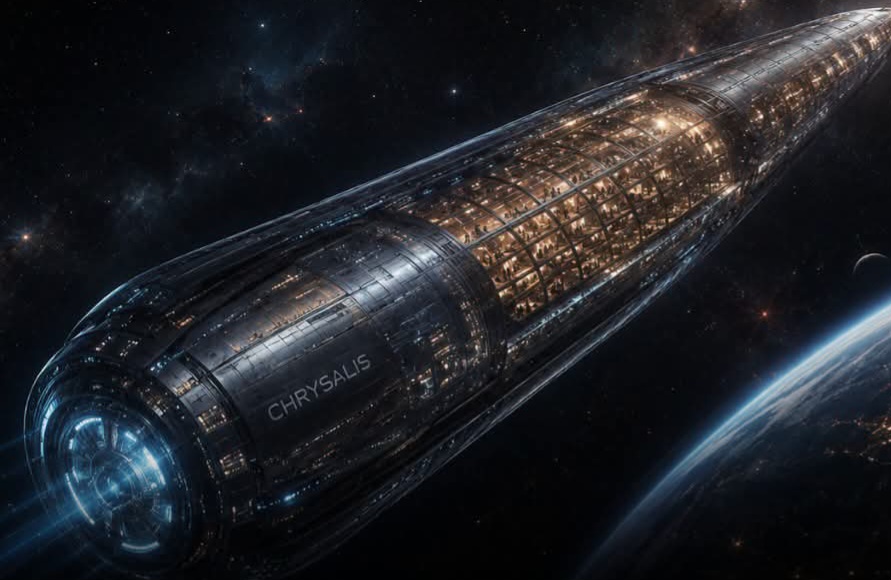
A futuristic concept for a giant interstellar spacecraft designed to carry humans on a centuries-long journey to another star system is drawing global attention, offering a glimpse into what long-term space exploration could look like.
Known as Chrysalis, the proposed spacecraft was developed as part of the Project Hyperion Design Competition, an international competition that brings together scientists, engineers, architects and urban planners to explore concepts for future human settlement beyond Earth.
The conceptual design envisions a 36-mile (about 58-kilometre) long generation ship capable of transporting approximately 2,400 people on a one-way mission to Alpha Centauri, the nearest star system to Earth, located about 4.37 light-years away.
Unlike conventional spacecraft, Chrysalis is designed to function as a self-sustaining space habitat. Its layered, rotating structure—often compared to a Russian nesting doll—is intended to generate artificial gravity while accommodating residential areas, farms, forests, factories and essential life-support systems needed to sustain multiple generations of inhabitants.
Under the proposed design, the voyage would take an estimated 400 years, meaning the original passengers would never reach the destination. Instead, successive generations born aboard the spacecraft would continue the journey until the mission’s completion.
The proposal also suggests that future crew members could undergo decades of preparation in an isolated environment, such as Antarctica, to simulate the challenges of living in a completely self-contained society before launch.
Although Chrysalis remains a conceptual design and is not an active space mission, it has generated widespread discussion among scientists and space enthusiasts about the future of human space exploration, the possibility of interstellar travel, and the social, technological and ethical challenges of sending generations of people on a voyage beyond the Solar System.
The project highlights how advances in engineering, sustainable habitat design and long-term planning could one day shape humanity’s ambitions to explore distant worlds, even if such missions remain far beyond current technological capabilities.
Concept for 400-Year Interstellar Starship Imagines Humanity’s Journey Beyond the Solar System
