


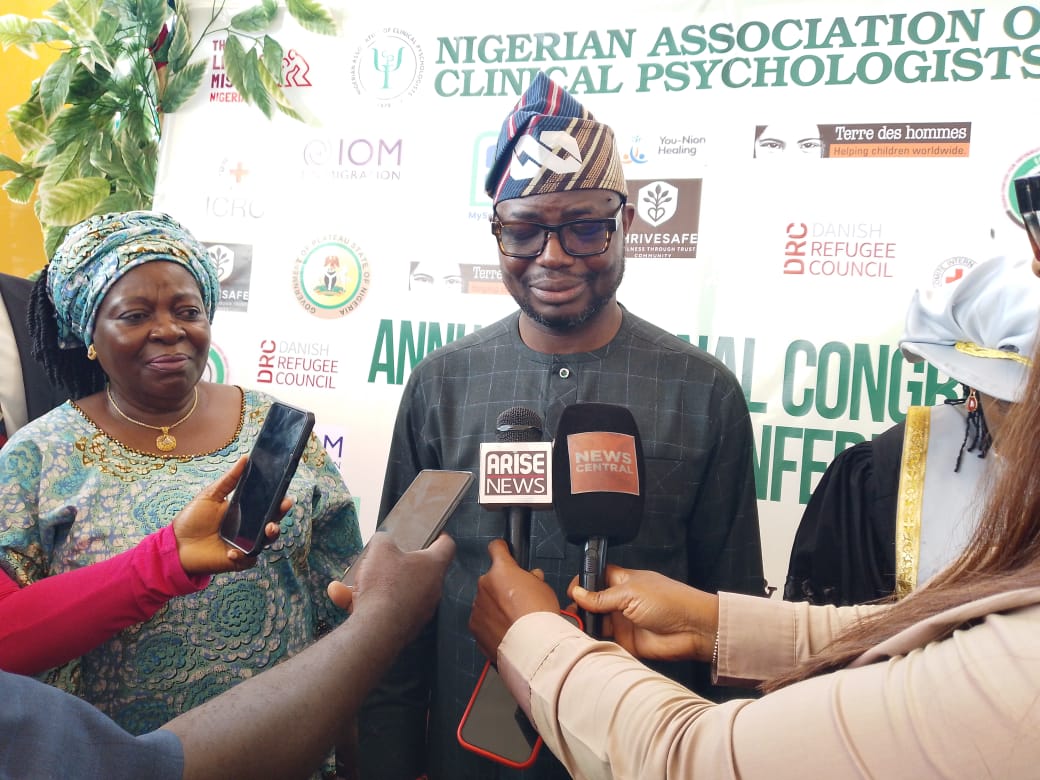
Doro Seeks Integration of Mental Health Support into Humanitarian Interventions
By Comfort Pius, Jos
The Minister of Humanitarian Affairs and Poverty Reduction, Hon. Dr Bernard M. Doro, has called for the integration of mental health and psychosocial support into humanitarian interventions, warning that the psychological effects of conflict often persist long after violence has subsided.
Doro made the call while chairing the 2026 Annual National Congress and Scientific Conference of the Nigerian Association of Clinical Psychologists (NACP), held on Monday at Crispan Hotel, Jos, Plateau State, with the theme, “Bridging Research and Practice: The Role of Clinical Psychologists in Building Resilient Communities in Humanitarian Context.”
He said affected communities needed more than emergency relief, food supplies and reconstructed homes to recover fully from the effects of violence and displacement, stressing that psychological healing was essential to lasting recovery.
According to him, trauma can continue to affect children, parents and young people long after immediate security threats have been addressed, with consequences for education, family relationships, livelihoods and community development.
“A crisis does not end when the shooting stops,” Doro said, noting that the psychological wounds of conflict must also be addressed if humanitarian interventions are to achieve sustainable results.
The minister described mental health as a critical issue linked to security, education and economic development, rather than an optional addition to humanitarian assistance.
He urged clinical psychologists, researchers and humanitarian stakeholders to develop practical approaches that would translate scientific findings into effective interventions for communities affected by conflict and displacement.
Highlighting the Federal Government’s approach to humanitarian delivery, Doro spoke about the One Humanitarian, One Poverty Response System (OHOPRS), an initiative designed to bring humanitarian response, social protection and poverty reduction under a coordinated delivery framework.
He explained that the approach was intended to move vulnerable households beyond short-term relief towards sustainable livelihoods, skills acquisition, education and long-term recovery.
However, Doro acknowledged that financial assistance and the rebuilding of homes alone could not address the psychological consequences of conflict.
“A rebuilt house is not a home if the family inside it is still reliving the night of that attack,” he said, advocating the integration of mental health and psychosocial support into standard humanitarian response.
The minister called on the NACP to collaborate with his ministry to develop a practical framework for incorporating mental health and psychosocial support into humanitarian programmes.
He also challenged researchers to provide evidence that could guide government policies and interventions, including identifying effective approaches, determining their costs and assessing how they could be implemented in communities where specialist services were limited.
Doro further advocated training healthcare workers and community volunteers, under professional supervision, to provide psychological first aid in areas that clinical psychologists might find difficult to reach.
He stressed that Nigerian institutions and professionals must be at the centre of efforts to develop sustainable solutions to the country’s humanitarian challenges.
In a separate interaction with journalists, Doro reassured the people of Plateau State that President Bola Ahmed Tinubu is making efforts to address security challenges across the country.
He, however, emphasised that efforts to end violence must be accompanied by measures to address its psychological consequences, describing clinical psychology as an important component of humanitarian intervention.
According to the minister, the conference provided an opportunity for professionals and researchers to strengthen collaboration and identify practical ways of translating research into support for affected populations.
He observed that psychosocial support had not received sufficient attention in Nigeria’s humanitarian response and expressed the need for sustained engagement between government institutions and mental health professionals.
Earlier, the Chairman of the Local Organising Committee, John Gana, said the conference was designed to move discussions beyond identifying problems to developing practical, evidence-based solutions that would strengthen the resilience of displaced and vulnerable populations.
Gana urged clinical psychologists, researchers and humanitarian stakeholders to ensure that research findings did not remain confined to academic journals and conference halls but were translated into meaningful interventions in communities where they were needed most.
He welcomed participants to Jos and expressed the organising committee’s commitment to making the conference intellectually stimulating and professionally rewarding.
Also speaking, the President of the Nigerian Association of Clinical Psychologists, Professor Gloria S. Karuri, expressed appreciation to the Plateau State Government, development partners, sponsors and other stakeholders for supporting the association’s activities.
Karuri disclosed that the association envisioned establishing offices and specialised therapy centres across the states of the federation to improve access to mental healthcare.
She stressed that mental healthcare must be accessible and affordable, particularly for communities affected by humanitarian emergencies.
The association also expressed its desire to acquire a permanent headquarters in the Federal Capital Territory to serve as its administrative base and a resource centre for members across the country.
The conference brought together clinical psychologists, academics, researchers, students, humanitarian stakeholders and development partners to deliberate on ways to strengthen the connection between scientific research and practical mental health interventions.
The discussions highlighted the need for stronger collaboration among government institutions, professional associations and humanitarian organisations to ensure that people affected by conflict receive not only material assistance but also the psychological support needed to rebuild their lives.
