

Nigeria’s Disability Population Estimated at 35 Million as New Data Pushes for Inclusive Planning

Nigeria’s Disability Population Estimated at 35 Million as New Data Pushes for Inclusive Planning
By Matthew Eloyi
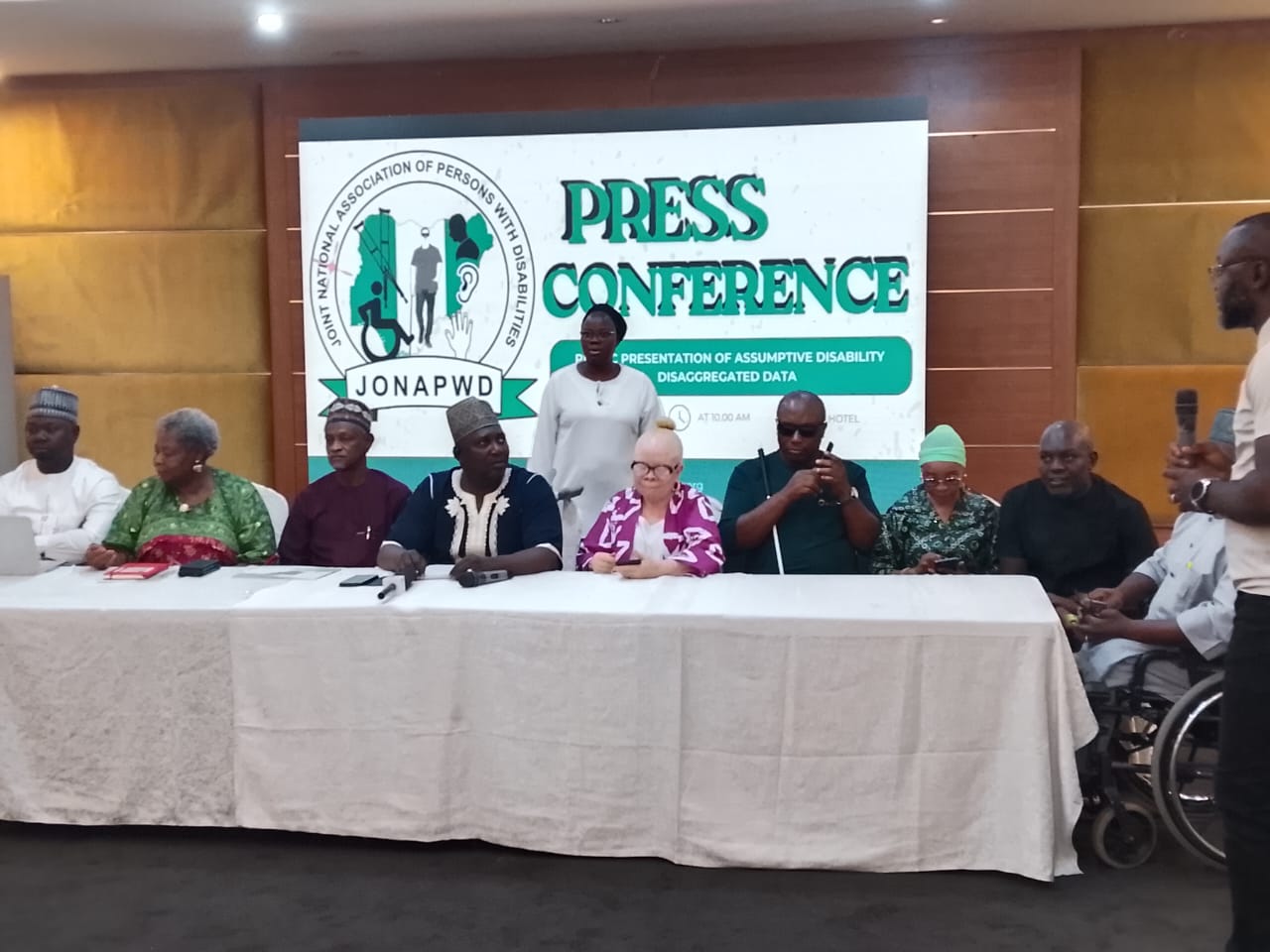
Nigeria may have as many as 35 million persons living with disabilities, according to newly presented assumptive demographic data unveiled by the Joint National Association of Persons with Disabilities (JONAPWD), highlighting the urgent need for reliable statistics to drive inclusive policies and development planning.
Speaking at a press conference during the public presentation of the disability-disaggregated data, the National President of JONAPWD, Aliyu A. Usman, said the report represents a crucial step toward addressing a longstanding gap in reliable demographic information about persons with disabilities in Nigeria.
Usman noted that for decades, the disability community has operated without a credible baseline dataset, making effective policy formulation and targeted interventions difficult. According to him, the new dataset applies the global benchmark that estimates persons with disabilities at about 15 per cent of any country’s population to Nigeria’s projected 2025 population figures.
“This report provides a clearer, though still evolving, picture of the magnitude of our community across the 36 states and the Federal Capital Territory,” he said.
The exploratory database estimates that Nigeria’s population of persons with disabilities stands at around 35 million. The analysis shows that Kano State has the highest estimated number of persons with disabilities at about 2.5 million, followed by Lagos State with approximately 2.1 million.
The report also provides a breakdown by disability type and gender. Physical disabilities make up the largest cluster with about 8.2 million persons, while the deaf community accounts for roughly 7.7 million people. Gender analysis indicates that male persons with disabilities number more than 17.6 million, while females account for about 17.2 million.
Usman explained that the dataset was enriched with insights from leaders of organisations of persons with disabilities across the country, whose lived experiences and advocacy work helped shape the estimates.
He, however, acknowledged gaps in the data, particularly concerning children and youth with disabilities, attributing the challenge to weak detection systems and inadequate disability-sensitive administrative structures in many states.
He added that the understanding of disability is evolving beyond visible impairments to include psychosocial disabilities, mental health conditions and other less visible forms of impairment, particularly among young Nigerians.
Also speaking, the Senior Special Assistant to President Bola Ahmed Tinubu on Special Needs and Equal Opportunities, Mohammed Abba Isa, commended JONAPWD for initiating the database project, describing it as a major step toward strengthening disability inclusion in the country.
He said the lack of credible and disaggregated data has long been a major barrier to effective policymaking for persons with disabilities.
Isa noted that the new dataset would support government efforts to build an official database for vulnerable populations and guide evidence-based planning.
He added that the administration of President Tinubu remains committed to supporting initiatives that generate reliable data to promote inclusive governance under its Renewed Hope Agenda.
According to him, the Office of the Senior Special Assistant to the President on Special Needs and Equal Opportunities will continue to collaborate with stakeholders, development partners and organisations of persons with disabilities to promote accessibility, inclusion and equal opportunities across all sectors.
