

Scholars Honour Buratai With Book on Defence, Intelligence and Statecraft

By Matthew Eloyi
A group of lecturers and researchers from universities across Nigeria has honoured former Chief of Army Staff (COAS), Lieutenant General Tukur Yusufu Buratai (rtd), CFR, with a new scholarly publication examining the intersection of defence, intelligence and statecraft in Nigeria.
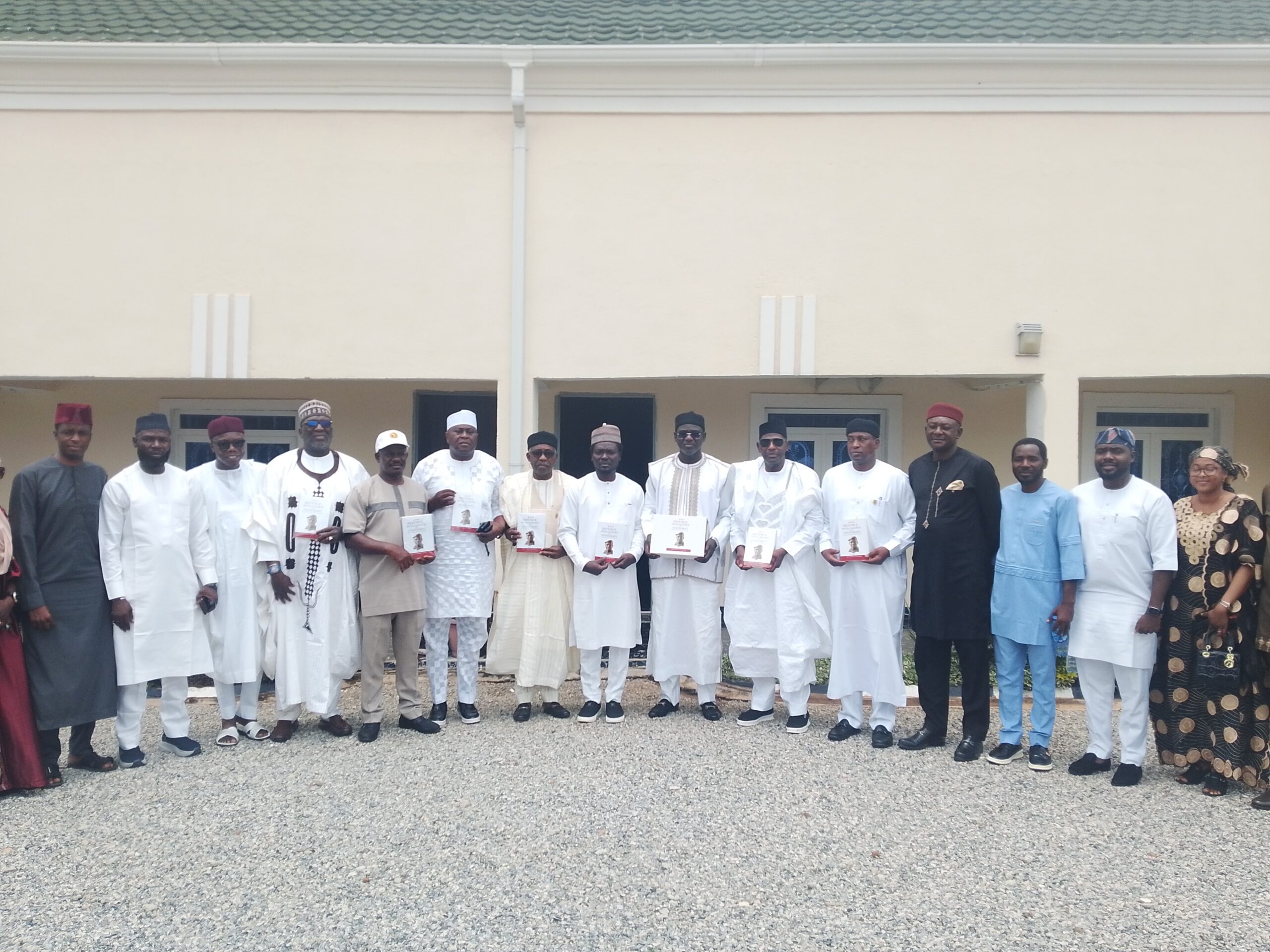
The academics, led by Associate Professor Sunday Adejoh and Dr. M.S. Abubakar, paid a courtesy visit to Buratai on Friday, during which they presented him with a newly published academic essay titled “Defence, Intelligence and Statecraft: A Festschrift for Lieutenant General T.Y. Buratai, Rtd, CFR.”
The publication brings together contributions from scholars, policy practitioners and senior security professionals to examine contemporary issues surrounding defence, intelligence and national security governance in Nigeria and beyond.
According to its editors, the volume is a scholarly tribute to Buratai, whose military career is presented as reflecting strategic leadership, institutional reform and commitment to national security. The book contains nine rigorously researched chapters dealing with contemporary challenges and opportunities in intelligence and defence governance.
The themes explored in the book include the foundations of intelligence, the institutional architecture of Nigeria’s national security system, civil-military relations, strategic decision-making, inter-agency cooperation, defence intelligence in a global context, emerging technologies and threats, as well as capacity building and professionalism within the intelligence community.
Speaking during the presentation, Adejoh said the decision to honour Buratai with the publication was informed by his contributions to Nigeria’s defence and security architecture.
He said the honour was not a routine gesture but a deliberate attempt to document the former Army chief’s contributions for present and future generations.
According to him, Buratai’s experience and contributions at the strategic, tactical and operational levels made him an appropriate subject for a book dealing with defence intelligence and statecraft.
“Your experiences, your contributions, both at the strategic, at the tactical, and at the operational level, cannot really be overemphasized,” Adejoh said.
He argued that Buratai’s career demonstrated the importance of intelligence in military leadership, resource management and national security decision-making, while his subsequent appointment as Nigeria’s ambassador reflected the dimension of statecraft associated with his career.
Adejoh also pointed to structural changes undertaken in the Nigerian Army during Buratai’s tenure as Chief of Army Staff, particularly the creation of new formations and forward operating bases in response to emerging security threats.
He said the scholars deliberately brought together researchers from different parts of the country, including the South-West, North-Central and North-East, to contribute to the publication.
Adejoh explained that the objective was to create a lasting intellectual record of Buratai’s contribution to national security.
“It is important to honor you while you are still alive. It is important that we honor you and put this down, that it will stand even above and ahead of you. Posterity will live to consult this masterpiece,” he said.
Also speaking, Dr. M.S. Abubakar said his decision to participate in the project was influenced by his personal interactions with Buratai, whom he credited with contributing to his knowledge of military studies.
Abubakar, who holds a PhD in military studies, said the publication was not intended as an exercise in flattery but as an effort to document contributions that deserved recognition.
He said scholars had a responsibility to continue drawing attention to positive contributions until they were properly acknowledged.
Abubakar also acknowledged Adejoh’s role as his former lecturer at Ahmadu Bello University, Zaria, and said the decision to feature Buratai in the book was reached jointly by the scholars.
In his response, Buratai commended the editors and contributors for the honour and specifically acknowledged Abubakar’s extensive writing and research work.
Although he noted that he had not yet read the full text of the book, Buratai said he had examined its synopsis and understood the background and objectives of the publication.
The former Army chief used the occasion to advocate a stronger emphasis on intelligence-driven approaches to addressing Nigeria’s security challenges, stressing the need to move beyond predominantly kinetic responses.
He argued that intelligence should be effectively integrated across the civil and military sectors and applied at tactical, operational and strategic levels.
According to him, appropriate investment and resource allocation to intelligence could enable security agencies to identify and neutralise threats at their embryonic stages before they develop into more serious security challenges.
Buratai further highlighted what he described as the essential nexus between defence, intelligence and statecraft, linking the three to the effective management of people and resources.
He described intelligence as a foundational tool for understanding intentions through the observation of behaviour and relationships, arguing that the principle applies across different levels of human organisation, from families to nations.
He likened effective leadership in governance and administration to the management of a household, where coordination, awareness and understanding are essential for achieving desired outcomes.
The former COAS also recommended the publication as a teaching and reference resource for military and security institutions, including the Nigerian Defence Academy, National Defence College and Armed Forces Command and Staff College, as well as security agencies such as the Nigeria Police Force and the Department of State Services.
He further expressed his commitment to supporting intellectual works that contribute to the development of Nigeria’s defence and security architecture.
Beyond its commemorative purpose, the publication is positioned by its editors as a contribution to scholarship, policymaking and professional practice. It is intended to serve policymakers, military and intelligence professionals, academics, researchers and students seeking a deeper understanding of the role of intelligence in contemporary defence strategy and statecraft.
The presentation therefore combined recognition of Buratai’s career and contributions with a broader call for stronger intellectual engagement with Nigeria’s evolving security environment, particularly through intelligence, institutional cooperation, professional capacity building and strategic decision-making.
