

Two Decades of EFCC: Billions Recovered, Hundreds Prosecuted, Yet Nigerians Still Ask—Has Corruption Reduced?
Two Decades of EFCC: Billions Recovered, Hundreds Prosecuted, Yet Nigerians Still Ask—Has Corruption Reduced?

Two Decades of EFCC: Billions Recovered, Hundreds Prosecuted, Yet Nigerians Still Ask—Has Corruption Reduced?
Since the establishment of the Economic and Financial Crimes Commission (EFCC) in 2003, the agency has remained Nigeria’s foremost institution in the fight against corruption, money laundering, advance fee fraud and other financial crimes.
Over the past two decades, the Commission has investigated thousands of suspects, prosecuted politically exposed persons, former governors, ministers, bankers, public officials and business executives, while announcing the recovery of billions of naira and millions of dollars in stolen assets.
Successive EFCC chairmen—from Nuhu Ribadu, Farida Waziri, Ibrahim Lamorde, Ibrahim Magu, Abdulrasheed Bawa to the current Chairman, Ola Olukoyede—have all promised to strengthen Nigeria’s anti-corruption campaign.
Yet, despite years of investigations, arrests and high-profile prosecutions, corruption continues to rank among Nigeria’s biggest governance challenges.
High-profile investigations
Over the years, the EFCC has investigated or prosecuted several prominent public officials and politically exposed persons.
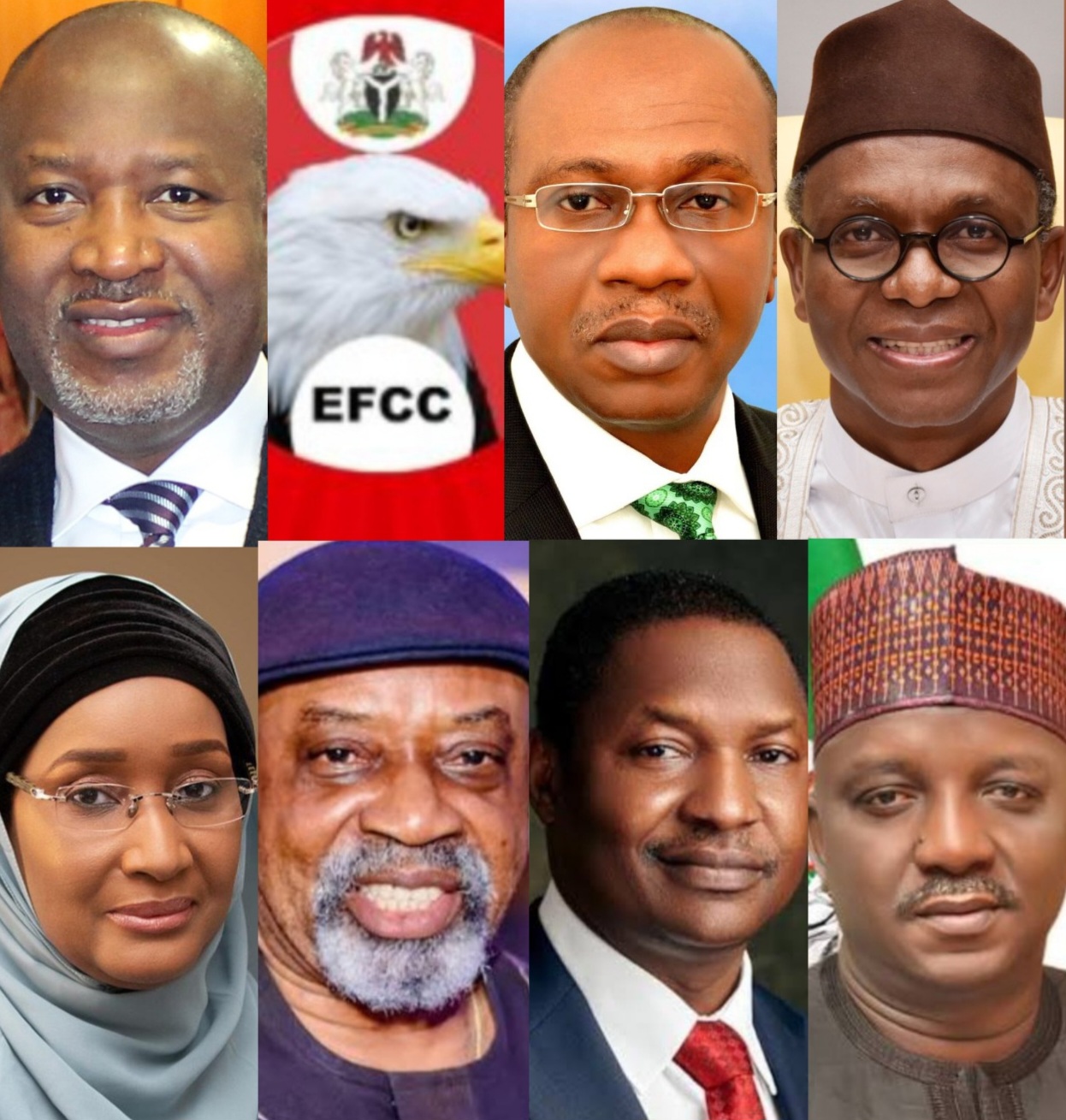
Some of the widely reported cases include Former Kaduna State Governor Nasir El-Rufai, Abubakar Malami former Attorney-General of the Federation, Dr. Mustapha Abdullahi Director-General of the Energy Commission of Nigeria, Hadi Sirika, former Aviation Minister, Chris Ngige former Minister of Labour and Employment, former Central Bank Governor Godwin Emefiele, former Aviation Minister Hadi Sirika, former Humanitarian Affairs Minister Sadiya Umar Farouq, former Power Minister Saleh Mamman, former governors, legislators, senior civil servants and bank executives.
The Commission has also prosecuted numerous cybercrime suspects, oil subsidy fraud suspects, procurement fraud cases and financial institution officials.
While some cases have resulted in convictions and asset forfeitures, many others remain before the courts years after they were filed.
Under Nigerian law, every accused person is presumed innocent until proven guilty by a competent court.
Recovery of public assets
One of the EFCC’s most visible achievements has been the recovery of stolen assets.
The Commission regularly announces recoveries running into billions of naira, foreign currencies, luxury vehicles, landed properties and other assets linked to corruption and financial crimes.
Some recovered assets have been forfeited permanently to the Federal Government through court orders, while others remain subjects of ongoing litigation.
According to the agency, many recovered funds are paid into designated Federal Government accounts, while forfeited assets are managed in accordance with court orders and existing laws.
The question many Nigerians ask
Despite these recoveries, one question continues to resonate among many Nigerians:
Where do all the recovered funds go?
This question has become a recurring subject of public debate, especially whenever the EFCC announces the recovery of huge sums running into billions or even trillions of naira.
Government agencies have maintained that recovered funds are remitted into government accounts and are expected to be used for national development in line with legal procedures.
However, civil society organisations and governance experts have repeatedly called for greater transparency in tracking recovered assets and how they are eventually utilised.
Why corruption persists
Experts argue that arrests alone cannot eliminate corruption.
Among the major challenges frequently identified are:
Prolonged court cases.
Weak institutional accountability.
Political interference allegations.
Delays in prosecution.
Plea bargain controversies.
Weak enforcement across some public institutions.
Many observers believe that while the EFCC has recorded notable successes, stronger judicial reforms and greater transparency are needed to ensure that anti-corruption efforts produce lasting results.
Beyond arrests
Anti-corruption analysts say success should not be measured only by the number of arrests or the value of recovered assets.
Rather, they argue, success should also be reflected in:
Reduced corruption levels.
Faster prosecution of cases.
More convictions based on due process.
Improved public accountability.
Better management of recovered assets.
Increased public confidence in anti-corruption institutions.
The road ahead
More than twenty years after the EFCC was established, the fight against corruption remains one of Nigeria’s biggest national challenges.
The Commission continues to investigate and prosecute financial crimes, but many Nigerians believe the ultimate measure of success will not simply be the billions recovered or the number of high-profile arrests announced.
Instead, they say the real victory will come when public resources are protected, corruption is significantly reduced, institutions become stronger and Nigerians can clearly see how recovered assets are returned to national development.
Two Decades of EFCC: Billions Recovered, Hundreds Prosecuted, Yet Nigerians Still Ask—Has Corruption Reduced?
