


When Politics Builds Roadblocks: The Shame of Blocking Peter Obi in Benue
Nigeria’s democracy is already burdened by too many things: insecurity, poverty, unemployment, distrust in public institutions and a political class that too often treats power as personal property.
The last thing the country needs is the emergence of another dangerous political culture in which opposition politicians are physically prevented from entering communities or meeting citizens.
That is why the reported obstruction of the convoy of Peter Obi in Benue State deserves unequivocal condemnation.
Whatever political differences exist between Peter Obi and his opponents, no Nigerian politician should be stopped from moving around the country by mobs or thugs.
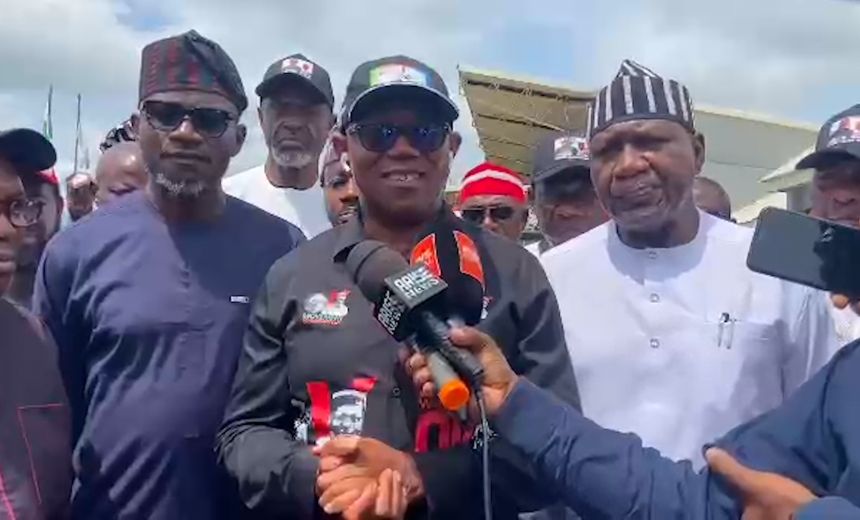
Obi, presidential candidate of the Nigeria Democratic Congress (NDC), travelled to Benue on Tuesday and said he intended to visit Yelewata to commiserate with families affected by the deadly violence that struck the community in 2025. His convoy was stopped along the Makurdi-Gboko road by youths who reportedly barricaded the highway and chanted for him to leave.
The Benue State Government has denied responsibility. It says it was not aware of Obi’s visit and has rejected his allegation that government-linked individuals organised the obstruction. The Commissioner for Information, Solomon Lorpev, said the government was investigating what happened and challenged those alleging the involvement of government officials to provide evidence.
Those denials should be taken seriously. But they do not make the incident less disturbing.
The central issue is simple: a group of people physically blocked a presidential candidate from proceeding to a community in a Nigerian state. That should concern every democrat, irrespective of political affiliation.
The Constitution is not optional
Nigeria’s Constitution does not give citizens freedom of movement only when their political views are convenient to those in power.
Section 41 provides that every Nigerian citizen is entitled to move freely throughout the country and reside in any part of it, subject only to narrowly defined lawful restrictions.
The Constitution also protects peaceful assembly and association, including the right to belong to political parties. The National Human Rights Commission has repeatedly underscored the importance of these freedoms to democratic participation.
Therefore, if a prominent opposition politician has committed no offence and there is no lawful order restricting his movement, the appropriate response to his presence is not a roadblock, intimidation or a mob.
If people disagree with Peter Obi, they have every democratic right to reject his politics. They can boo him. They can criticise his policies. They can campaign against him. Most importantly, they can vote against him.
What they cannot legitimately do is replace the ballot box with the barricade.
The Benue Government has questions to answer — even if it did not organise the blockade
The Alia administration insists that it had no knowledge of Obi’s visit and that proper security coordination should have preceded the movement of a presidential candidate.
There may be legitimate security considerations surrounding the visit of a major political figure. The government is entitled to insist on appropriate coordination with security agencies. But protocol cannot become a political veto.
If there was inadequate notification, the solution was for the relevant authorities to coordinate security arrangements, not for private citizens to mount a roadblock.
Indeed, the Benue Government itself has acknowledged that recognised security agencies, rather than thugs, should handle legitimate security concerns. That is precisely the point.
If Obi’s visit presented a security threat, where were the police?
If there were legitimate restrictions on the route, who issued them?
If there was no restriction, who authorised private citizens to block a public highway and prevent a presidential candidate from proceeding?
These are questions that cannot simply disappear beneath competing political statements.
A dangerous precedent
Nigeria has seen enough of political intolerance.
For decades, political contests have sometimes been accompanied by intimidation, violence, harassment and the use of state or party structures to frustrate opponents.
The lesson Nigeria should have learnt by now is that political violence rarely remains confined to its original target.
Today it may be Peter Obi.
Tomorrow it could be another opposition candidate.
The next day, it could be a governor, a senator, a journalist, an activist or an ordinary citizen whose views have become inconvenient.
That is why the principle matters more than the individual.
The newly enacted Electoral Act 2026 is particularly instructive. It provides that the role of the police and other federal security agencies at political rallies, processions and meetings is to provide adequate security, and states that registered political parties, aspirants and candidates should not be prevented from holding political rallies, processions or meetings for constitutional political purposes.
The spirit behind such provisions is unmistakable: political competition must be settled through democratic engagement, not coercion.
A visit to grieving families should never become a political battlefield
There is also something deeply troubling about the circumstances surrounding Obi’s proposed visit.
Yelewata became a symbol of Nigeria’s continuing security crisis after the killings that devastated the community. Obi said his purpose was to meet affected families, offer condolences and listen to their concerns.
Even if one believes his visit had a political dimension — and politicians rarely travel without political calculations — that should not diminish the right of citizens to receive him.
Indeed, if a politician wants to turn a humanitarian visit into political capital, the answer is not to prevent him from going.
The answer is to expose the political calculation and let Nigerians judge it.
Politics should be contested with ideas, evidence and votes.
The police must investigate
The most responsible way forward is for the security agencies to establish exactly what happened.
Who mobilised the youths?
Who financed or coordinated them, if anyone did?
Were any political appointees involved?
Were weapons carried?
Were threats made?
Was there a prior security directive?
Did the police receive advance notification of Obi’s visit?
And, critically, why was a public highway allowed to become the scene of a political confrontation?
Reports indicate that the police acknowledged the obstruction and that an investigation was underway.
That investigation must not become another Nigerian investigation that produces headlines today and disappears tomorrow.
If government officials were involved, they should be held accountable.
If opposition actors fabricated allegations against the government, that should also be established.
If ordinary youths acted independently, the public deserves to know what motivated them.
Facts, not propaganda, are what Nigeria needs.
Let the ballot be the battlefield
Perhaps the most revealing aspect of this incident is that it occurred as Nigeria moves closer to the 2027 general elections.
The political temperature will inevitably rise.
More candidates will travel across states. More rallies will be held. More accusations will be exchanged. Supporters will clash on social media and politicians will attack one another with increasingly colourful language.
But there must be a red line.
That red line is physical intimidation.
Minister of Aviation Festus Keyamo, reacting to the Benue incident, made essentially the same point, arguing that anyone angry with a candidate should express that anger through the ballot rather than violent acts during campaigns.
That is the minimum standard Nigeria should demand.
Peter Obi does not have to be popular.
He does not have to be supported.
He does not have to be welcomed by everyone in Benue.
But he must be allowed to move, speak and engage citizens within the law.
The same principle must apply to every other presidential candidate — whether from the ruling party or opposition, whether popular or unpopular, whether one agrees with his politics or considers it misguided.
Democracy cannot survive when politicians need permission from mobs to travel through Nigeria.
Benue, a state that has suffered terribly from insecurity, should be especially wary of normalising another form of intimidation.
The state does not need political roadblocks.
Nigeria does not need political thuggery dressed up as popular anger.
And Nigerians certainly do not need a 2027 election in which candidates are physically prevented from reaching voters.
If Peter Obi is wrong, defeat his ideas. If his politics is unpopular, defeat him at the polls. If his visit was politically motivated, expose the motive. If he violated a lawful requirement, enforce the law.
But do not put a roadblock between a Nigerian citizen and his constitutional rights.
The ballot box, not the barricade, must decide Nigeria’s political future.
