


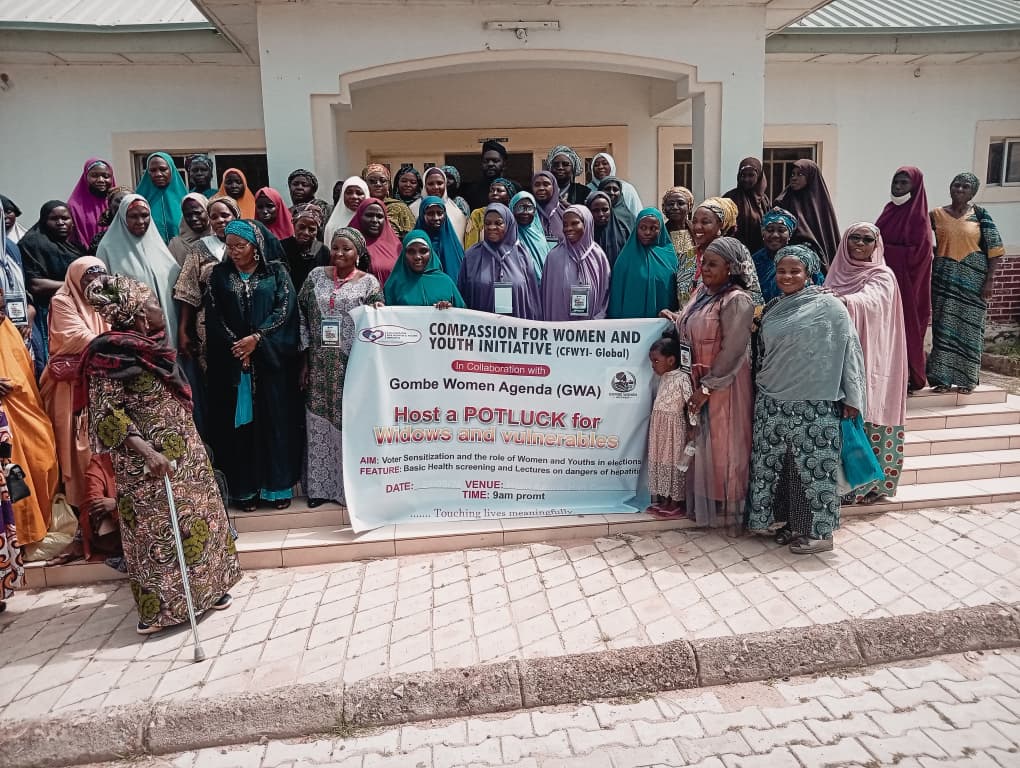
Your Vote, Your Future: Gombe Women’s Groups Launch Election Sensitisation
By Auwal Ahmad Umar
Women and youths in Gombe State have been urged to think carefully about their choices at the ballot box and not allow campaign gifts or financial inducements to determine who they vote for.
The call was made during a pre-election sensitisation programme organised by Compassion for Women Initiative and Gombe Women Agenda to encourage women to make informed choices and resist political manipulation ahead of the forthcoming elections.
The organisers said the programme was prompted by concerns that poverty and the rising cost of living could make some women vulnerable to politicians who offer money, food, clothing and other items during campaigns.
Speaking at the programme, Amb. Ibrahim Yusuf, Chairman of the Gombe Civil Society Network (GONET) and Convener of Gombe Women Agenda, represented by Auwal Ahmad Umar, said the initiative was designed to help women understand the importance of their votes.
Mr Yusuf said economic hardship often leaves people in difficult situations where immediate assistance from politicians can appear attractive.
He, however, urged women to look beyond such temporary benefits and consider what candidates could offer in terms of good governance and development.
“Any person giving you money to vote for him will not give you the dividends of democracy, which include security, quality education, healthcare and other development,” he said.
He listed cash, food, clothing and other material items among the common forms of inducement used during election campaigns.
The State Coordinator of Compassion for Women and Youth Initiative, Hajiya Fatima Abdullahi, said the programme was particularly important because women and youths make up a large part of the electorate.
She said the organisations were concerned that women facing financial difficulties could easily be influenced by small amounts of money or other gifts offered during election campaigns.
“We looked at the fact that the elections are coming and the preparations, as we know, for campaigns. The usual thing we are afraid of is the giveaways to the masses,” she said.
Ms Abdullahi said a woman struggling to feed her family might see a bag of food, clothing or some money from a politician as an opportunity to solve an immediate problem.
Rather than telling such women outright to reject the gifts, she said the organisation’s message was to separate accepting assistance from deciding who to vote for.
“We cannot tell them not to collect. What if we make the mistake of telling them not to collect? We lose them. So, what we tell them is: collect, but vote rightly,” she said.
She said the important thing was for women to retain their freedom to make their own choices at the polling unit.
The Assistant Secretary of Gombe Women Agenda, Fatima Chadi, also urged women not to allow politicians or influential individuals to dictate their choices through threats, intimidation or religious sentiments.
She warned against situations where voters are asked to swear that they will support a particular candidate in exchange for money or other benefits.
Ms Chadi said women should be allowed to make their political choices freely and based on their assessment of the candidates.
She added that the programme was also intended to create a support system where vulnerable women could speak about their challenges, receive advice and seek assistance.
Describing the initiative as a “stepping stone”, Ms Chadi said changing voting behaviour and addressing the challenges facing women would require continued engagement beyond the election period.
The organisers said their goal was to help women and youths understand the power of their votes and assess candidates based on their competence, integrity, policies and ability to deliver meaningful development.
They urged participants to consider the long-term interests of their families and communities when making decisions at the polls, rather than exchanging their votes for temporary political benefits.
