


Strategic Embrace, Private Reservations: The Obi–Kwankwaso Alliance
By Ameh Abraham
There are political alliances that make sense on paper, and there are those that make sense only in the desperate hours before an election. The newly formed partnership between Peter Obi and Rabiu Kwankwaso, now formalized under the Nigeria Democratic Congress (NDC), belongs to a third category: the kind that makes perfect sense until you look at it too closely.
When the two men finally aligned politically in early May 2026, many Nigerians reacted the way football fans react after a last-minute transfer deal: excitement first, questions later.
READ ALSO: Tinubu-Ojo Threatens Protest Over Alleged Manipulation of Lagos APC Primaries
Social media erupted. Supporters celebrated. Analysts drew electoral maps. Political commentators suddenly became mathematicians, calculating voting blocs from Kano to Onitsha.
On paper, the alliance looks formidable.
One man commands passionate urban youth support and elite frustration with the old order. The other commands are one of the most disciplined grassroots political structures in Northern Nigeria. One speaks the language of technocratic reform. The other understands the hard arithmetic of northern political mobilisation.
Together, they potentially bridge demographics, geography, religion, and generational frustration.
But Nigerian politics is not only about mathematics. It is also like chemistry. And chemistry is sometimes unpredictable.
This alliance may either become a historic coalition or one of the most sophisticated misunderstandings in recent political history.
How They Sold It to Themselves (And to Us)
Kwankwaso, never one to under-explain, gave his most detailed account yet on Arise TV (May 10, 2026). He traced the alliance back to the First Republic, invoking the ghosts of Tafawa Balewa and Nnamdi Azikiwe. He reminded everyone of Shehu Shagari and Alex Ekwueme. He essentially argued that North-Southeast partnerships are not just strategic but historical—almost ancestral.
“We are going back to what Tafawa Balewa did during their time,” he said, with the confidence of a man who has clearly rehearsed this speech in the mirror.
Kwankwaso also dismissed concerns about a hidden power struggle. “The problem people are having, especially leaders, is that they are too greedy to the extent that they begin to have issues,” he said. “There is so much to do. You don’t have to fight your deputy.”
That last line is doing a lot of heavy lifting. In Nigerian politics, fighting your deputy is practically a tradition. From Aikhomu to Atiku to Osinbajo, the Nigerian vice presidency has often been described as the world’s most powerful waiting room. To suggest that Kwankwaso and Obi will not eventually glare at each other over who gets the final say is either naive or genius.
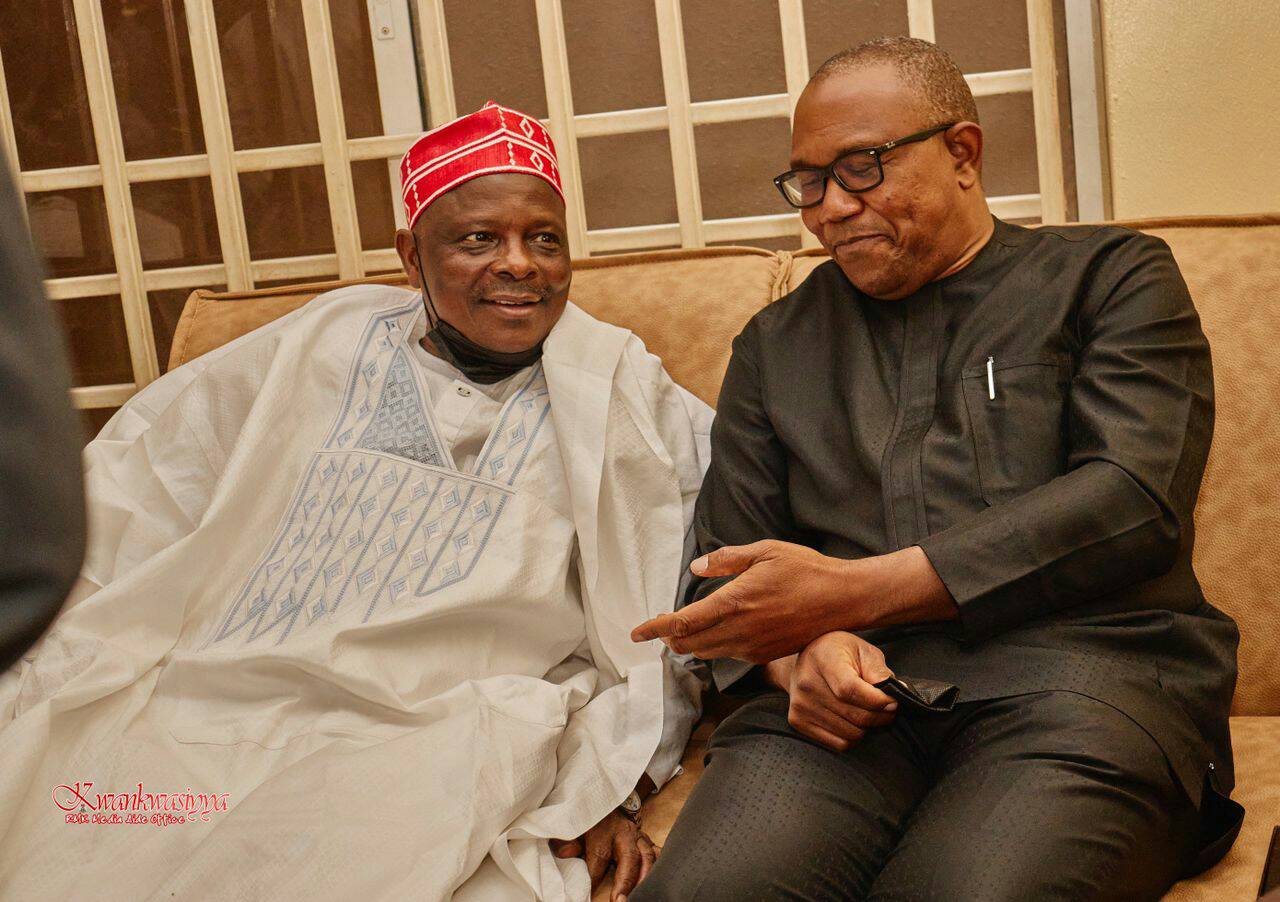
And then came the photograph that everyone shared but no one wanted to over-analyze.
On Tuesday night, May 19, 2026, shortly after the NDC’s screening committee cleared Obi as the party’s sole presidential aspirant, the former Anambra governor paid a courtesy visit to Kwankwaso at his Maitama residence in Abuja. The photographs show two men seated comfortably, smiling, engaged in what looks like a relaxed conversation. Kwankwaso later posted on X: “Last night, I received a courtesy visit from my brother, His Excellency Peter Obi, shortly after his successful screening as the presidential aspirant of our party, the NDC. The future is bright and full of promise.”
It was the kind of political photograph that says everything and nothing at the same time. Two men in a room. Two ambitions under one roof. Two political cultures trying to smile in the same direction.
The Deep Structural Divide Nobody Wants to Name
Here is the uncomfortable truth that the smiling photographs cannot hide: Kwankwaso’s political machinery, the famous Kwankwasiyya movement, is not built on Twitter trends or viral hashtags. It is built on long-standing grassroots loyalty, patronage structures, physical mobilisation, and deep northern political identity.
Obi’s “Obidient” movement, on the other hand, emerged as a largely anti-establishment uprising fuelled by youth anger, social media organisation, and urban discontent.
These are not naturally identical political cultures.
One side believes in disciplined political hierarchy. The other thrives on decentralised activism. One understands politics as structure. The other often understands politics as moral rebellion.
Trying to merge both may resemble mixing fire and generator fuel: powerful, but volatile.
As the BBC Pidgin analysis noted, the real test will not be the handshake at the convention. It will be the moment when hard choices about power-sharing, candidate selection, and campaign strategy have to be made. That is when alliances either mature into movements or disintegrate into mutual accusations.
The Skeptics Are Having a Field Day
Not everyone is buying the happy marriage narrative.
Ndigbo for Tinubu (NDI-ABAT), a group whose name alone suggests they have fully embraced the absurdity of Nigerian political nomenclature, dismissed the Obi-Kwankwaso ticket as lacking substance. They predicted it would “crumble like a pack of cards.”
That is the kind of colourful imagery that Nigerian political analysts love. But here is the uncomfortable truth: they might not be entirely wrong.
The Obidient movement was built on anti-structure. It was a spontaneous combustion of frustration, not a carefully engineered machine. Can those same voters who despise the old order warm up to a traditional party structure like the NDC? Can they trust a man like Kwankwaso, who has been in and out of the establishment more times than a revolving door?
And on the other side, can Kwankwaso’s northern base accept a southern presidential candidate? Kwankwaso himself says yes. His political instincts say maybe. But his opponents in Kano could say something else entirely.
A report by Independent.ng argued that the joint ticket “may be a game-changer” for the opposition, but only if both sides are willing to make sacrifices that neither has historically been willing to make. That is a big “if.” In Nigerian politics, sacrifice is usually something you demand from the other person.
The Kano Bombshell (Or: The Allegation That Won’t Go Away)
Here is where the satire sharpens into something like suspicion.
The Kano State Government which is currently not exactly friendly to Kwankwaso, made an explosive allegation. According to Sanusi Bature, Director General of Media and Publicity at Government House Kano, Kwankwaso may actually be working for President Tinubu.
Yes, you read that correctly. The man who just formed an opposition alliance to unseat Tinubu might, according to his local rivals, be a secret agent of the very man he claims to oppose.
Bature claimed that moves were initiated to engage the APC leadership, including an arrangement for a possible meeting with Tinubu. The meeting was reportedly cancelled because Kwankwaso said he was traveling to China. And then it was never rescheduled.
Now, this could be political mischief. It could also be true. In Nigerian politics, both are equally probable. And that is the real problem for the Obi-Kwankwaso alliance: not that it is weak, but that no one fully trusts it.
As the BBC Pidgin analysis put it, in Nigerian politics, such rumours are never fully dismissed because political defections here happen very frequently.
The Burden of Youth Hope
Perhaps the most fascinating part of the Obi-Kwankwaso story is the emotional investment of young Nigerians. Many youths are no longer merely supporting politicians; they are investing hope itself into political outcomes.
That is both powerful and risky.
Because when hope repeatedly collides with Nigerian political reality, cynicism eventually replaces idealism.
The alliance therefore carries a burden beyond elections. It must prove that coalition politics in Nigeria can transcend elite bargaining and become a genuine national project. Otherwise, it risks becoming another beautifully packaged political arrangement that collapses immediately after voters finish clapping.
The Obidient movement was born from a sense of exclusion. The Kwankwasiyya movement was built on a sense of loyalty. One wants to tear down the old structure. One wants to inherit it. These are not small differences. They are fundamental disagreements about what politics is for.
What Happens When the Talking Stops?
Beneath the smiling photographs and convention speeches lies the uncomfortable Nigerian political reality nobody wants to discuss publicly: ambition.
Politics in Nigeria is often less about ideology and more about negotiated interests. Alliances survive not because everybody agrees, but because everybody temporarily benefits.
The critical question, therefore, is simple: what happens when power-sharing discussions become real?
Who controls party structures? Who chooses candidates? Who determines appointments? Who manages campaign funding? Who leads after victory? And perhaps most dangerously in Nigerian politics, whose loyalists feel shortchanged?
These questions destroy more alliances than opposition attacks ever do.
The Obi-Kwankwaso alliance is not a marriage of love. It is a marriage of mathematics. They looked at the 2023 results, Obi winning the South-East and parts of the South-South and Kwankwaso taking Kano and pockets of the North-West, and realized that separately, they were interesting. Together, they might be dangerous.
But mathematics does not account for ego. It does not account for the moment, deep into a campaign, when one side feels it is doing all the work. It does not account for the phone call that never comes, the rally that gets double-booked, or the quiet interview where one partner says “we” and the other corrects it to “I.”
For now, the NDC is the most exciting thing in Nigerian opposition politics. But excitement, as every Nigerian knows, is not the same as electricity. And in 2027, voters will be looking for light.
The Verdict: A Coalition That Might Work — Or Might Not
The alliance has achieved one thing already: it has injected uncertainty into the 2027 calculations. And uncertainty is dangerous for incumbents.
The APC understands this perfectly. A fragmented opposition is manageable. A coordinated opposition is something else entirely.
But coordination is not the same as unity. And unity is not the same as trust.
Kwankwaso’s political base may follow him, but will it follow Obi? Obi’s young supporters may cheer him, but will they queue behind Kwankwaso’s machine? These are not rhetorical questions. They are the questions that will determine whether this alliance is a movement or just another memo.
Still, the symbolism of the alliance matters enormously. For years, Nigerian politics has struggled with regional distrust, especially between the North and Southeast. The Obi-Kwankwaso understanding attempts to present a different political image, one that suggests coalition rather than ethnic isolation.
That alone explains why the ruling establishment is watching carefully.
But watching is not the same as worrying. And as of today, the jury is not just out , it is still being selected.
One thing is certain, however: 2027 will not be a quiet election. And whether the Obi-Kwankwaso alliance ends in a historic victory or a spectacular implosion, it will be one of the most fascinating stories to watch.
Because in Nigerian politics, the marriages that begin with the most applause often end with the most silence.