

Beyond Price Tags: The World’s Most Valuable Objects That Money Can Hardly Buy
Beyond Price Tags: The World's Most Valuable Objects That Money Can Hardly Buy

Beyond Price Tags: The World’s Most Valuable Objects That Money Can Hardly Buy
For most people, wealth is measured in millions or billions of dollars. Yet beyond the world’s luxury homes, superyachts and private jets lies an extraordinary category of objects whose value extends far beyond ordinary financial calculations.
Some are priceless because of their history. Others derive their worth from scientific rarity, cultural importance or the fact that they simply cannot be replaced.
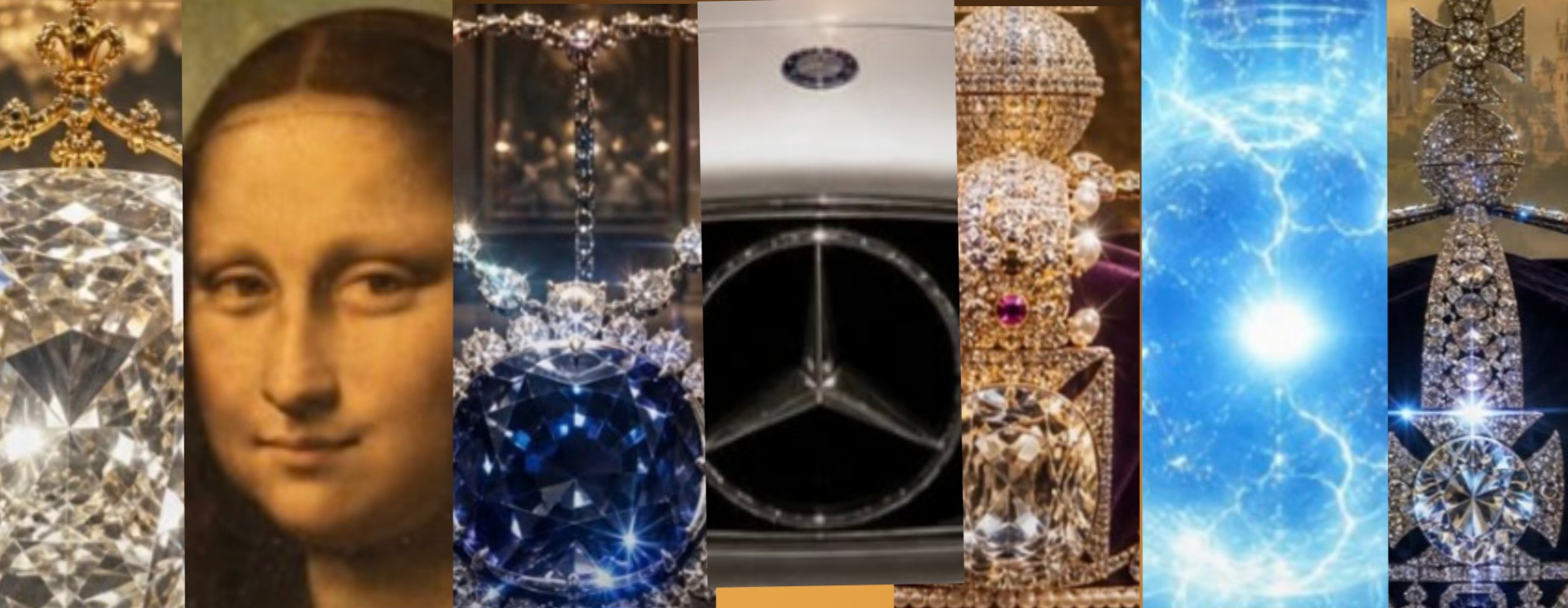
From legendary diamonds and priceless works of art to antimatter produced in laboratories, these remarkable objects demonstrate that true value is not always measured in money alone.
Antimatter: The World’s Most Expensive Substance
Scientists regard antimatter as the most expensive material ever produced.
Unlike ordinary matter, antimatter consists of particles with opposite electrical charges. When matter and antimatter meet, they annihilate one another, releasing enormous amounts of energy.
Only microscopic quantities have ever been created in research facilities such as CERN.
Because producing even tiny amounts requires highly advanced particle accelerators and enormous energy, experts estimate that one gram of antimatter could theoretically cost tens of trillions of dollars.
However, no one has ever produced anywhere near that quantity, making the figure a scientific estimate rather than a market price.
The 1955 Mercedes-Benz Uhlenhaut Coupé
Among collectors, the Mercedes-Benz 300 SLR Uhlenhaut Coupé is considered one of the rarest automobiles ever built.
Only two examples were produced.
In 2022, one was sold for approximately €135 million (about US$143 million at the time), making it the most expensive car ever sold publicly.
Named after legendary engineer Rudolf Uhlenhaut, the vehicle combines engineering excellence, racing heritage and extreme rarity.
The British Crown Jewels
Housed in the Tower of London, the British Crown Jewels comprise more than 100 ceremonial objects used during royal coronations and state occasions.
The collection includes crowns, sceptres, swords, orbs and ceremonial regalia adorned with thousands of precious gemstones.
Among them is the Great Star of Africa (Cullinan I), the largest clear-cut diamond in the world.
Although experts occasionally estimate their value in the billions, historians generally regard the Crown Jewels as priceless because they are national treasures that cannot legally be sold.
The Hope Diamond
The Hope Diamond is one of the world’s most famous gemstones.
Weighing 45.52 carats, the deep-blue diamond is renowned not only for its beauty but also for centuries of legends claiming it carries a curse upon its owners.
Today, the diamond is housed at the Smithsonian Institution in Washington, D.C., where millions of visitors view it each year.
Experts estimate its value at hundreds of millions of dollars, though its historical importance makes any precise valuation difficult.
The Koh-i-Noor Diamond
Few gemstones have generated as much historical debate as the Koh-i-Noor, whose name means “Mountain of Light.”
The diamond has passed through the hands of several South Asian rulers over centuries before becoming part of the British Crown Jewels.
Today, it remains one of the world’s most politically sensitive diamonds.
Governments including India, Pakistan, Afghanistan and Iran have, at various times, asserted historical claims over its ownership.
Because of its unique history and diplomatic significance, experts generally consider it impossible to assign an accurate market value.
The Mona Lisa
Perhaps no painting is more famous than Mona Lisa, created by Leonardo da Vinci during the early 16th century.
The masterpiece hangs inside the Louvre Museum, where it attracts millions of visitors annually.
In 1962, it was insured for US$100 million, which would amount to well over US$1 billion today after adjusting for inflation.
However, because it is owned by the French state, the Mona Lisa cannot legally be bought or sold, making it effectively priceless.
The Cullinan Diamond
Discovered in South Africa in 1905, the Cullinan Diamond remains the largest rough gem-quality diamond ever found, weighing 3,106 carats.
Rather than remaining intact, the diamond was cut into several major gemstones, many of which now form part of the British Crown Jewels.
The two largest pieces—Cullinan I and Cullinan II—are displayed on the Sovereign’s Sceptre and the Imperial State Crown.
Had the original rough diamond remained uncut, experts believe its value today would likely be measured in billions of dollars.
When Value Goes Beyond Money
Economists note that an object’s value is often determined by more than its physical composition.
Historical significance, scientific uniqueness, cultural importance and rarity frequently outweigh material worth.
Some of the world’s most valuable objects cannot be reproduced.
Others cannot legally be traded.
Still others, like antimatter, exist only in minute quantities created through cutting-edge scientific research.
Together, they illustrate an important reality: at the highest level, value is no longer simply measured by price tags or market demand.
Instead, it reflects humanity’s history, scientific achievement, artistic brilliance and the rarity of things that may never exist again.
Beyond Price Tags: The World’s Most Valuable Objects That Money Can Hardly Buy
