


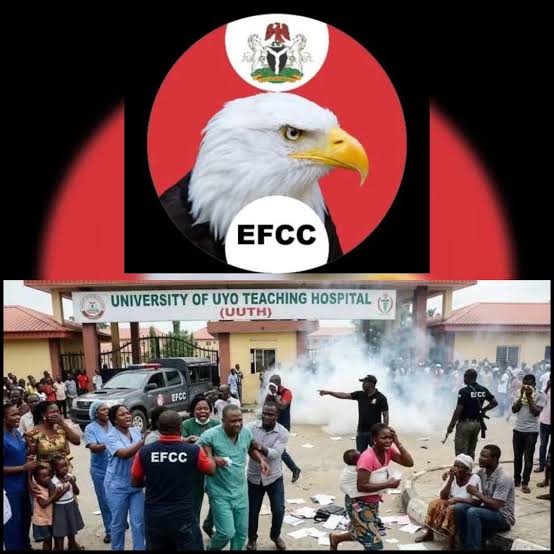
EFCC, Hospitals and the Human Cost of Force
By Jerry Adesewo, Abuja
What happened at the University of Uyo Teaching Hospital was more than an operation gone wrong. For many Nigerians watching the disturbing videos and testimonies emerging from Akwa Ibom State, it felt like something sacred had been violated.
Hospitals are among the few places society expects to remain untouched by chaos — spaces where urgency is measured by heartbeats, not handcuffs. But that fragile expectation was shattered when operatives of the Economic and Financial Crimes Commission stormed the teaching hospital in Uyo during an attempt to verify a medical report linked to an ongoing fraud case.
READ ALSO: Interior Minister Tunji-Ojo Hosts US Embassy Delegation in Abuja
What followed has now triggered outrage across Nigeria’s medical community.
According to multiple reports and testimonies from medical workers, the incident allegedly involved physical assault, gunfire, tear gas, arrests, and the forceful detention of Professor Effiong Ekpe, a respected cardiothoracic surgeon and Deputy Chairman of the Medical Advisory Committee of the hospital.
The Nigerian Medical Association described the operation as “reckless and barbaric,” while doctors across Akwa Ibom State embarked on an indefinite strike in protest.
But beyond the institutional statements and legal arguments lies something more painful: the human casualties of fear.
Patients reportedly fled in panic as gunshots rang out within the hospital premises. Medical personnel attempting to intervene were allegedly beaten, shoved, exposed to tear gas, or arrested. Phones were confiscated or damaged as staff members tried to document the incident.
And somewhere in the middle of that confusion were sick people. People already fighting for breath, pain, recovery, or survival.
That is perhaps the most haunting aspect of the Uyo incident. Hospitals are environments built around vulnerability. Every disruption carries consequences beyond property damage or procedural disputes. A frightened patient can deteriorate. A delayed emergency can become fatal. A traumatized doctor cannot instantly return to emotional balance and continue surgery as though nothing happened.
This is why many Nigerians see the incident not merely as an enforcement controversy, but as a dangerous erosion of institutional boundaries.
The EFCC has defended its actions, insisting that its operatives visited the hospital only after repeated letters seeking authentication of a medical report allegedly received no response from hospital management. The Commission also claimed its officers were attacked by hospital staff and acted professionally throughout the operation.
Yet even if procedural disagreements existed, nothing justifies transforming a public hospital into a scene of terror, because force has symbolism.
When armed operatives storm a hospital environment, the message extends beyond the immediate target. It communicates power overpowering sensitivity. It suggests that institutions of care can suddenly become theatres of confrontation.
And in a country already weighed down by insecurity, distrust of institutions, and public anxiety, that symbolism matters deeply.
Professor Ekpe himself has now become more than an individual in this story. He represents a wider frustration among Nigerian medical professionals who increasingly feel vulnerable, overworked, underprotected, and frequently disrespected despite operating within one of the country’s most fragile systems.
Nigeria’s healthcare sector is already struggling under enormous pressure — brain drain, underfunding, infrastructure deficits, and workforce exhaustion. The last thing it needs is the normalization of violent confrontations inside medical facilities.
The strike action declared by the NMA therefore reflects not only solidarity, but fear: fear that if such an incident passes without accountability, it may happen again elsewhere. That is why calls for justice are growing louder.
Not performative outrage. Not political spin. But transparent investigation, accountability, and institutional restraint.
If officers acted outside lawful conduct, they must face consequences. If excessive force was used, it must be acknowledged. If procedures were ignored on either side, those failures must also be addressed.
Because a democracy cannot function when hospitals become battlegrounds between enforcement agencies and medical professionals.
The tragedy of the Uyo incident is not only that people were allegedly assaulted. It is that trust itself was injured.
And trust, once damaged inside institutions meant to save lives, is far harder to heal.