

The Last Flight: The Photograph That Marked the End of America’s 20-Year War in Afghanistan
The Last Flight: The Photograph That Marked the End of America’s 20-Year War in Afghanistan

The Last Flight: The Photograph That Marked the End of America’s 20-Year War in Afghanistan
August 30, 2021, became one of the most defining dates in the history of the United States’ military involvement in Afghanistan. In the darkness of Kabul, the final American military aircraft lifted off from Hamid Karzai International Airport, bringing nearly two decades of war, sacrifice and controversy to an end.
Inside the final C-17 Globemaster III was Major General Chris Donahue, commander of the U.S. Army’s 82nd Airborne Division. At 3:29 p.m. Eastern Time, the aircraft departed Kabul, carrying the last U.S. service member out of Afghanistan.
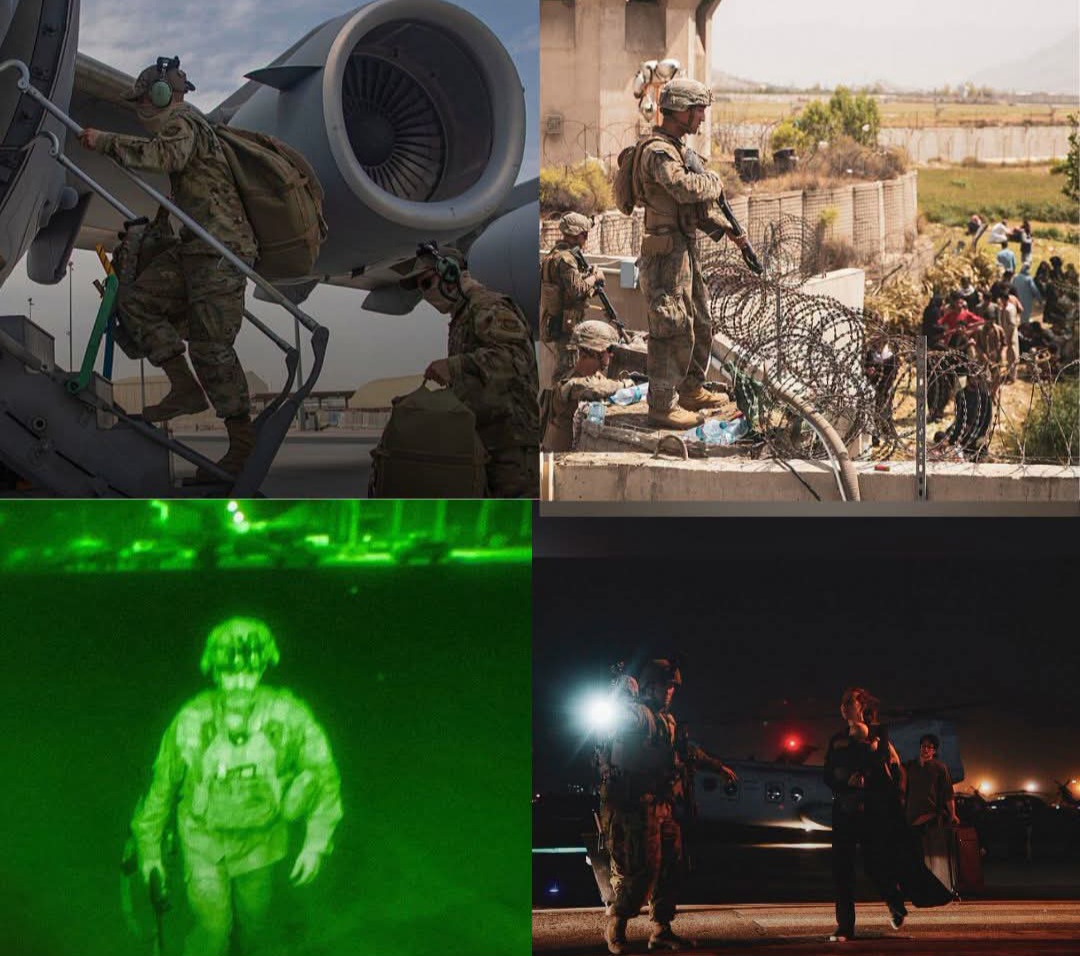
A night-vision photograph of Donahue stepping aboard the aircraft became one of the most striking images of the entire withdrawal. It captured, in a single frame, the closing moment of America’s longest war.
The photograph was taken by Master Sgt. Alex Burnett and showed Donahue carrying his rifle and equipment as he walked toward the aircraft. His silhouette against the darkness symbolised the departure of the final American soldier from a country where generations of U.S. troops had served.
A war born from tragedy
The American war in Afghanistan began in October 2001, just weeks after the September 11 terrorist attacks that killed nearly 3,000 people in the United States.
The U.S.-led military campaign was launched to dismantle al-Qaeda and remove the Taliban government, which had provided sanctuary to Osama bin Laden and the terrorist organisation responsible for the attacks.
The Taliban regime was quickly driven from Kabul, but the conflict did not end.
What began as a counterterrorism operation developed into a prolonged military and nation-building campaign. American and allied forces fought Taliban insurgents while supporting successive Afghan governments, training Afghan security forces and attempting to build institutions capable of maintaining the country’s security.
For almost 20 years, Afghanistan remained a major focus of American foreign and military policy.
Thousands of American service members were deployed there, alongside troops from allied countries. Afghan civilians and security personnel bore an enormous share of the conflict’s human cost.
The final collapse
In 2021, the United States began withdrawing its remaining forces under an agreement reached with the Taliban.
As American troops pulled back, however, the Taliban advanced rapidly across Afghanistan.
By August 15, 2021, Taliban fighters had entered Kabul, and President Ashraf Ghani had fled the country.
The sudden collapse of the Afghan government triggered a desperate race to evacuate American citizens, Afghan allies and other vulnerable people.
Kabul airport became the centre of the enormous evacuation operation.
For thousands of Afghans, reaching the airport represented a final chance to escape a country once again under Taliban control.
A historic airlift
Between August 14 and August 30, U.S. forces evacuated approximately 79,000 people from Kabul, including about 6,000 American citizens. When the broader U.S. and allied evacuation effort was counted, more than 123,000 people were transported out of Afghanistan.
Military aircraft operated around the clock, carrying people from Kabul to safety while American troops attempted to maintain security at the airport.
The operation became one of the largest airlifts in modern military history.
But the extraordinary evacuation was also marked by tragedy.
On August 26, an ISIS-K suicide bomber attacked crowds outside Hamid Karzai International Airport.
The explosion killed 13 U.S. service members and more than 170 Afghan civilians, turning an already chaotic evacuation into an even more devastating chapter.
Despite the attack, the evacuation continued.
The final departure
Four days later, the last American aircraft prepared to leave.
At 3:29 p.m. Eastern Time on August 30, the final C-17 departed Kabul.
General Kenneth McKenzie, then commander of U.S. Central Command, formally announced that the U.S. military evacuation was complete.
And aboard that aircraft was Major General Chris Donahue.
His departure made him the last American service member to leave Afghanistan.
The significance of that moment was not lost on the U.S. military.
After almost 20 years, the American military presence in Afghanistan had ended.
No parade marked the occasion. There was no grand ceremony.
Instead, there was a dark runway, a waiting aircraft and a soldier walking toward the final flight.
A photograph that became history
The photograph of Donahue boarding the C-17 was captured using night-vision technology.
It quickly became an enduring visual representation of the end of America’s war.
The image was striking partly because of what it did not show.
There were no crowds, speeches or flags.
Just one soldier, his equipment and the aircraft waiting to carry him away.
Yet behind that single figure stood two decades of history — the September 11 attacks, the invasion of Afghanistan, battles against the Taliban and al-Qaeda, the deaths of thousands of people, billions of dollars spent, generations of Afghan civilians affected by war and years of American attempts to establish a stable Afghan state.
The Taliban return
The U.S. withdrawal also produced a remarkable historical reversal.
The Taliban had been removed from power by American forces in 2001.
Twenty years later, the Taliban were back in Kabul.
The final American aircraft departed without the Afghan government that Washington had spent years supporting remaining in power.
For the United States, the withdrawal marked the end of its longest war.
For Afghanistan, it opened another uncertain chapter.
The country entered a new era under Taliban rule, while many Afghans who had worked alongside the United States and its allies were left seeking ways to leave.
Twenty years, one final image
The significance of August 30, 2021, extends far beyond the departure of one aircraft.
It was the final moment of a military campaign that had begun in response to one of the darkest days in American history.
The war had lasted nearly 20 years.
The final evacuation lasted just over two weeks.
And the final image lasted only a fraction of a second.
But that photograph of Major General Chris Donahue stepping aboard the last American aircraft from Kabul captured something much larger than one man’s departure.
It captured the closing of an era.
A war that began with America’s determination to prevent another September 11 ended two decades later with the Taliban once again in control of Afghanistan — and one final American soldier disappearing into the darkness aboard the last flight out of Kabul.
The Last Flight: The Photograph That Marked the End of America’s 20-Year War in Afghanistan
