


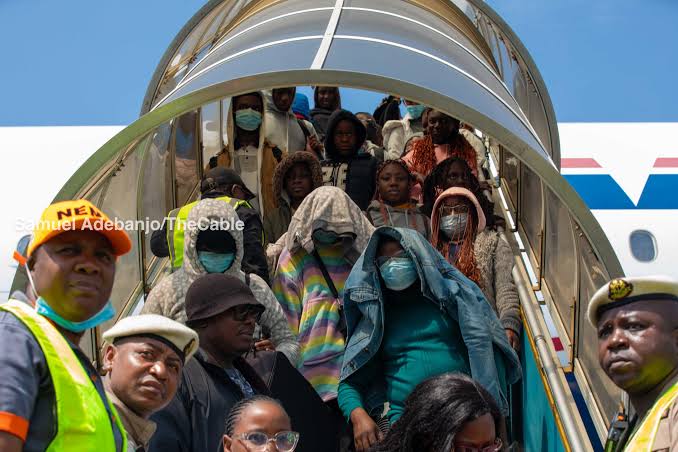
The Unforgiving Homecoming: When “Hell in South Africa” Becomes the Lesser Evil
By Ameh Abraham
There is perhaps no greater tragedy for a Nigerian than to flee Nigeria, only to be forced back. But there is an even greater indictment: that the experience in the host country has become so unbearable that returning to Nigeria, with all its failures, feels like salvation.
For years, young Nigerians have looked southward, to South Africa, to Ghana, to Europe, to anywhere that might offer what home has denied them: reliable electricity, a stable currency, a job that pays without requiring a bribe, and a society where hard work still means something. But in recent weeks, the nightmare has returned. Xenophobic attacks in South Africa have once again targeted foreigners, and Nigerians have been in the crosshairs. Shops looted. Homes burned. Lives threatened. And now, the Nigerian government has begun evacuating its citizens from a country that many had called home for years, sometimes decades.
READ ALSO: Peter Obi Calls for Tinubu’s Resignation Over Governance Concerns
The evacuation is framed as a rescue mission. And indeed, for those whose lives were in immediate danger, it is. But behind the headlines lies a quieter, more painful story: the story of Nigerians who sold everything to escape Nigeria, who gave up lands, businesses, family connections, and community ties, only to find themselves right back where they started or worse. The fact that they chose to return to Nigeria, with its well-documented economic hardship, security crisis, and collapsing infrastructure, is the most damning possible testimony about the conditions they fled. No one leaves a paradise for a burning house. But when the alternative is hell, even a burning house becomes a refuge.
“I Don’t Wish My South Africa Experience for My Enemies”
The testimonies of returnees leave no room for ambiguity. Ezenwa Obiageri Abigail, a businesswoman who sold clothes, shoes, and handmade beads in Johannesburg, put it bluntly: “With the experience I got, I won’t advise even my enemies to travel to South Africa” (Punch, 2019). She lost over R20,000 (approximately N500,000) during the attacks, and her customers in Nigeria whom she owed money remain unpaid. Yet she counts herself lucky to be alive.
Kayode Johnson, a stylist who spent seven years in South Africa, watched his shop and house go up in flames. His brother was murdered in cold blood. “They killed one of my brothers. His corpse is still in South Africa,” he told reporters after arriving in Lagos. His estimated loss: R200,000 (approximately N5 million). Despite returning with nothing, his message to Nigerians still in South Africa was unambiguous: “I will advise them to return home; there is nothing like home” (Punch, 2019).
Roseth Uzomba, a Congolese woman married to a Nigerian, had lived in South Africa for seventeen years. She ran a salon offering hairdressing, pedicure, and manicure services. But the attacks became so severe that she withdrew her five children from school for two months because militants were threatening to kill foreign nationals’ kids. “It was horrible. The violence I experienced there can never be blotted out of my memory in this lifetime,” she said. “I will never ever go back to South Africa and I won’t allow anybody that I know to travel to that country. It is not a country to go to” (Punch, 2019).
Ibe Jonas, a 34-year-old spare parts dealer from Orlu, Imo State, had spent fourteen years in Pretoria. He lost his shop worth R1.2 million (approximately N30 million). But worse than the financial loss was the systematic brutality he endured. He described how South African police would plant drugs on innocent Nigerians to extort them, how thousands of Nigerians are held in detention camps, and how militants go from house to house looking for victims. “When they see a Nigerian alone, they will kidnap them, take them somewhere and kill them,” he said. “It was hell. It was the grace of God that brought me out early” (Punch, 2019).
The Anatomy of Hell: What Makes South Africa Unbearable
The returnees’ testimonies reveal a pattern of persecution that goes far beyond sporadic violence. It is a systematic, daily grinding down of human dignity.
First, there is the collusion of the state. Multiple returnees accused South African police of either standing by during attacks or actively participating in the persecution. Helen Ogunbanjo, who dealt in Nigerian food items for eight years, revealed that the South African government had warned media houses against reporting negativity about the country. She noted that xenophobia is not episodic but “a daily situation”. Jonas recounted how police ignored their pleas for protection during attacks. This is not mob violence; it is state-sanctioned or state-tolerated hostility.
Second, there is the economic strangulation. Even before the fires, foreigners operate under constant threat. Jonas described being arrested and detained for two months for an offence he didn’t commit. He had to pay his lawyer R5,000 (approximately N125,000) to secure his release. Aliu Saheed, an Osun indigene, worked in the protocol department of a South African company for six months but was never paid. “In the company where I worked at the airport, they refused to pay my salary” (APC Fan Club, 2019). When your labour is stolen and the legal system offers no redress, you are not a resident; you are prey.
Third, there is the psychological terror. The constant fear of attack, the knowledge that your children could be killed at school, the uncertainty of whether you will survive the night, this is not living. It is surviving. One returnee, who asked not to be named, described hiding for days in Pretoria as Zulu militants went “from house to house, looking for Nigerians to kill” (APC Fan Club, 2019). Another, a 15-year-old girl named Onyiyechi Uzomba, said simply: “I like it [Nigeria]. It is better than being killed in another country” (Punch, 2019). When a teenager prefers the uncertainty of Nigeria to the terror of South Africa, the comparison is complete.
The Double Tragedy: No Home to Stay, No Home to Return To
Here lies the deepest wound. These returnees did not leave Nigeria because they hated it. They left because Nigeria failed them. And now, forced back by fire and sword, they return to the same failure, but without the cushion of savings, assets, or hope they had the first time.
Juwon Sadiku, an Oyo State businessman, captured this contradiction perfectly. After narrating his narrow escape from South Africa, he added: “If the situation in Nigeria were better, most of us would not have gone to South Africa to risk our lives. If government could provide uninterrupted power supply, create a friendlier business environment, most of us will prefer to stay here and salvage our country” (APC Fan Club, 2019).
That single sentence is an indictment of two nations. South Africa is condemned for its xenophobia. But Nigeria is condemned for making emigration a rational choice in the first place.
The returnees arrive with nothing. Some, like Roseth Uzomba, have been away for seventeen years, nearly two decades. They have lost their businesses, their homes, their social networks, and in some cases, their family members. They return to a country where the unemployment rate is among the highest in the world, where millions of young people are desperate for any work, and where those who have been abroad are often resented for having “tried their luck” while others stayed behind.
The Nigerian government has promised assistance. The chairman of Air Peace, Allen Onyema, who volunteered his airline to evacuate stranded Nigerians free of charge, demonstrated more patriotism than many government agencies. But promises are not jobs. Sympathy is not a salary. And the trauma of watching your shop burn, your brother die, or your children hide from killers does not disappear at Murtala Muhammed International Airport.
Beyond Condemnation: What Must Change
The xenophobia in South Africa is a crisis, and the evacuation of our citizens is necessary. We can and should condemn South Africa, diplomatically, economically, and morally. The African Union must take this seriously. The South African government must pay compensation and prosecute perpetrators.
But condemnation is not enough. The deeper crisis is that Nigeria has become a country people cannot stay in and cannot return to. The economy does not work. Security does not hold. Hope does not last.
As one returnee, Roland Chibuzo from Abia State, noted: “Many of our people are reluctant to come back to Nigeria because they have invested heavily in South Africa. Some have houses, hotels and other investments. If they return home, what will they be doing here? Where would they start from? It is a serious dilemma” (APC Fan Club, 2019). Those who did return made the calculation that their lives were worth more than their investments. That calculation should never have to be made.
The shame of the returnee is not just South Africa’s doing. It is the product of decades of leadership failure, economic mismanagement, and a national indifference to the suffering of ordinary Nigerians. If Nigeria had jobs, security, and functioning infrastructure, the flow of emigrants would slow to a trickle. If Nigeria had a government that truly cared, the returnees would be met not with bureaucratic indifference but with resettlement packages, job training, and psychological support.
No Nigerian should have to flee their own country to survive. And no Nigerian who flees should ever be forced to return because the country they ran to has rejected them.
Until Nigeria becomes a place worth staying, until the lights stay on, until the naira stabilizes, until a job is something you earn rather than something you bribe your way into, the tragedy of forced return will keep repeating. And each returnee will carry with them not just the trauma of xenophobia, but the quiet wound of having no home that truly wants them.
The returnees who landed in Lagos sang the national anthem. They cried. They thanked God. They embraced family members. But as the cameras left and the officials departed, they faced a question that no government has answered: Now what?
We owe them more than evacuation. We owe them a country worth returning to.
