

Túnel de Bambu: A Journey That Changed Everything
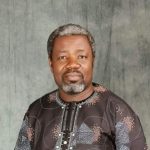
By Dr Abdulrazak Ibrahim
Some twenty-three years ago, I left Nigeria for the first time. I did not know it then, but that journey would quietly reshape my life. I was at the early stages of my career, trained but still untested in the wider world. Curious and, in many ways, naive.
From Kano, I flew KLM through Amsterdam. It was my first real encounter with a world beyond what I knew. I still remember the scent of the aircraft, the quiet order of everything, even the sniffer dogs at Schiphol. Small details, but they stayed with me.
READ ALSO: UniAbuja (Yakubu Gowon University) to Graduate 12,624 Students at Combined Convocation
Years later, that same route carried a different weight. The attempted bombing by a young Nigerian had altered something subtle but profound. The ease was gone. In time, even the route itself disappeared, as KLM stopped flying out of Kano. What was once an open passage began to feel narrower, shaped by suspicion and consequence.
From São Paulo, I arrived in Salvador, Bahia. At the airport, I was received by my host Mrs Eutalia, holding a placard with my name. In that moment, in a foreign land, I felt seen.
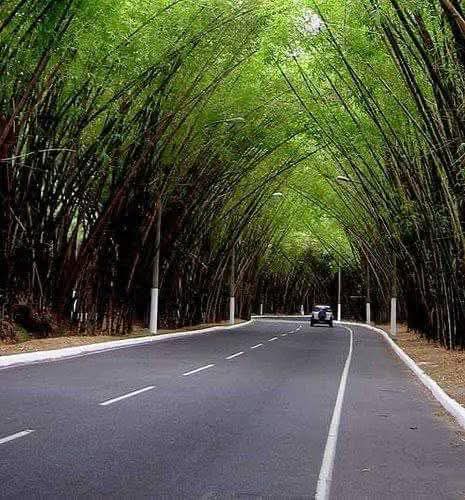
Then, on the drive into the city, I saw it. The túnel de bambu (bamboo tunnel). A green arch over the road. Quiet. Almost sacred.
That image has never left me. But Salvador was more than scenery. It was an awakening.
Bahia is often described as having one of the largest concentrations of Black people outside Africa, and walking through Salvador, you feel it immediately. Not as statistics, but as presence.
The city breathes Africa.
I saw Yoruba influences in the rhythms, the spirituality, the food, the names. And I would later discover Hausa traces as well, deep and historical.
It was in Bahia that enslaved Muslims, many of them Hausa, organized what is now known as the Malê Revolt of 1835, one of the earliest and most significant slave resistance movements in Brazil. A story of faith, intellect, and resistance that I would later explore extensively in my writings around 2012, alongside other Afro-Brazilian histories and resistance movements.
Salvador did not feel entirely foreign. It felt familiar. Places like Pelourinho, once marked by pain, now pulse with culture and expression. It was here that Michael Jackson filmed parts of his “They Don’t Care About Us,” turning the space into a global echo of struggle, resilience, and dignity.
Even in everyday spaces, the layers were visible. Names like Jardim de Allah (garden of Allah) reminded me that culture and belief travel, transform, but never truly disappear.
From Salvador, I set out for Fortaleza. I was told to take a night bus. It became a two-day journey.
The bus kept stopping. I never quite knew why. I was too wary to step down, afraid it might leave me behind in a place where I spoke no language and no one understood mine.
So I stayed. I survived on apples. But something else happened on that journey.
I was listening to Daniel, a Brazilian country musician. I did not understand the words, but I felt the music. By the time I arrived in Fortaleza, I was already in love with some of his songs.
That was my first real lesson. Culture reaches you before language does.
In Fortaleza, I was first received by Eduardo, my laboratory tutor. He looked at me and said, “It’s you!” as if I had unsettled an expectation.
He later admitted he had been expecting the image he knew from television, a hefty black African, not this skinny, almost Brazilian-looking guy standing before him.
That night, I encountered a hammock for the first time. I could not sleep in it. At some point, I quietly brought it down and chose the certainty of the floor.
In the morning, Eduardo was alarmed to find me there. He thought I had fallen off in the night. “My God, I was afraid you had died from the hammock,” he later admitted.
Over the next few months, something shifted.
I learned Portuguese. Not perfectly, but enough to connect, to navigate, to begin to belong.
At the end of the training, my supervisor showed me a page about the PEC-PG scholarship program. It planted a seed.
Soon after, I returned to Brazil for my Master’s, and years later, again for my PhD.
Over time, I became deeply embedded in the scientific system, eventually contributing to the development of biotechnology approaches for the control of whitefly.
Looking back, that single moment opened a path that would later extend to many others, some of whom are now doctors and professors in Nigeria and Brazil.
Looking back now, that journey was not just travel. It was transformation. And here is the irony.
Little did I know that this same Brazil, this journey that began with uncertainty, apples on a bus, and a bamboo tunnel, would become part of my life in ways I could never have imagined.
My first child would be Brazilian. And then, years later, almost as if it had been spoken into existence, I would have another Brazilian.
From a young man unsure whether to step off a bus, to building a life that spans continents.
From the moment I boarded that plane out of Kano and Nigeria, I never truly returned in the same way.
That journey set me on a path across countries, across systems, across identities, shaping me into the near globetrotter I have become today.
The túnel de bambu was not just a road.
It was a passage. A passage into exposure. Into identity. Into science as lived experience.
And in many ways, I am still walking through it.
[…] READ ALSO: Túnel de Bambu: A Journey That Changed Everything […]
[…] READ ALSO: Túnel de Bambu: A Journey That Changed Everything […]