


ECOWAS Charts New Course With Ambitious Six-Pillar Integration Plan
By Matthew Eloyi
West Africa’s regional bloc, the Economic Community of West African States (ECOWAS), is pushing forward an ambitious new roadmap aimed at redefining its future in the face of rising political uncertainty, economic strain, and shifting regional alliances.
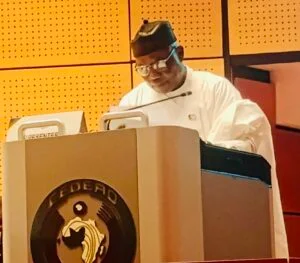
At the centre of this renewed vision is a six-pillar strategy known as the “Compact of the Future of Regional Integration,” unveiled in Abuja during the First Ordinary Session of the ECOWAS Parliament. The proposal, presented by ECOWAS Commissioner for Political Affairs, Peace and Security, Amb. Abdel-Fatau Musah, is being positioned as a bold reset of the organisation’s purpose and effectiveness.
Musah described the initiative as more than just another policy document. It is, he said, a survival strategy for a bloc confronting one of the most complex periods in its nearly five-decade history.
“The Compact is designed to operationalise the ECOWAS Vision 2050, and represents a fundamental reset of the regional integration agenda, shifting the bloc from an elite-driven ECOWAS of States to ECOWAS of the Peoples.
“This initiative acknowledges that the regional body is at its most fragile point since its establishment in 1975, due largely to governance failures, democratic setbacks and the emergence of alternative alliances such as the Alliance of Sahel States (AES), comprising Burkina Faso, Mali and Niger,” he said.
Against this backdrop, ECOWAS leaders are attempting to reposition the organisation as a more people-centred institution—one that delivers tangible benefits such as improved security cooperation, freer movement of people and goods, and stronger digital connectivity across borders.
Musah explained that the proposal was not developed in isolation. It emerged from broad consultations involving citizens across West Africa, civil society organisations, ECOWAS institutions, and members of the African diaspora. The framework was also endorsed in principle by the ECOWAS Authority of Heads of State and Government, which has called for a special summit dedicated to the future of regional integration.
At its core, the Compact seeks to rebuild trust between governments and citizens while making regional integration more relevant in a rapidly changing world.
“This is due largely to governance failures, democratic setbacks and the emergence of alternative alliances such as the Alliance of Sahel States (AES), comprising Burkina Faso, Mali and Niger,” he said.
The strategy is built around six interconnected pillars that cut across the political, economic, technological and institutional landscape of West Africa.
On the economic front, ECOWAS is targeting a sharp rise in intra-regional trade to 30 per cent by 2035, alongside efforts to deepen industrialisation, strengthen food sovereignty, and introduce the long-discussed ECO single currency by 2040.
Security and governance reforms form another central pillar. The bloc is reaffirming its zero-tolerance stance on military coups and unconstitutional changes of government, while also proposing a stronger ECOWAS Standby Force to respond to emerging security threats.
Technology and innovation also feature prominently, with plans to establish a Digital Single Market by 2030, aimed at boosting connectivity and regional competitiveness in the digital economy.
Social inclusion commitments within the Compact are equally notable, with proposals to increase women’s representation in leadership positions to 40 per cent and formalise youth participation in governance structures across member states.
Institutional reform is another key focus, as ECOWAS seeks to make its operations more merit-based, accountable, and financially independent through full implementation of the Community Levy by 2030.
Perhaps one of the most politically sensitive aspects of the initiative is its emphasis on “strategic autonomy.” In a rapidly shifting global order, ECOWAS is seeking to position itself as a stronger geopolitical actor capable of defending West Africa’s collective interests.
The Compact also leaves room for engagement with the Sahel states of Mali, Burkina Faso and Niger, outlining structured dialogue and confidence-building measures aimed at preventing their permanent exit from the bloc.
To address long-standing concerns about implementation gaps, the framework introduces monitoring mechanisms, including compliance scorecards for member states and evidence-based performance tracking.
As the debate unfolds within the ECOWAS Parliament, lawmakers are weighing the promise of transformation against the practical realities of enforcement in a region often challenged by political instability and uneven development.
Still, for ECOWAS, the Compact represents a defining attempt to move beyond declarations and towards a more integrated, resilient and citizen-focused West Africa.
