

From Tafawa Balewa to Tinubu — The Story of Nigeria Through Its Leaders (1)
From Tafawa Balewa to Tinubu — The Story of Nigeria Through Its Leaders (1)

From Tafawa Balewa to Tinubu — The Story of Nigeria Through Its Leaders (1)
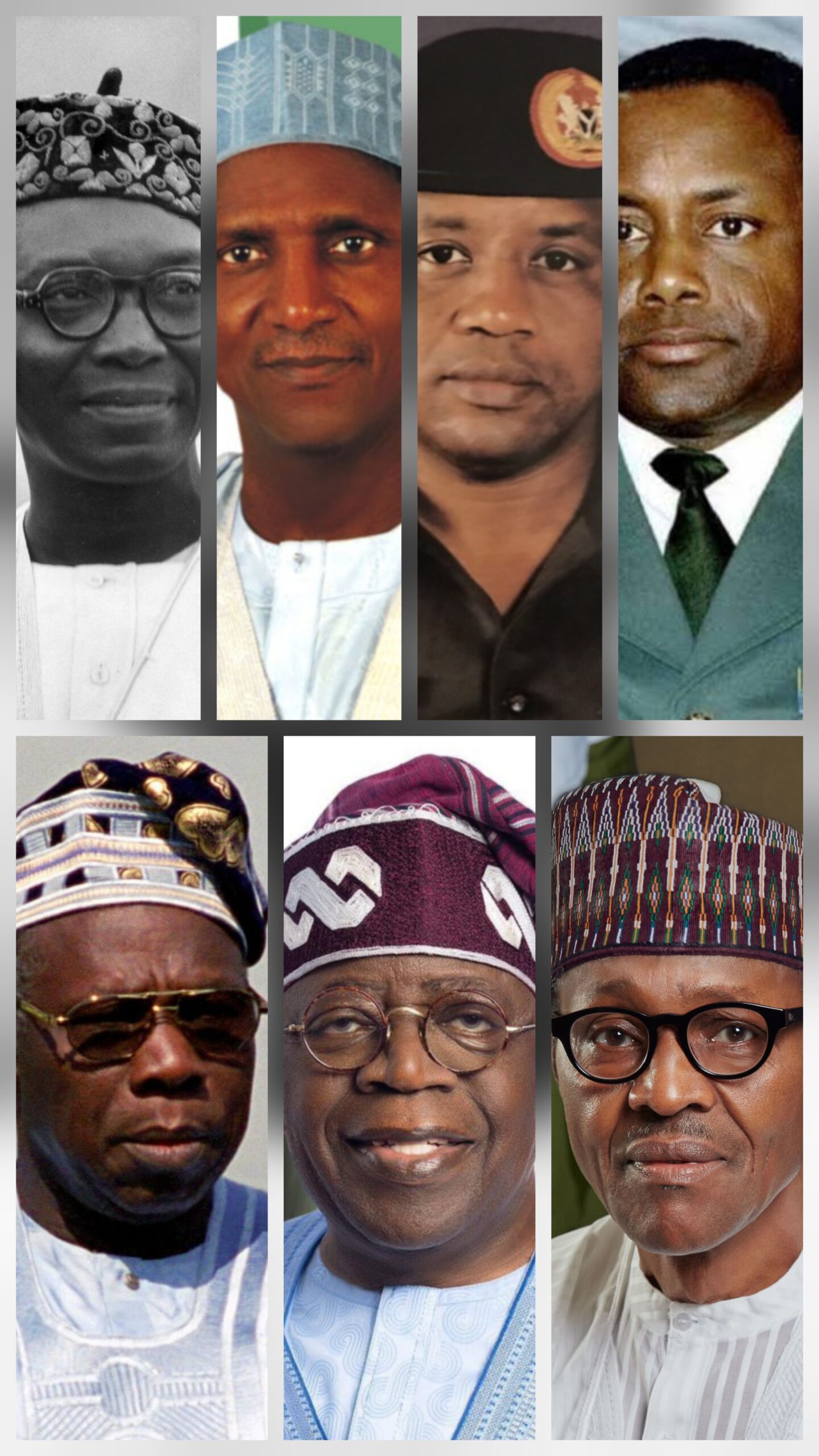
Nigeria’s history is closely linked to the men and women who have led the country since independence. Every administration came with its own vision, achievements and challenges. Some leaders came to power through democratic elections, while others assumed office after military coups or constitutional transitions.
ALSO READ: Tinubu Charges Team Nigeria to Compete with Integrity at Glasgow 2026 Commonwealth Games
Over the decades, Nigeria has experienced periods of economic growth, political instability, military rule, democratic reforms, civil war, anti-corruption campaigns, infrastructure development and security challenges. Every leader has left a mark on the country’s history—some remembered for bold reforms, others for controversies, while many are remembered for both.
Since gaining independence from Britain on October 1, 1960, Nigeria has had military Heads of State, elected Presidents and one Interim Head of Government. Two leaders—Olusegun Obasanjo and Muhammadu Buhari—served both as military rulers and later as elected civilian Presidents, making their leadership journeys unique in Nigeria’s political history.
This feature examines each Nigerian leader from independence to the present, highlighting their background, achievements, challenges and the legacy they left behind.
1. Abubakar Tafawa Balewa (1960–1966)
Background
Sir Abubakar Tafawa Balewa was born in Bauchi Province in December 1912. He trained as a teacher before entering politics. He became one of the leading figures in Nigeria’s independence movement and worked closely with regional leaders to negotiate self-rule from Britain.
On October 1, 1960, Nigeria became an independent nation and Balewa became the country’s first Prime Minister.
Major Achievements
Balewa played a key role in ensuring a peaceful transition from British colonial rule to independence.
His government promoted unity among Nigeria’s different ethnic and religious groups at a time when the country was still building its national identity.
He strengthened Nigeria’s foreign relations and was respected across Africa for supporting the liberation of countries still under colonial rule.
Nigeria also became an active member of the United Nations and played an important role in African diplomacy during his administration.
Major Challenges
Regional rivalry between the North, West and East increased during his government.
Political disagreements and allegations of election malpractice created tension across the country.
Violence during the Western Region crisis weakened public confidence in the government.
Historical Significance
Balewa remains Nigeria’s first and only Prime Minister.
He led Nigeria during the country’s first years as an independent nation.
Legacy
Many Nigerians remember him as a calm and respected leader who believed in dialogue and national unity.
His administration ended after the military coup of January 15, 1966, during which he was assassinated.
2. Nnamdi Azikiwe (1963–1966)
Background
Dr. Nnamdi Azikiwe, popularly known as “Zik,” was born on November 16, 1904.
He was one of Nigeria’s greatest nationalists, journalists and political leaders.
Before becoming President, he served as Governor-General after independence.
When Nigeria became a republic in 1963, he became the country’s first ceremonial President.
Major Achievements
Azikiwe inspired many Nigerians during the struggle for independence.
He promoted education and national unity.
Through his newspapers and speeches, he encouraged African nationalism and the fight against colonial rule.
He represented Nigeria at important international events and helped improve the country’s image abroad.
Major Challenges
Although he was President, executive powers were held mainly by the Prime Minister.
Political crises between Nigeria’s regions affected his administration.
The growing instability eventually led to the military coup of January 1966.
Historical Significance
Azikiwe is regarded as one of the founding fathers of modern Nigeria.
His influence extended beyond politics into education, journalism and diplomacy.
Legacy
He remains one of Nigeria’s most respected nationalist leaders.
His contributions to independence continue to be recognised across the country.
3. Johnson Aguiyi-Ironsi (January–July 1966)
Background
Major General Johnson Aguiyi-Ironsi became Nigeria’s first military Head of State after the January 1966 coup.
Before taking power, he served as the General Officer Commanding the Nigerian Army.
Major Achievements
He restored order after the violent coup.
His administration attempted to strengthen national unity.
He introduced the Unification Decree, which sought to replace Nigeria’s federal system with a unitary government.
Major Challenges
The Unification Decree was strongly opposed in many parts of Northern Nigeria.
Ethnic tension increased following the January coup.
On July 29, 1966, another military coup removed him from office, and he was later killed.
Historical Significance
Ironsi became Nigeria’s first military ruler.
His short administration marked the beginning of military involvement in Nigerian politics.
Legacy
Although he ruled for only six months, his government changed Nigeria’s political direction and paved the way for decades of military rule.
4. Yakubu Gowon (1966–1975)
Background
General Yakubu Gowon became Head of State at just 31 years old after the July 1966 coup.
He remains one of Nigeria’s youngest national leaders.
Major Achievements
His administration kept Nigeria together during the Civil War between 1967 and 1970.
After the war, he introduced the famous policy of “No Victor, No Vanquished,” encouraging reconciliation instead of revenge.
He launched the programme of Reconstruction, Rehabilitation and Reconciliation.
His government created 12 states from the former four regions.
Nigeria also benefited from rising oil revenues during his administration.
Major Challenges
The Nigerian Civil War claimed millions of lives and caused widespread destruction.
Despite increased oil income, corruption became a growing concern.
His government was criticised for delaying the return to civilian rule.
Historical Significance
Gowon led Nigeria through its greatest national crisis and preserved the country’s unity.
Legacy
He is remembered as the leader who kept Nigeria together during the Civil War, although debates continue over decisions taken during that difficult period.
5. Murtala Mohammed (1975–1976)
Background
General Murtala Ramat Mohammed became Nigeria’s Head of State on July 29, 1975, after a bloodless military coup that removed General Yakubu Gowon. Although his time in office lasted only about six months, he remains one of Nigeria’s most respected leaders because of his bold leadership and determination to reform the country.
Major Achievements
Murtala Mohammed quickly introduced reforms in the civil service to improve efficiency and accountability.
He launched plans to move Nigeria’s capital from Lagos to Abuja, a decision that was later completed by another administration.
His government also took a strong stand against corruption and indiscipline in public service.
In foreign policy, he supported African countries fighting against colonial rule and apartheid, earning Nigeria respect across the continent.
Major Challenges
His administration had little time to complete many of its programmes because of its short duration.
Some of the civil service reforms also generated controversy, as thousands of public workers were dismissed.
Historical Significance
He is remembered as one of Nigeria’s most courageous and decisive leaders.
Legacy
On February 13, 1976, General Murtala Mohammed was assassinated during a failed coup in Lagos. His death shocked the nation, and many roads, schools and public institutions across Nigeria were later named in his honour.
6. Olusegun Obasanjo (1976–1979)
Background
Following the assassination of Murtala Mohammed, Lieutenant General Olusegun Obasanjo became Nigeria’s Head of State.
He completed many of the programmes started by his predecessor and prepared the country for a return to democratic rule.
Major Achievements
Obasanjo successfully handed over power to an elected civilian government in 1979, making him the first Nigerian military ruler to voluntarily transfer power to a civilian administration.
His government continued the development of Abuja as Nigeria’s future capital.
Several infrastructure and education projects also progressed during his administration.
Nigeria strengthened its role in African peace and liberation efforts.
Major Challenges
Like many governments of the period, his administration faced economic pressures caused by changes in global oil prices.
Some critics argued that corruption remained a challenge.
Historical Significance
His peaceful transfer of power in 1979 became one of the most important moments in Nigeria’s democratic history.
Legacy
Obasanjo is remembered as the military leader who kept his promise to return Nigeria to civilian rule.
7. Shehu Shagari (1979–1983)
Background
Alhaji Shehu Shagari became Nigeria’s first Executive President after winning the 1979 election. His victory marked the beginning of the Second Republic.
Major Achievements
His administration introduced the Green Revolution programme to increase food production and reduce dependence on imported food.
Road construction, housing projects and educational development also received attention.
Nigeria maintained peaceful relations with many countries during his presidency.
Major Challenges
The global fall in oil prices seriously affected Nigeria’s economy.
Inflation increased while unemployment became a major concern.
His administration also faced allegations of corruption and poor financial management.
The Maitatsine religious uprising in Kano and other parts of northern Nigeria claimed many lives and posed a serious security challenge.
Historical Significance
Shagari became Nigeria’s first democratically elected Executive President.
Legacy
His administration ended on December 31, 1983, when the military overthrew his government.
8. Muhammadu Buhari (1983–1985)
Background
Major General Muhammadu Buhari became Head of State after the military coup that removed President Shehu Shagari.
His government focused strongly on discipline, accountability and fighting corruption.
Major Achievements
His administration introduced the famous War Against Indiscipline (WAI) campaign, encouraging Nigerians to obey rules, keep public places clean and respect national values.
The government also introduced measures to reduce corruption and improve financial discipline.
Efforts were made to recover public funds and strengthen government accountability.
Major Challenges
The economy remained weak because of falling oil prices and heavy foreign debt.
His administration was criticised for restrictions on civil liberties, including the detention of some politicians and journalists.
The government also introduced Decree No. 4, which many Nigerians believed limited press freedom.
Historical Significance
Buhari’s military government became known for its strict anti-corruption campaign and emphasis on discipline.
Legacy
Supporters remember him for promoting discipline and accountability, while critics point to concerns over human rights and press freedom.
His military government ended in August 1985 after another military coup.
Interesting Historical Facts
General Murtala Mohammed ruled Nigeria for only about six months but remains one of the country’s most admired leaders.
General Olusegun Obasanjo became the first Nigerian military ruler to voluntarily hand over power to a democratically elected civilian government.
President Shehu Shagari became Nigeria’s first Executive President under the presidential system of government.
General Muhammadu Buhari later returned to power as an elected civilian President in 2015, making him one of only two Nigerian leaders to serve as both a military Head of State and a civilian President.
9. Ibrahim Babangida (1985–1993)
Background
General Ibrahim Badamasi Babangida, popularly known as IBB, became Nigeria’s Military President on August 27, 1985, after removing General Muhammadu Buhari in a military coup.
He ruled Nigeria for eight years, making him one of the country’s longest-serving military leaders.
Major Achievements
One of his biggest economic policies was the introduction of the Structural Adjustment Programme (SAP), which aimed to reduce government spending, encourage private investment and strengthen the economy.
His administration established important institutions, including the:
National Drug Law Enforcement Agency (NDLEA)
Federal Road Safety Corps (FRSC)
National Commission for Mass Literacy
His government also encouraged private broadcasting, leading to the establishment of Nigeria’s first privately owned television and radio stations.
Several roads, bridges and public projects were also completed during his administration.
Major Challenges
SAP brought major economic hardship to many Nigerians.
Prices of goods increased sharply while many workers lost their jobs.
The biggest controversy of his administration was the annulment of the June 12, 1993 presidential election, widely believed to have been won by Moshood Kashimawo Olawale Abiola.
The decision triggered nationwide protests and one of Nigeria’s biggest political crises.
Historical Significance
IBB introduced many reforms that changed Nigeria’s economy and media landscape.
Legacy
Supporters credit him with economic reforms and institutional development.
Critics remember his government mainly for the June 12 election annulment and the economic hardship caused by SAP.
He stepped aside in August 1993.
10. Ernest Shonekan (August–November 1993)
Background
Chief Ernest Adegunle Oladeinde Shonekan became Head of the Interim National Government after Babangida stepped aside.
He was a respected businessman before entering government.
Major Achievements
His administration attempted to calm the political crisis that followed the annulled June 12 election.
He encouraged dialogue and sought economic stability.
Major Challenges
The Interim National Government lacked strong political support.
Many Nigerians rejected its legitimacy.
The country experienced political uncertainty, protests and economic difficulties.
Historical Significance
Shonekan remains Nigeria’s only Head of an Interim National Government.
Legacy
His administration lasted only about three months before General Sani Abacha took power in November 1993.
11. Sani Abacha (1993–1998)
Background
General Sani Abacha assumed power on November 17, 1993.
His administration became one of the most controversial periods in Nigeria’s history.
Major Achievements
His government expanded road construction and infrastructure projects.
Foreign exchange reserves improved during parts of his administration.
Some petroleum and military projects also received significant investment.
Major Challenges
His government faced widespread criticism over alleged human rights abuses.
Many opposition politicians and activists were detained.
The execution of Ken Saro-Wiwa and eight other Ogoni activists in 1995 attracted international condemnation.
Nigeria faced sanctions from several countries and was suspended from the Commonwealth.
After his death, billions of dollars believed to have been stolen during his administration were traced to foreign accounts, leading to the recovery of what became known as the “Abacha Loot.”
Historical Significance
Abacha ruled Nigeria during one of its most politically tense periods.
Legacy
His government remains one of the most debated in Nigerian history.
Supporters point to improvements in security and foreign reserves, while critics focus on human rights concerns, political repression and corruption.
Abacha died suddenly on June 8, 1998.
12. Abdulsalami Abubakar (1998–1999)
Background
General Abdulsalami Abubakar became Head of State after the death of General Sani Abacha.
He inherited a country facing political uncertainty and international pressure.
Major Achievements
His greatest achievement was returning Nigeria to democratic rule.
He released many political detainees.
His administration introduced a transition programme that led to democratic elections.
Political parties were registered, and preparations were made for civilian rule.
Major Challenges
The government had limited time to solve Nigeria’s economic and political problems.
There was also pressure to restore Nigeria’s international image.
Historical Significance
Abdulsalami successfully organised Nigeria’s transition from military rule to democracy.
Legacy
On May 29, 1999, he peacefully handed power to an elected civilian government led by Olusegun Obasanjo.
His administration is widely remembered for ending almost 16 consecutive years of military rule.
Interesting Historical Facts
Ibrahim Babangida ruled Nigeria longer than any other military leader after General Yakubu Gowon.
The June 12, 1993 election is widely regarded as one of Nigeria’s freest and fairest elections, despite being annulled.
Ernest Shonekan remains Nigeria’s only Interim Head of Government.
Sani Abacha ruled for less than five years, but his administration remains one of the most discussed periods in Nigeria’s political history.
Abdulsalami Abubakar completed Nigeria’s transition to democracy in less than one year.
From Tafawa Balewa to Tinubu — The Story of Nigeria Through Its Leaders (1)
