


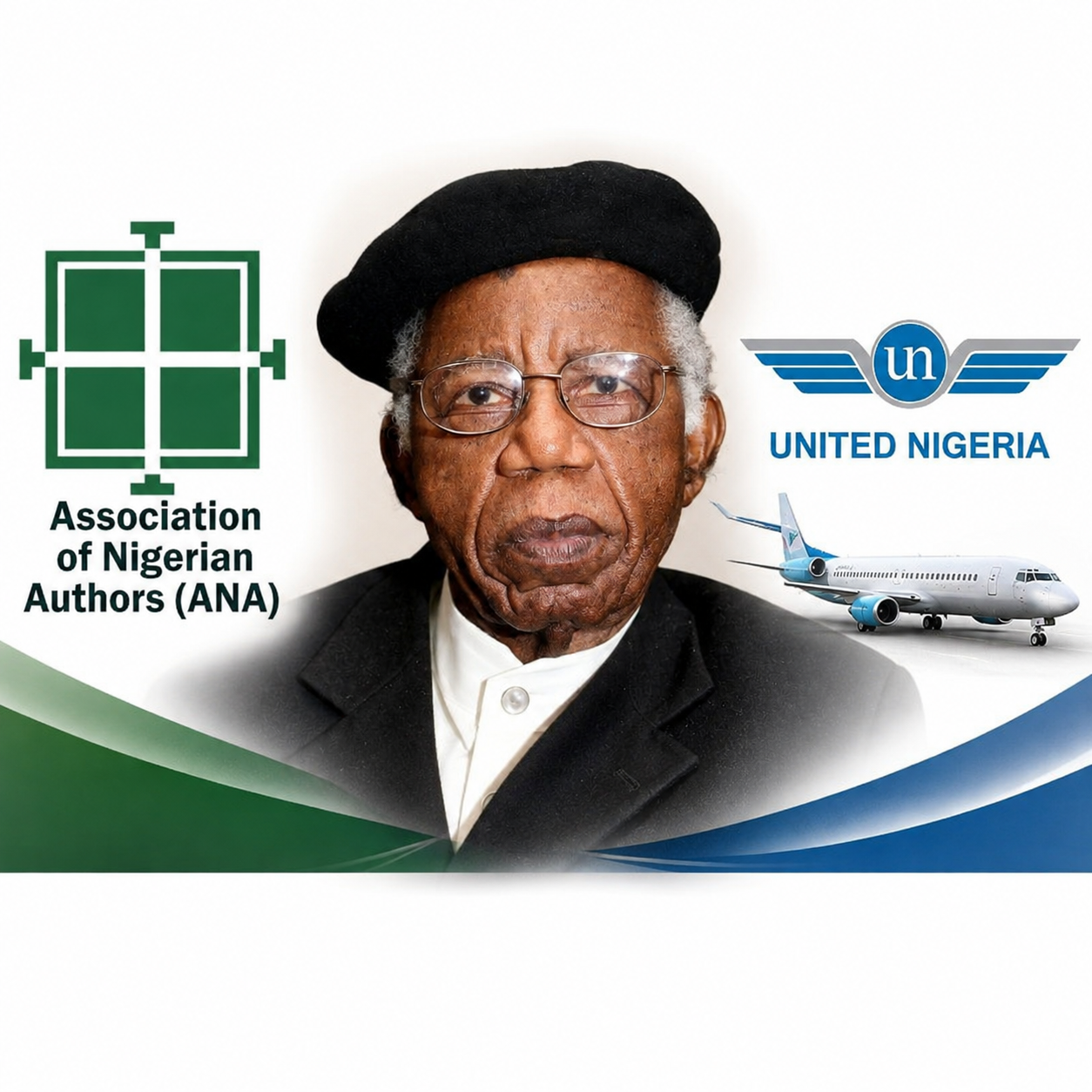
ANA Secures Long-Term Sponsorship for Chinua Achebe Prize for Fiction
By Jerry Adesewo, Abuja
The Association of Nigerian Authors (ANA) has secured a 10-year sponsorship commitment worth ₦20 million from United Nigeria Airlines (UNA) to sustain the Chinua Achebe Prize for Fiction, providing the prestigious literary award with a long-term financial foundation.
Under the agreement, United Nigeria Airlines will contribute ₦2 million annually to the prize over the next decade. The commitment followed discussions between ANA President Dr. Usman Akanbi and the Executive Chairman of United Nigeria Airlines, Professor Obiora Okonkwo.
READ ALSO: Warri Kingdom Unveils Investment Roadmap, Digital Platform at Itsekiri Development Forum
The intervention comes at an important moment for the prize, which had faced uncertainty following the disruption of its expected sponsorship from the Anambra State Government. The new arrangement gives ANA greater certainty in planning future editions and ensures that an award established in honour of one of Africa’s most influential writers can continue to provide recognition and encouragement to Nigerian fiction writers.
The Chinua Achebe Prize for Fiction was established in 2021 through a partnership between the Anambra State Government and ANA. The inaugural edition was won by Obinna Udenwe for his novel ‘Colours of Hatred’, establishing the award as a significant new platform for Nigerian prose fiction.
The prize initially received ₦1 million annually from the Anambra State Government under former Governor Willie Obiano. The sponsorship was subsequently maintained by Governor Chukwuma Soludo, who increased the annual contribution to ₦2 million as the cost of administering the award rose.
Over its first five years, the prize has begun to build its own literary lineage. Udenwe’s inaugural victory was followed by subsequent winners, including Nzesylva, whose name appears among the previous recipients of the award, before Ndidi Chiazor-Enenmor emerged as the 2025 winner with her novel ‘See Morocco, See Spain.’
The 2025 edition demonstrated the growing competitive strength of the prize. Fifteen novels were submitted, with ‘See Morocco, See Spain’, Obinna Udenwe’s ‘Years of Shame,’ and Anthony Oha’s ‘Insignia of the Gods’ making the final shortlist. Chiazor-Enenmor eventually took the prize for her novel’s exploration of irregular migration, resilience, and the difficult choices confronting young Africans seeking better lives beyond the continent.
Her victory also gave the award a particularly interesting dimension, as she had previously won the ANA Prose Prize in 2022 for ‘If They Tell the Story’, while her work ‘A Father’s Pride’ had been a finalist for the Nigeria Prize for Literature in 2024.
The 2025 result also highlighted the depth of contemporary Nigerian fiction. Udenwe’s ‘Years of Shame’, which emerged as first runner-up, explores tradition, history, and the consequences of societal taboos, while Oha’s ‘Insignia of the Gods’ was recognised for its allegorical examination of political corruption and the attraction of power.
For ANA, therefore, the latest sponsorship is about more than keeping an annual prize alive. It is an investment in a literary institution that is beginning to create a record of its own, while carrying the name of a writer whose influence continues to shape African literature.
Achebe’s connection to ANA is also unusually direct. He was instrumental in the formation of the Association of Nigerian Authors in 1981 at the University of Nigeria, Nsukka, and became its pioneer president. His association with the organisation gives the prize an institutional significance beyond the conventional relationship between a literary award and the person whose name it bears.
Professor Okonkwo, according to ANA, recognised this significance in deciding to provide the long-term sponsorship. His intervention also forms part of a broader effort to preserve Achebe’s memory and legacy.
United Nigeria Airlines recently named one of its newly acquired Boeing 737-800NG aircraft after Chinua Achebe, while another was named after His Royal Majesty, Igwe Nnaemeka Achebe, the Obi of Onitsha. Professor Okonkwo also personally supported the construction of a statue of Achebe, unveiled in July at Ugwunwasike Roundabout in Ogidi, the author’s hometown.
The sponsorship, therefore, connects three strands of Nigerian cultural life: literature, private-sector philanthropy, and the preservation of national heritage. It also demonstrates the potential role of Nigerian businesses in supporting cultural institutions that have traditionally depended heavily on government or donor funding.
For the Association of Nigerian Authors, the immediate benefit is continuity. Rather than approaching each edition of the prize with uncertainty over funding, the organisation now has a 10-year commitment around which it can plan.
For Nigerian writers, the significance is even greater. A literary prize survives not simply by announcing a winner each year, but by creating a credible ecosystem in which writers are encouraged to produce ambitious work, publishers invest in new voices and readers are introduced to stories that reflect the changing realities of the country.
The Chinua Achebe Prize for Fiction is still a young award, having been established only in 2021. But its first five years have already produced a succession of writers and works engaging questions of identity, migration, history, politics, tradition and the human condition.
The ₦20 million commitment from United Nigeria Airlines could therefore mark a new chapter in its development.
With a decade of financial stability now in sight, ANA has an opportunity to move the prize beyond survival and into institution-building: strengthening its judging processes, increasing its visibility internationally, expanding its support for emerging writers, and ensuring that the name of Chinua Achebe continues to be associated not only with literary history but also with the future of Nigerian fiction.
The challenge now is to make the next ten years worthy of the name on the prize and to grow it further to a minimum N5,000,000 grand prize, or more.