

Authors Document Shaibu’s Battle-Tested Leadership in New Military Book

Authors Document Shaibu’s Battle-Tested Leadership in New Military Book
By Matthew Eloyi
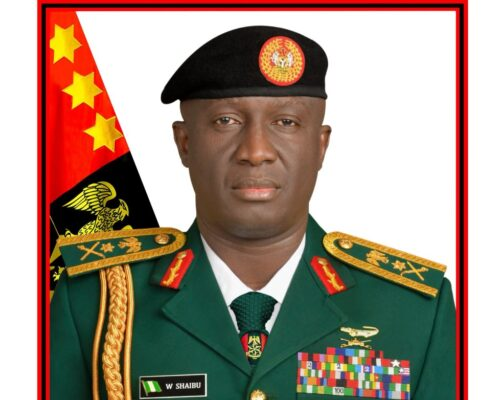
The leadership philosophy and operational command style of the Chief of Army Staff, Lieutenant General Waidi Shaibu, have been documented in a new publication, The Shaibu Doctrine: Mission Command and the Remaking of Nigeria’s Army at War, which seeks to stimulate a national conversation on military leadership, doctrine and the future of Nigeria’s Armed Forces.
The book, authored by Associate Prof. Sunday Adejoh of the Nigerian Defence Academy and Dr. M.S. Abubakar, was unveiled in Abuja on Tuesday by the Strategic Leadership Initiative, Elbroco International Security Company Ltd and Clarivox Creatives, in collaboration with the Kalthum Foundation for Peace.
Speaking at the event, the Executive Director of the Strategic Leadership Initiative, Sir Dr. AK Etta Peters said the publication went beyond a conventional account of military operations, describing it as a product of rigorous scholarship and operational insight designed to preserve and institutionalise the lessons of Nigeria’s ongoing fight against insecurity.
He said the publication had received a significant endorsement from President Bola Ahmed Tinubu, who graciously approved and wrote the foreword to the book.
Peters said the President’s decision to write the foreword underscored the importance and relevance of The Shaibu Doctrine: Mission Command and the Remaking of Nigeria’s Army at War, particularly its focus on the leadership style and strategy of the Chief of Army Staff, Lieutenant General Waidi Shaibu.
According to him, the book examines the command philosophy of Lt. Gen. Shaibu, particularly his adoption of the Mission Command doctrine, which places greater responsibility on commanders at different levels while encouraging initiative and adaptability in uncertain operational environments.
“General Shaibu has, in the most difficult of times, demonstrated what visionary military leadership looks like,” Peters said.
He explained that Mission Command was built around trust in officers and soldiers, decentralisation of responsibility and empowerment of initiative, adding that the approach had contributed to a more adaptive and professional Nigerian Army.
Peters said the leadership style had also produced improvements in troop morale, operational tempo and civil-military relations, while contributing to ongoing efforts to tackle insurgency and other forms of insecurity across the country.
He argued that Nigeria’s security challenges could not be defeated by firepower alone, stressing the need for ideas, doctrine and institutional reforms capable of outliving individual administrations and military commanders.
“Firepower alone will not win this war. We need ideas. We need doctrine. We need to institutionalize the lessons we are learning so that they outlive any one administration or any one leader,” he said.
He described The Shaibu Doctrine as a strategic framework for policymakers, an institutional record for the military and a potential textbook for scholars and military cadets studying contemporary Nigerian military leadership.
Peters further said the publication offered citizens hope that the Nigerian Army was not only fighting insecurity but was also undergoing reforms to reposition it for the complexities of 21st-century warfare.
The public presentation of the book is scheduled for October 30, 2026, at the Congress Hall of Transcorp Hilton Hotel, Abuja.
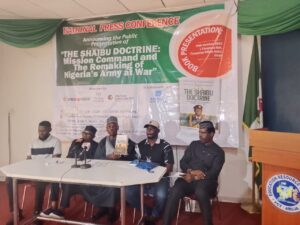
Responding to questions from journalists, one of the book’s co-authors, Dr. M.S. Abubakar, disclosed that the Nigerian Army was already deploying unmanned aerial vehicles in its operations but could do more to strengthen local production and technological capacity.
Abubakar said the military had been making efforts to procure military-grade drones, including from Turkey, while local firms had also shown interest in developing the technology.
He, however, cautioned against claims concerning the exact cost of military drones, noting that prices vary significantly according to their specifications and operational capabilities.
“There are drones that can cost even 1.5 million US dollars. They are in different categories. And there are drones that you set up. They stay up in the air for 72 hours,” he said.
According to him, drones were particularly useful for surveillance and pre-emptive operations because they could provide commanders with intelligence about enemy movements before attacks were launched.
Abubakar said the Nigerian Army was using drones along Nigeria’s borders with Chad and Niger, noting that the technology was helping security forces monitor activities in difficult-to-access areas.
He gave the Army a “B rating” for its current efforts in drone procurement, while urging it to do more to support the development of indigenous capabilities.
The security expert also called on Nigerian entrepreneurs and technology innovators to explore opportunities in drone manufacturing, citing developments in Ukraine as an example of how local innovation could contribute to military capability.
Explaining why the authors chose to document the leadership philosophy of Lt. Gen. Shaibu, Abubakar said the book was informed by both academic research and extensive practical exposure to Nigeria’s counter-insurgency theatres.
He disclosed that he had been embedded in the theatre of operations since 2013 and had maintained closer involvement from 2015 through 2021, giving him firsthand knowledge of the challenges confronting troops in the North-East and North-West.
Abubakar described Lt. Gen. Shaibu as a “war-tested military officer”, saying the two had interacted with him at different stages of his career, including when he served as a brigade commander in Bama, Borno State, and later as Theatre Commander of Operation Lafiya Dole.
“He is a war-tested military officer,” Abubakar said, adding that Shaibu had distinguished himself during his previous operational assignments.
He acknowledged the difficulties confronting the military in the counter-insurgency campaign, stressing that the nature of asymmetric warfare made the fight particularly complex because insurgents and terrorists often operate within civilian populations rather than from clearly identifiable battle positions.
According to him, unlike conventional warfare, where opposing forces can be identified by uniforms, flags and established positions, terrorists and insurgents conceal themselves among civilians, making intelligence gathering and community cooperation critical to military success.
He noted that, in some cases, civilians provide insurgents with logistics, including food and fuel, further complicating military operations.
Abubakar said these realities underscored the importance of a command doctrine capable of enabling military commanders to make rapid decisions and adapt to changing battlefield conditions.
The authors contend that The Shaibu Doctrine therefore provides an opportunity to examine how leadership, operational experience, technology and institutional learning can combine to strengthen Nigeria’s response to insecurity.
The organisers said the October 30 public presentation would provide a broader platform for policymakers, military officers, academics, security experts, journalists and members of the public to engage with the ideas contained in the book.
