


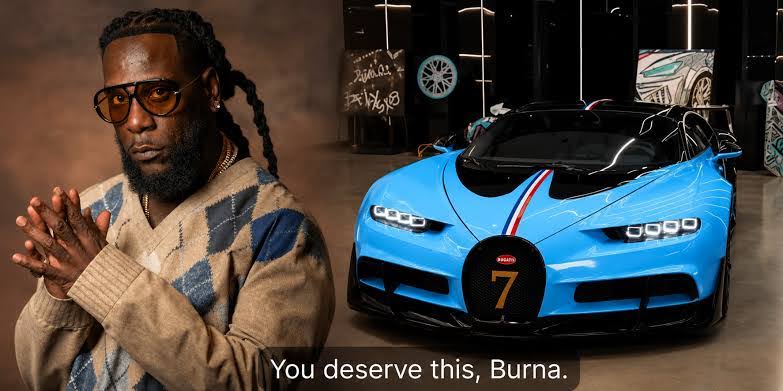
Burna Boy’s ₦9bn Bugatti: Luxury Statement or Financial Mistake?
By Matthew Eloyi
The sight of a ₦9 billion Bugatti Chiron cruising through the streets of Lagos has reignited an old and increasingly contentious debate in Nigeria: where should the line be drawn between personal wealth, luxury consumption and social responsibility?
At the centre of the latest controversy is Grammy-winning Nigerian singer Burna Boy, whose reported acquisition of a customised, one-of-one Venuum wide-body Bugatti Chiron has attracted considerable attention since the vehicle was recently spotted on the streets of Lagos.
But while the luxury car has become a spectacle for motorists, fans and social media users, Nigerian content creator and self-styled financial expert Ojaigho Prosper, popularly known as GehGeh, has taken a sharply different view.
In a video circulated on social media, GehGeh described the reported purchase as a “financial mistake” and questioned the practical value of such an expensive vehicle in Nigeria.
His criticism was not directed merely at the cost of the automobile. Rather, he framed the purchase within the wider realities of Nigeria’s economic difficulties, poor road infrastructure and rising concerns about unemployment and hardship.
“Burna Boy, that your car wey you buy eh, call Aboki iron condemn make them come carry that financial mistake wey you buy from your compound. It’s a shame,” he said.
GehGeh went further, giving the singer what he described as 24 hours to dispose of the hypercar. He suggested that Burna Boy could instead channel the proceeds into projects capable of producing wider social benefits, including community empowerment, solar energy and youth employment.
“Call Aboki now. I’m giving 24 hours. That car you buy, what benefit is it to me as a Nigerian?” he asked.
The controversy has been fuelled by the striking contrast between the Bugatti’s extraordinary engineering and the realities of the environment in which it is being driven.
The vehicle reportedly seen in Lagos is an ultra-low, high-performance hypercar designed for speed and exclusivity. Its appearance on Nigerian roads has therefore generated questions about whether such a vehicle can be used comfortably amid potholes, speed bumps, uneven surfaces and congested urban traffic.
GehGeh used that contrast to strengthen his criticism.
“Look at our roads. You carry billions of naira go buy car, but the roads wey you wan use the car drive no good,” he said.
“The country you come from, the roads are bad, and you are buying a car wey no get use to you and the country.”
He also pointed to the economic pressures confronting many Nigerians, adding: “Nigerians are hungry and you are buying a car.”
His argument essentially raises a question that goes beyond Burna Boy: should extremely wealthy Nigerians be expected to consider the wider social implications of conspicuous luxury spending?
The debate intensified following the circulation of a video showing Burna Boy driving the customised Bugatti through Lagos after leaving a popular nightclub.
The unusual sight attracted large crowds, with fans reportedly running alongside the vehicle as it made its way through traffic.
For many Nigerians, the spectacle represented the extraordinary spending power of one of Africa’s most successful entertainers. For others, it became a symbol of the widening gap between Nigeria’s wealthy elite and millions of citizens struggling with the rising cost of living.
The vehicle’s ability to navigate Lagos roads also became a subject of discussion. Social media users questioned how an ultra-low hypercar could cope with speed bumps and rough road surfaces, while some speculated that its hydraulic lift system may have been used to raise the vehicle when encountering obstacles.
READ ALSO: King Sunny Ade at 80: Eight Decades of Rhythm, Legacy and Global Stardom
The argument surrounding the Bugatti, however, is unlikely to end with the vehicle itself.
Nigeria has a long tradition of celebrities displaying expensive houses, automobiles, jewellery and designer fashion. Such displays are often regarded as symbols of success, particularly in an entertainment industry where material wealth is frequently associated with achievement.
Burna Boy’s global career, international awards and commercial success have placed him among Nigeria’s most prominent entertainers. From that perspective, supporters of his purchase may regard the Bugatti simply as a private luxury acquired with legitimately earned wealth.
There is also a fundamental question of personal choice. If an individual has accumulated sufficient wealth to purchase an expensive asset, should that person be required to redirect the money towards public or community projects?
GehGeh’s intervention, however, reflects a different school of thought, one that argues that extraordinary wealth carries a degree of social responsibility, particularly in a country where millions continue to face economic hardship.
That tension between private entitlement and public responsibility is what has made the Bugatti controversy resonate far beyond the automobile itself.
The debate also exposes two very different realities existing side by side.
On one side is a Nigerian entertainment industry producing globally recognised stars capable of earning and spending enormous sums. On the other is a population confronting high living costs, infrastructure deficits, unemployment and other economic pressures.
The Bugatti has consequently become more than a luxury automobile. To some, it represents ambition, success and the rewards of international recognition. To others, it is an uncomfortable reminder of inequality and the distance between celebrity wealth and everyday Nigerian life.
Social media reactions have reflected both positions, with users divided over whether celebrities should be free to spend their wealth as they please or whether prominent Nigerians should demonstrate greater social responsibility.
For now, Burna Boy’s reported Bugatti remains firmly in the spotlight, not necessarily because of what it can do on the road, but because of what its presence has come to represent.
The controversy ultimately leaves Nigerians with a broader question: when personal wealth reaches extraordinary levels in a society facing extraordinary challenges, is luxury consumption simply a private choice, or does it carry a wider social responsibility?
